

Key takeaways
- Compare the best broadcast spreaders for lawns big and small, from a handheld crank model to tow-behind and high-capacity machines, plus setup tips.
A broadcast spreader flings granules in a wide fan as you move, which makes it the fastest way to feed, seed or lime a lawn. The catch is that the machine is only half of the result. Walking pace, pass spacing and gate setting decide whether the lawn greens up evenly or shows pale and dark stripes a few weeks later. The five machines below cover the main ways people spread: a steel walk-behind for rough ground, a budget plastic model for small yards, a tow-behind for riders, a hand-crank unit for tight spaces and a high-capacity machine for large properties.
Every pick is a current model from a known maker, and each suits a different lawn size and budget. Choosing the right type matters more than choosing between two similar machines of the same type, and after the picks, the buying guide explains calibration, edge control and upkeep.
As an Amazon Associate, we earn from qualifying purchases.
Quick answer
For most home lawns, the EarthWay 2150 brings the most even pattern and the toughest frame. Small yards are served well by the Scotts EdgeGuard Mini, riders should look at the Agri-Fab tow-behind, tiny spaces suit the Scotts Whirl, and acre-plus properties justify the EarthWay 2170.
EarthWay 2150 Commercial: steel frame and pneumatic tires

The EarthWay 2150 is the walk-behind lawn-care crews tend to buy with their own money, and the build explains why. A rustproof poly hopper holding 50 pounds sits on an epoxy-coated steel frame, and the machine rolls on 13-inch pneumatic stud tires with poly rims. Air-filled tires matter more than they sound: they float over ruts and lumps instead of bouncing, and every bounce of a hard wheel shifts the gate opening and throw pattern for a step or two.
The metering system is EarthWay’s EV-N-SPRED three-hole drop design, which feeds granules onto the spinner plate at three points for a balanced fan. A Side Spread Control lever shuts off the left side of the pattern, so you can run along driveways and beds without throwing product where it does not belong. A removable screen breaks up clumps before they reach the gate, and solid linkage, rather than a cable, keeps the flow setting where you dialed it.
Limits are mostly about size and setup. At roughly 25 pounds empty and 75 pounds loaded, it is a real push on slopes, and the printed assembly directions are widely described as unclear, so allow extra time on day one. A hopper cover costs extra, which matters in a damp shed. It fits owners of half-acre to two-acre lawns, anyone with uneven ground, and buyers who would rather pay once for hardware that holds up.
Scotts Turf Builder EdgeGuard Mini: budget plastic walk-behind

The Scotts EdgeGuard Mini is the small, light end of the walk-behind market. The plastic hopper holds enough product to cover up to 5,000 square feet per fill, and the machine arrives assembled and pre-calibrated, with a control panel that lists settings for Scotts seed, feed and weed-control products. For a first spreader, that dial removes the guesswork for the most common homeowner products.
Its headline feature is EdgeGuard, a lever that blocks the right side of the spread pattern. Run the blocked side along a sidewalk, driveway or patio edge and granules stay on the grass instead of scattering onto hard surfaces, where they stain and wash into drains. The Mini is light enough to hang on a garage hook, which suits small sheds and townhouse garages.
The trade-offs follow from the size and the plastic build. The small hopper means refills on anything bigger than a modest suburban lawn, and the narrower throw means more passes than a wide commercial machine. Plastic wheels and gears are the wear points over time, and the printed settings are tuned to Scotts granule sizes, so other brands need a careful test pass before a full application. It fits small and medium lawns, first-time owners and anyone spreading a few bags a year.
Agri-Fab 45-0463: tow-behind for riding mowers

If you already own a lawn tractor or riding mower, the Agri-Fab 45-0463 turns spreading into seat time. The rustproof poly hopper carries 130 pounds of seed, fertilizer or ice melt, the universal hitch pins to any make of tractor, and the spread width reaches up to 12 feet, so an acre-class lawn takes a handful of long passes instead of an afternoon of pushing. An enclosed gearbox keeps grit away from the spinner drive.
The detail that makes tow-behind spreading workable is a flow control lever the driver can work from the seat. That matters at every headland turn and every stop, because a broadcast spreader keeps throwing while it rolls and dumps a pile when it halts with the gate open. The 45-0463 rolls on pneumatic tires that handle pasture edges and rough patches better than small solid wheels.
There are real handling notes. A towed spreader swings wide on turns, reverses awkwardly, and its pattern depends on holding a steady ground speed, so jerky throttle work shows up in the lawn. It also needs storage room; this is not a hang-it-on-the-wall tool. It fits properties from about half an acre upward where a tractor already lives, including winter ice melt duty on long driveways.
Scotts Whirl: handheld hand-crank for small lawns

The Scotts Whirl shrinks the broadcast idea down to one hand. You hold the hopper, turn the crank, and an adjustable arm support braces against your forearm so the load does not hang from your wrist alone. It holds enough product to cover up to 1,500 square feet, and it handles grass seed, fertilizer, salt and ice melt, making it a four-season tool.
A handheld earns its place in the jobs wheeled machines do badly: overseeding a bare patch, feeding a narrow side yard between fences, working around trees and beds where a push spreader cannot turn, and scattering ice melt on steps and a front walk in winter. It stores in a bucket or on a shelf, with no tires to puncture and little to rinse beyond a quick brush and wash.
Capacity and consistency are the honest limits. Fifteen hundred square feet per fill means constant refilling on a full lawn, and the pattern depends on your crank rhythm and walking pace, so a wandering pace lays down a wandering rate. A full hopper of dense fertilizer gets heavy on the arm over a long session. It fits townhouse and city yards, patch seeding, and anyone who wants one tool for lawn feeding and winter steps.
EarthWay 2170 Commercial: high capacity for large properties
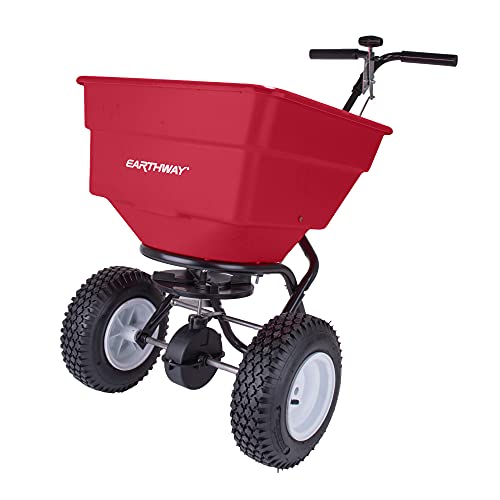
The EarthWay 2170 takes the 2150 formula and doubles the hopper. Capacity is 100 pounds, about 3,350 cubic inches, so two full bags go in at once and an acre gets fed without a refill stop. The steel frame carries a 175-pound load rating, the gearbox is an enclosed super-duty unit built for heavy seasonal use, and the machine rides on the same 13-inch pneumatic stud tires as its smaller sibling.
It uses the same EV-N-SPRED three-hole drop system with Side Spread Control, so the pattern discipline carries over: even feed onto the plate, and a left-side shut-off for edges along beds, paths and water. The T-handle adjusts for operator height, which matters when a loaded machine weighing well over 100 pounds has to be pushed in straight lines. Solid linkage control, a hopper screen and widely available spare parts complete a machine built to be repaired, not replaced.
The limits are scale and cost. It is bulky in a garage, heavy work on slopes when full, and plain overkill for a quarter-acre lawn, where its width and turning circle become annoyances. Assembly takes time, as with the 2150. It fits acre-plus lawns, estates, sports fields and serious home users who want commercial hardware without a tractor-mounted unit.
How to choose
Begin with lawn size and how you move across it. Under about 5,000 square feet, a handheld or the Mini class is enough. From there to roughly two acres, a walk-behind is the sweet spot, with pneumatic tires if the ground is rough. Beyond that, or wherever a tractor already does the mowing, tow-behind capacity saves real hours.
Treat every setting chart as a rough guide, not true calibration. The number printed on a bag assumes a walking speed, a granule size and a machine in perfect tune. To calibrate, weigh out a known amount of product, spread a measured area such as a taped-off driveway section, then sweep up and weigh what landed. Adjust the gate and repeat until the applied rate matches the bag rate. Ten minutes of this saves a season of guessing.
Plan your passes around the pattern’s tapered edges. A broadcast fan throws heavy in the middle and light at the sides, so passes should overlap by roughly half the effective spread width. Gaps between passes show up later as pale stripes; doubled passes show up as dark stripes and, with fertilizer, as burned lines that take weeks to fade. A steady, repeatable pace matters as much as the gate number.
An edge guard is worth having, not a gimmick. Whether it is a blocking lever like EdgeGuard, a side shut-off like EarthWay’s control, or a deflector kit, keeping granules off driveways, patios, pools and beds saves product, prevents concrete staining and keeps fertilizer out of storm drains. If your lawn has many hard edges, rank this feature high.
Match hopper capacity to the job, not to ambition. A hopper close to one bag, or one lawn’s worth of product, keeps your rhythm unbroken; refilling mid-pass breaks both pace and rate. Oversizing has a hidden cost too: leftover product sitting in an open half bag absorbs shed humidity and cakes into clumps that jam gates. Buy the size you will empty in one session.
Finally, think about what wears out. On budget models, plastic gears and axles are the first failure point, especially if the machine is stored dirty. On steel machines, the frame lasts but fertilizer residue is corrosive and will eat linkages and fasteners if you skip rinsing. Whatever you buy, empty it, hose it out, let it dry fully and store it dry; that single habit decides whether any spreader lasts three seasons or fifteen.
Who should skip
Skip the whole category if your outdoor space is a balcony, a patio garden or a few containers; a hand scoop and a watering can do that job better. Skip the big walk-behinds and the tow-behind if your lawn is mostly narrow strips and tight corners, where a drop spreader or a handheld lays product more precisely. Skip the handheld if you have a full-size lawn to feed several times a year, because the refills and arm fatigue will sour you on the chore. And skip every model here if you are not willing to calibrate at least once; an uncalibrated broadcast spreader is a stripe-making machine, and no feature on any of these five fixes that.
Frequently Asked Questions
Can one spreader handle both grass seed and fertilizer?
Yes. All five machines spread seed, fertilizer, lime and ice melt. The gate setting differs for each product because granule size and weight differ, so check the chart for each material and calibrate when accuracy really matters, such as a full overseeding.
How do I keep granules off my driveway and flower beds?
Use the edge feature when your machine has one, and walk edges with the blocked side toward the hard surface. Sweep up strays the same day, because fertilizer left on concrete can stain it and rain will wash granules into storm drains.
Why did my lawn come up in stripes?
Stripes almost always trace back to pass spacing or pace. Passes set too far apart leave pale gaps, passes overlapped too much leave dark or burned lines, and speeding up or slowing down mid-pass changes the rate. Walk at one steady pace and overlap by about half the spread width.
Can I spread ice melt with a broadcast spreader in winter?
Yes; the handheld and tow-behind picks here are especially handy for steps and long driveways. Use dry material, open the gate wider for coarse products, and rinse afterward, because melt residue is hard on metal parts.
Final verdict
Match the machine to the lawn and the habit, not to the biggest hopper on the page. The EarthWay 2150 is the best all-round walk-behind for typical and rough lawns, the Scotts EdgeGuard Mini covers small yards simply and cheaply, the Agri-Fab 45-0463 makes tractor owners faster, the Scotts Whirl owns patches, tight spaces and winter steps, and the EarthWay 2170 is the high-capacity answer for acre-plus ground. Pick your class, calibrate once and rinse after every use.
Product and ASIN Reference
| Product | ASIN |
|---|---|
| EarthWay 2150 Commercial 50 lb Broadcast Spreader | B00002N66D |
| Scotts Turf Builder EdgeGuard Mini Broadcast Spreader | B002YPS1KK |
| Agri-Fab 45-0463 130 lb Tow-Behind Broadcast Spreader | B002U0KDHI |
| Scotts Whirl Hand-Powered Spreader | B0DV9W259K |
| EarthWay 2170 Commercial 100 lb Broadcast Spreader | B00004RB0E |
More from Amazon
Programs that pair well with the guide above. Offers and eligibility are set by Amazon and may change.
Collect the home and kitchen items you want in one registry that guests can shop from.
Create a wedding registrySet up recurring deliveries of everyday items on eligible products. Terms and savings are set by Amazon.
Explore Subscribe & SaveFree shipping on eligible items, Prime Video and more. Eligible new members can start with a free trial.
Start a Prime free trialAudiobooks and podcasts to listen to on the go. Eligible new members can start with a free trial.
Try Audible freeAs an Amazon Associate we earn from qualifying purchases.


Write Your Review
No reviews yet. Be the first to share your experience!