

Key takeaways
- Compare the best sprinklers for lawns and garden beds, from oscillating and impact models to quiet gear drives and spot sprinklers for small areas.
A sprinkler is a simple tool with a specific job: put an even layer of water on one defined shape of ground, then get out of the way. The trouble is that lawns and beds come in rectangles, circles, long strips, and awkward corners, and no single spray pattern suits them all. Matching the pattern to the shape matters more than any headline coverage number, because water that lands on the driveway is water your grass never sees.
This guide compares five sprinklers across the main types: an oscillating model for rectangles, a gear-drive rotor for big circles, an impact head for maximum throw, a spinning sprinkler for medium lawns, and a stationary spot sprinkler for small beds. Every coverage figure below is the maker’s figure, and each assumes healthy household water pressure. If your pressure runs low, expect every pattern to shrink.
As an Amazon Associate, we earn from qualifying purchases.
Quick answer
For a rectangular lawn, choose the Melnor XT Turbo oscillating sprinkler for its adjustable width and range. For a large open yard, the Orbit H2O-Six gear drive covers the most ground quietly from a spike base. Tight budgets and big throws point to the Rain Bird P5R impact head, while the Gilmour spot sprinkler handles small beds.
How to choose
Oscillating sprinklers sweep a fan of jets back and forth, laying down a rectangle with fairly even coverage. They are the natural fit for typical suburban lawns, and better models let you trim the width and shorten the throw on each side so the pattern hugs the grass instead of the sidewalk.
Rotating or spinning sprinklers throw arms of water around a central axis and paint a circle. They suit round or square patches and are simple, with few adjustments beyond placement and faucet pressure.Impact sprinklers use a spring-loaded arm that snaps against the stream, producing the familiar clicking sound and the longest throws of any hose-end type. They shrug off gritty water better than most, but the noise and the heavy droplets near the head are real trade-offs.
Gear-drive rotor heads turn slowly and silently on an internal gear set, sending one or two focused streams in a full or partial circle. They are the quiet option for large lawns and early-morning watering near bedroom windows.
Stationary spot sprinklers have no moving parts. They throw one fixed circle and are ideal for small beds, new seed, and patches that need a soak while the rest of the yard stays dry.
Whatever the type, treat coverage claims with care. Those figures are measured at strong household pressure with no wind, and low pressure shrinks every pattern, sometimes dramatically. Construction matters too: metal bases stay put and survive being dragged across concrete, while plastic bases are lighter but can crack and let the sprinkler tip or wander. Sled bases glide over flat lawns, while spike bases anchor better in soft soil and on slopes.
Melnor XT Turbo Oscillating Sprinkler 65078-AMZ
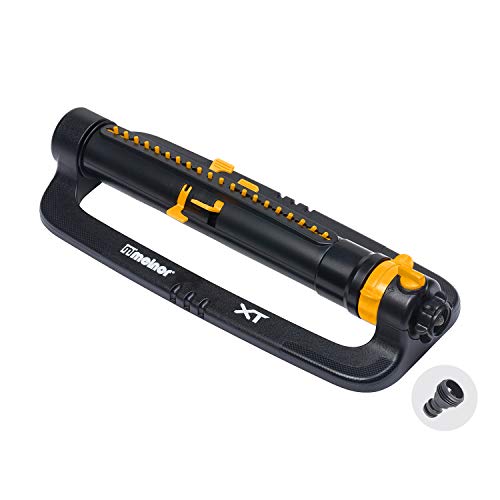
This oscillating sprinkler is the rectangle specialist of the group. Twenty precision nozzles sweep back and forth over a wide sled base, and the maker rates coverage at up to 4,500 square feet. Three-way adjustment is the real draw: sliding tabs narrow or widen the spray width, range controls shorten the throw on the left and right independently, and a flow dial on the unit lets you fine-tune distance without walking back to the faucet. That combination makes it easy to water a lawn that sits between a house wall and a driveway without soaking either one.
The base is a sturdy plastic sled that slides across grass and resists tipping, and the bundled QuickConnect adapter snaps onto the hose for fast moves between front and back yards. A built-in clean-out tool helps clear clogged nozzles, which is the most common cause of streaky coverage on any oscillating model.
The honest caveats: the gear drive and nozzle bar are polymer, so store it out of winter freezes, and the full 4,500 square feet only appears at strong pressure. On a weak well pump or a long, thin hose run, expect a noticeably smaller rectangle. For most rectangular lawns at normal pressure, though, it is the easiest pattern here to place precisely.
Orbit H2O-Six Gear-Drive Sprinkler 58573N

The H2O-Six is a gear-drive rotor that replaces the usual single stream with six selectable spray patterns, from a gentle fan to a focused jet, chosen by rotating the head. The maker rates coverage at up to 5,026 square feet, the largest figure in this guide, and the head turns through a full circle or a partial arc you set by hand. Because the rotation is gear-driven rather than impact-driven, it runs whisper-quiet, which matters for dawn watering near open windows.
It mounts on a metal T-spike that pushes into soft soil and holds its position far better than a lightweight sled on uneven ground. A flow-through outlet on the spike lets you chain a second sprinkler in series, though each added unit divides the pressure and shrinks both patterns.
Two honest notes. The body and gear housing are plastic, and internal gear drives are the wear point on every sprinkler of this type; gritty water shortens their life, so the inlet filter washer needs an occasional rinse. The spike also rules out hard, dry, or rocky soil unless you soften the spot first.
Rain Bird P5R Plastic Impact Sprinkler

The P5R is the classic impact head: a spring arm snaps against the stream, clicks the head around in steps, and throws water farther than anything else in this guide. Rain Bird rates the spray distance at 24 to 45 feet, adjustable from a 20-degree wedge to a full 360-degree circle, and a diffuser screw breaks up the stream to shorten the throw and fill in close to the head. Impact heads also tolerate gritty water that would stall finer mechanisms, which is why the design has survived for decades.
Understand exactly what you are buying: this is the head only, with a threaded half-inch base. It includes no spike or sled, so budget for a step spike or tripod base if you do not already own one, and the total setup cost is head plus base.
The body is high-impact polymer rather than brass, and that is the durability trade-off at this end of the line. Plastic impact arms and bearings wear faster than metal ones, and the clicking is genuinely loud in a quiet yard. In exchange you get the longest throw and the simplest mechanism here, with replacement nozzles and parts that are easy to find.
Dramm ColorStorm Spinning Sprinkler 15074

Dramm’s spinning sprinkler gives the rotating type a heavy metal base and a distinctive spray: the spinning head throws out an intricate pattern of fine streams that lands softly, which suits lawns that puddle under heavy droplets. The maker describes coverage as a circle of up to roughly 38 feet across, a good match for small to midsize lawns. The Green finish on this listing is one of several colors in the line, all built on the same mechanism.
The stationary die-cast metal base is the standout feature. It stays where you put it, survives being pulled around the yard by the hose, and gives the sprinkler a planted feel that plastic sled bases rarely match. There is almost nothing to adjust: you set the circle size at the faucet, since higher pressure spins the head faster and throws the pattern wider.
That simplicity is also the limitation. There is no partial-circle setting, no width trim, and no way to keep water off a path crossing the circle. Placement is your only control. Buy it for an unobstructed round or square area where you want gentle rain and a base that lasts for years.
Gilmour Circle Pattern Spot Sprinkler 808763-1001

This is the stationary spot sprinkler in its purest form: a small, heavy, all-metal head with no moving parts that throws one fixed circle of up to 30 feet in diameter, covering as much as about 700 square feet at full pressure. It sits flat on its low-profile base, small enough to tuck between shrubs, inside a raised bed, or on a narrow strip of lawn that every other sprinkler in this guide would overshoot.
Gilmour positions it for sod, new seed, and trouble spots, and that is exactly where it shines. The spray is gentle, the pattern is predictable, and because nothing rotates, it works at low water pressure where geared and spinning heads can stall. Shrinking the circle is as simple as easing the faucet down. With no gears to strip and no arm to snap, it is also the sprinkler most likely to still be working in a decade.
The limits are obvious and worth accepting with open eyes. One pattern, one size range, no adjustments on the unit itself, and coverage that tops out quickly. It will not water a whole lawn efficiently. As a targeted tool for beds, patches, and seed, it is close to unbeatable value in durability per task.
Who should skip a lawn sprinkler
Skip hose-end sprinklers entirely if your yard is large and permanent enough to justify in-ground irrigation; a buried system with a timer waters more evenly and saves the daily hose routine. Gardeners whose beds are dense and close to the house are usually better served by soaker hoses or drip lines, since overhead spray wets foliage and invites disease on susceptible plants. Anyone on very low well pressure should solve the pressure problem first or choose the stationary spot design, because rotating heads may not turn at all. And if your only job is a few containers, a watering can beats every product here.
Frequently Asked Questions
Why does my sprinkler cover less area than the box promises?
Coverage figures are maker figures measured at strong pressure, often around the top of the household range, with no wind. Long hoses, small-diameter hoses, and low municipal or well pressure all shrink the pattern. Measure your actual throw with a tape and plan overlap around the real number, not the headline.
How much overlap do I need between sprinkler positions?
Plan on head-to-head coverage: each position’s spray should just reach the next position. Patterns deliver the least water at their edges, so overlapping the edges into the stronger part of the neighboring pattern produces an even result. Moving the sprinkler two or three times in a session beats one long soak from a single spot.
When is the best time of day to run a sprinkler?
Early morning is the sweet spot. Wind is usually calmest, so less spray drifts away, and evaporation losses are low, while the grass still dries during the day. Evening watering leaves foliage wet overnight, which encourages fungal problems, and midday watering loses the most water to heat and wind.
How do I keep a sprinkler pattern even over the season?
Most streaks come from clogged nozzles or a head that has tipped off level. Rinse inlet filter washers, clear oscillating nozzles with the clean-out tool or a pin, flush impact and gear-drive heads at the hose before attaching, and re-level spike and sled bases each time you move them.
Final verdict
Match the pattern to the shape and you cannot go far wrong. The Melnor XT Turbo is the default pick for rectangular lawns, the Orbit H2O-Six covers big circles quietly, and the Rain Bird P5R throws farthest once you add a base. The Dramm spinner brings gentle rain and a metal base to medium lawns, and the Gilmour spot sprinkler outlasts everything for beds and patches. Measure your pressure and your lawn first, then choose.
Product and ASIN Reference
| Product | ASIN |
|---|---|
| Melnor XT Turbo Oscillating Sprinkler 65078-AMZ | B07NDZX9XT |
| Orbit H2O-Six Gear-Drive Sprinkler 58573N | B000FJX4IQ |
| Rain Bird P5R Plastic Impact Sprinkler | B000FJX67U |
| Dramm ColorStorm Spinning Sprinkler 15074 | B006L90F72 |
| Gilmour Circle Pattern Spot Sprinkler 808763-1001 | B000NCV0RW |
More from Amazon
Programs that pair well with the guide above. Offers and eligibility are set by Amazon and may change.
Collect the home and kitchen items you want in one registry that guests can shop from.
Create a wedding registrySet up recurring deliveries of everyday items on eligible products. Terms and savings are set by Amazon.
Explore Subscribe & SaveFree shipping on eligible items, Prime Video and more. Eligible new members can start with a free trial.
Start a Prime free trialAudiobooks and podcasts to listen to on the go. Eligible new members can start with a free trial.
Try Audible freeAs an Amazon Associate we earn from qualifying purchases.



Write Your Review
No reviews yet. Be the first to share your experience!