

Key takeaways
- The best manual log splitters and kindling splitters compared: cast-iron ring splitters, a wedge point, a slide hammer and a 10-ton hand hydraulic press.
A manual log splitter replaces the riskiest move in firewood prep — swinging a sharp edge at a round you are steadying with your other hand — with a fixed wedge and controlled force. The blade stays still, the wood moves, and your hands stay clear of the edge. This guide compares five manual designs: two cast-iron ring splitters, a stump-mounted wedge point, a slide hammer, and a hand-pumped hydraulic press.
Two of the five picks are the two sizes of the same cast-iron design, because that design anchors the category and the right size depends on the wood you burn. The other three picks work on entirely different principles, so most firewood routines are covered.
Every pick here is human-powered. There is no engine to winterize, no cord to manage, and nothing to plug in, which is why these tools suit a patio or porch wood pile as well as a garage corner. They also share one honest limit: your arms set the pace, so the guide is frank about where each design stops being the right tool.
As an Amazon Associate, we earn from qualifying purchases.
Quick answer
For most households, the Kindling Cracker Original is the manual splitter to buy: a one-piece cast-iron ring that turns split firewood into kindling with a mallet, no moving parts and nothing to sharpen. If your stove takes bigger rounds, the King XL version opens the ring to nine inches. For whole unsplit logs, the Sun Joe LJ10M hand hydraulic press does the heavy work.
Kindling Cracker Firewood Splitter (Original)

The tool that created this category is a single casting: a splitting wedge standing inside a protective iron ring, with bolt holes in the base so it can be fixed permanently to a stump or bench. You set a piece of firewood on the wedge and tap it down with a mallet, a club hammer, or even another piece of wood. Because the edge never swings, the split is controlled and the pieces stay inside the ring instead of flying across the yard.
The Original’s ring takes logs up to six and a half inches across, which covers the standard splits sold and stacked for fireplaces and fire pits. It is the right size for making kindling and for breaking down stove wood into smaller sticks. There is nothing to adjust, assemble, or maintain beyond an occasional wire-brushing.
Specs
- Type: stationary ring-and-wedge kindling splitter
- Material: cast iron, one-piece casting
- Maximum log diameter: 6.5 inches
- Dimensions: 9 x 13 x 9 inches
- Weight: 10 pounds
- Warranty: 5 years
Kindling Cracker XL (King)

The King XL is the same one-piece cast-iron idea scaled up: a taller frame and a nine-inch ring that accepts full-size stove splits without a first pass through an axe or maul. Wood-stove households that burn every night through winter are the audience — the bigger throat turns a two-step chore into one step, every single evening.
At just over twenty-one pounds it is a fixture rather than a portable tool, and it rewards a permanent mounting spot beside the wood pile. The wedge, ring, and base are a single casting with no joints to loosen, and the listed model is the version sold through Northern Tool’s marketplace storefront.
Specs
- Type: stationary ring-and-wedge kindling splitter
- Material: cast iron, one-piece casting
- Maximum log diameter: 9 inches
- Dimensions: 9 x 9 x 17 inches
- Weight: 21.4 pounds
- Model number: 118995
Sun Joe LJ10M 10-Ton Hydraulic Log Splitter

Ring splitters only reduce wood that is already split. The LJ10M attacks the round itself: lay a log on the rail, work the two pump handles, and a hydraulic ram drives the log against a fixed wedge with ten tons of force. It handles logs up to eighteen inches long and eight inches in diameter, which covers most rounds a homeowner brings home from a tree service or a delivered cord.
The trade-off is pace and weight. Each split takes a series of handle strokes rather than one mallet tap, and at eighty-seven pounds this is a roll-it-out-of-the-garage tool, not a carry-to-the-pile one. In return you get splitting power no arm swing can match, with no engine, no cord, and no fuel to store.
Specs
- Type: manual hydraulic log splitter, hand-pumped
- Splitting force: 10 tons
- Maximum log size: 18 inches long, 8 inches diameter
- Dimensions: 41.12 x 8.12 x 11.8 inches
- Weight: 87 pounds
- Hydraulic oil capacity: 0.17 gallons
- Model number: LJ10M
SPEED FORCE Wedge-Point Kindling Splitter

The wedge point strips the ring splitter down to its working end. It is a nodular cast-iron wedge on a base plate that screws down to a stump or a heavy block; you stand the log on the point and drive it down with a mallet. With no ring around the wood, there is no fixed diameter ceiling and no length limit imposed by a frame, so odd-shaped pieces that refuse to sit in a ring still split.
It is also the smallest and lightest tool here, easy to store on a shelf and easy to carry out to a campsite wood pile. The compromise is guidance: without the ring, the log is less contained as it opens, so it asks for a steadier setup and a flatter, well-seated base than the ring designs. Choose a stump with a level top, drive the mounting screws fully home before the first log, and check them at the start of each season, because a wedge that shifts under a mallet strike wastes force and concentration alike.
Specs
- Type: stationary wedge point, stump-mounted
- Material: nodular cast iron
- Maximum log diameter: not stated
- Dimensions: 8.31 x 3.94 x 3.78 inches
- Weight: 3.74 pounds
Logosol Smart-Splitter
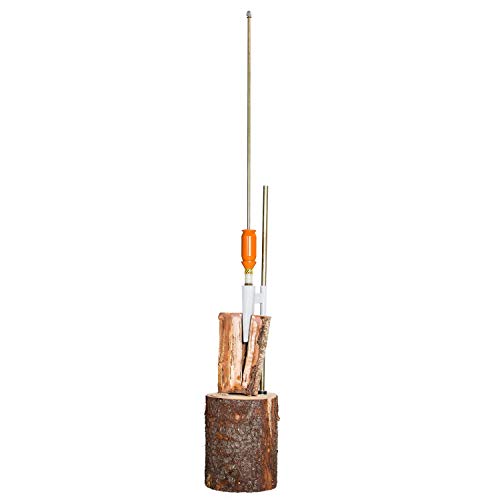
The Smart-Splitter works like a slide hammer stood on end. The wedge sits on the log, a weight slides up the guide rod, and dropping the weight drives the wedge through the wood. Because the log rests on the ground rather than inside a frame, the design is not limited by a ring diameter, and the whole tool breaks down into a slim package that hangs on a wall.
It suits mixed piles of awkward rounds that fit nowhere else, and owners who want one tool for both logs and kindling-sized pieces. The technique takes a few logs to learn: the wedge can need a pry to finish stringy or knotty pieces, and the rod wants a reasonably flat, firm surface under the log to work at its best.
Specs
- Type: slide-hammer (drop-weight) manual splitter
- Splitting force: 14 tons, per the listing designation
- Maximum log diameter: not stated
- Weight: 19.8 pounds
- Model number: 10024
How to choose
Start with the wood, not the tool. If your firewood arrives already split and your real chore is kindling, a ring splitter or wedge point is the whole answer — measure your largest splits and buy the ring size that swallows them. If you start from unsplit rounds, only the hydraulic press and the slide hammer on this list are built for that first split.
Match the mechanism to your volume. A mallet-driven wedge is fast for a basket of kindling and slow for a cord; the hand hydraulic reverses that, trading strokes for force. Consider mounting and storage, too: ring splitters work best bolted to a stump, the wedge point needs a stump of its own, and the hydraulic needs flat ground and garage space.
Finally, respect the size limits printed for each design. Forcing an oversized round into a small ring or onto a light wedge is how tools and tempers break. Straight-grained, seasoned wood splits dramatically easier than green or knotty wood in every design here, so a splitter is never a substitute for letting firewood dry.
Think about the striking tool as part of the purchase. Ring splitters and the wedge point are driven by a three- or four-pound club hammer or a short sledge; a full-length maul is clumsy at that range, and a light claw hammer will tire you before the pile shrinks. Gloves with a good grip and basic eye protection belong in the same budget line, because split pieces do occasionally jump sideways as they open.
Who should skip
Skip manual splitters entirely if you process several cords of large hardwood rounds every season — that workload belongs to powered hydraulic machines, and no hand tool on this page will keep up. Also skip them if swinging a mallet or pumping handles is physically difficult; these tools remove the sharp edge, not the effort.
If you light only the occasional fire pit evening, a basic splitting wedge struck with a maul, or simply buying a bundle of kindling, is the cheaper answer. And if your wood is mostly very large, knotty, or stringy rounds, budget for a powered splitter instead of fighting grain that manual force cannot bully.
FAQ
Are manual log splitters safer than an axe or maul?
They remove the most dangerous element, the swinging sharp edge aimed near your hands and feet. The wedge stays fixed and your striking hand works well away from it. They are not risk-free: wear gloves and eye protection, keep the striking tool in good repair, and never hold a log in place by hand while someone else strikes it.
What size log can a kindling splitter handle?
The ring sets the limit. The Original Kindling Cracker takes pieces up to six and a half inches across, and the King XL opens that to nine inches. Pieces must also be short enough to sit stably on the wedge. Anything bigger needs a first split from a maul, a slide hammer, or a hydraulic press before the ring can finish the job.
Can a manual hydraulic splitter really split a full cord?
Yes, with patience. A ten-ton hand hydraulic like the LJ10M has the force for typical rounds up to eighteen inches long, but every split costs a series of handle strokes, so a cord is an afternoon project rather than a quick task. It fits households that split a modest pile at a time, close to where the wood is burned.
Do kindling splitters need sharpening or maintenance?
Very little. The cast-iron ring splitters and the wedge point have no moving parts; a wire brush and a dry storage spot are enough, and the wedge edge works by pressure more than sharpness. The hydraulic press asks for an occasional oil check and clean storage, and the slide hammer wants its rod kept clean so the weight travels freely.
Final verdict
For kindling and stove-wood prep, the Kindling Cracker Original remains the benchmark: one casting, no moving parts, and a controlled split every time. Step up to the King XL if your splits run large. Choose the Sun Joe LJ10M when unsplit rounds are the job, the SPEED FORCE wedge point for the smallest budget and storage footprint, and the Logosol Smart-Splitter for awkward rounds that fit no ring.
Product and ASIN Reference
| Product | ASIN |
|---|---|
| Kindling Cracker Firewood Splitter (Original) | B01KKU8Z0Q |
| Kindling Cracker XL (King) | B0725RRRS5 |
| Sun Joe LJ10M 10-Ton Hydraulic Log Splitter | B00VPJAPS2 |
| SPEED FORCE Wedge-Point Kindling Splitter | B08VF131Z2 |
| Logosol Smart-Splitter | B000G8OXPY |
More from Amazon
Programs that pair well with the guide above. Offers and eligibility are set by Amazon and may change.
Collect the home and kitchen items you want in one registry that guests can shop from.
Create a wedding registrySet up recurring deliveries of everyday items on eligible products. Terms and savings are set by Amazon.
Explore Subscribe & SaveFree shipping on eligible items, Prime Video and more. Eligible new members can start with a free trial.
Start a Prime free trialAudiobooks and podcasts to listen to on the go. Eligible new members can start with a free trial.
Try Audible freeAs an Amazon Associate we earn from qualifying purchases.




Write Your Review
No reviews yet. Be the first to share your experience!