

Key takeaways
- Compare the best handheld spreaders for seed, fertilizer and ice melt, from a battery powered Scotts Wizz to a chest-mount Solo and a Chapin shaker.
The real decision with a handheld spreader is how you want to trade coverage against control. A small broadcast unit throws seed or fertilizer in a fan wide enough to finish a modest lawn quickly, but that same fan can scatter granules into flower beds and onto paths. A shaker bottle does the opposite, placing material only where you aim it, at the cost of far slower coverage on open ground. The four models below serve small-lawn owners, gardeners side-dressing beds and borders, and households that also spread ice melt in winter. Each was chosen from the names, capacities and dimensions published on its Amazon page, so the figures quoted here trace back to the listings themselves rather than to roundup summaries or manufacturer brochures.
Quick Picks
As an Amazon Associate we earn from qualifying purchases.
| Product | Best for | Key spec from title |
|---|---|---|
| Scotts Wizz Hand-Held Spreader | Battery powered spreading on small lawns | Holds up to 2,500 sq ft of product |
| SOLO 421 Chest-Mount Spreader | Big loads on slopes and uneven ground | 20-pound capacity |
| Brinly HHS3-5BH Handheld Spreader | Spot seeding and tight side yards | 5 lb capacity |
| Chapin 8740A Hand Shaker Spreader | Steps, paths and precise spot work | 64-ounce bottle |
How to Choose
Broadcast Fan or Shaker Drop
Start with the pattern, because it decides where stray granules land. Rotary handhelds such as the Scotts Wizz, the SOLO 421 and the Brinly spin material outward in a fan, which suits open lawn where a few steps cover a wide strip. Shaker bottles like the Chapin 8740A release product straight down through lid openings, so nothing travels sideways into a vegetable bed or a fish pond border. If most of your spreading happens along edges, between shrubs or on narrow side yards, the drop pattern protects plantings. If your ground is mostly open turf, the fan pattern finishes the job in far fewer passes.
Hopper Capacity and Refill Trips
Capacity controls how often you walk back to the bag. The Chapin bottle holds 64 ounces, enough for steps, a path and a few bare patches before it needs topping up. The Brinly carries 5 pounds, a sensible middle size for spot seeding a small lawn in one fill. The SOLO chest unit holds 20 pounds, which matters on a sloping plot where every return trip crosses awkward ground. Match the hopper to your longest single session rather than your biggest imagined job, because a full large hopper is heavy from the first step, while a small one costs only a short walk when the area turns out bigger than expected.
Power Source and Flow Control
How the impeller turns changes both effort and consistency. The Wizz runs its spinner from four AA batteries, so your walking pace alone sets the overlap between passes. Hand-crank models such as the SOLO and Brinly tie the throw to your cranking rhythm, which some people find easier to keep steady on rough ground. Flow control matters just as much: the Wizz lists 23 settings, the Brinly uses an adjustable flow gate, and the Chapin swaps between three lid openings sized for different granules. Fine grass seed and coarse ice melt flow very differently, so a model with several settings handles both without clogging or dumping.
Carry Style and Arm Fatigue
A handheld spreader hangs its whole loaded weight on you, so the carry method deserves attention. The Wizz and Brinly are held in one hand, which keeps the other free for gates and works well for short sessions. The SOLO spreads its 20 pound load across a cross-shoulder strap with the hopper riding on your chest, leaving both hands available for the crank and the fingertip levers. The Chapin is light enough empty that even a full bottle stays easy on steps. Think about session length honestly: a one-hand grip that feels fine at the bag can ache badly by the far corner of the yard.
The 4 Best Options
Scotts Wizz Hand-Held Spreader
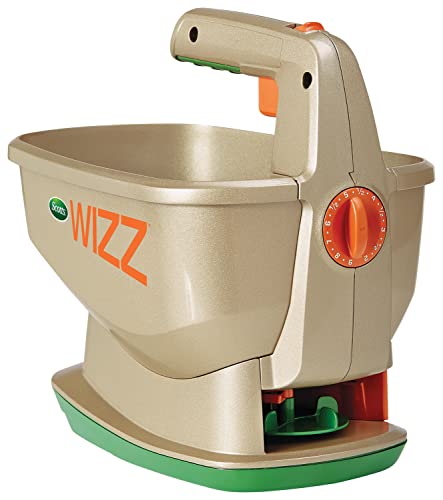
Battery power makes this the easiest starting point for a small, fairly flat lawn. The motor turns the impeller at a steady rate while you walk, so the pattern stays even without any cranking rhythm to learn, and the EdgeGuard feature helps keep product off driveways and beds when you run along a border. Its maker rates the hopper for enough product to cover up to 2,500 square feet, which fits many front lawns in a single fill. It also handles salt and ice melt, so the same unit earns its shelf space in winter.
Specs
- Dimensions: 23.25 x 7.75 x 19.25 in
- Model number: 71131
- Power: 4 AA batteries required
- Broadcast width: 5 ft
- Settings: 23
- Coverage per fill: up to 2,500 sq ft of Scotts product
- Item weight: 2.1 lb
Best for: Small flat lawns where you want a steady battery driven fan and border control.
Watch out for: Confirm the battery compartment seal is intact before winter use, since the unit also handles ice melt.
SOLO 421 Chest-Mount Spreader

This is the heavy lifter of the group, built for ground where a wheeled machine would bounce, tip or simply not fit. The 20 pound hopper rides against your chest on a cross-shoulder strap, and fingertip levers set both the volume and the direction of throw while your other hand works the crank. An integrated agitator keeps granules moving down onto the impeller, which helps prevent the stop-start flow that leaves pale stripes. The moulded polyethylene container shrugs off fertilizer dust and rinses clean after a session on a food plot, orchard row or sloping bank.
Specs
- Dimensions: 11.2 x 10.5 x 19.4 in
- Model number: 421S
- Capacity: 20 lb
- Mounting: chest-mount with cross-shoulder strap
- Controls: fingertip direction and volume levers
- Container material: polyethylene
- Agitator: integrated
Best for: Slopes, food plots and large rough areas where wheels struggle and refills are costly.
Watch out for: Check the crank handle is fully tightened before each session, as it can work loose in use.
Brinly HHS3-5BH Handheld Spreader
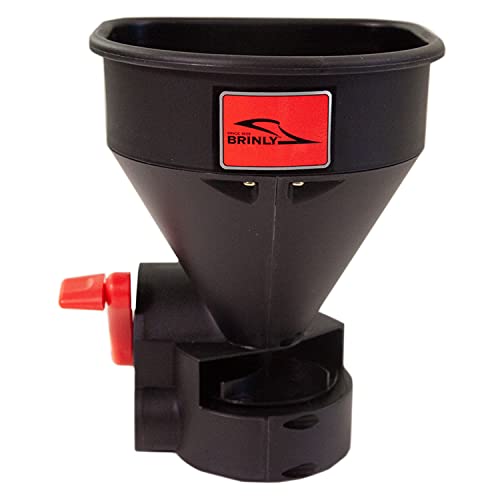
Brinly aims this compact rotary model at spot work: reseeding a worn patch, feeding a side yard or treating a shaded strip where grass struggles. The scoop-shaped hopper opening lets you fill straight from the bag without a separate funnel, and the adjustable flow gate pairs with a trigger handle so you can start and stop the throw exactly at a patch boundary. Enclosed gears and steel-plated hardware suit a tool that will live in a damp shed, and the 5 pound capacity is enough for a focused session without loading your wrist the way a bigger hopper would.
Specs
- Dimensions: 11 x 7 x 9 in
- Model number: HHS3-5BH
- Capacity: 5 lb (0.5 gal)
- Broadcast width: up to 5 ft
- Flow control: adjustable flow gate
- Gears: enclosed, with steel-plated hardware
- Item weight: 1.5 lb
Best for: Spot seeding, side yards and short focused sessions on small lawns.
Watch out for: Support the hopper base with your free hand when it is full, since 5 lb in one grip tires quickly.
Chapin 8740A Hand Shaker Spreader

The simplest tool here has no impeller, no gears and nothing to power. You fill the 64 ounce poly bottle through its wide screw top, twist the lid to one of three openings sized small, large or wide, and shake granules directly onto the target. That direct drop makes it the natural choice for salting steps, feeding a narrow border or sanding a short icy path, where a broadcast fan would waste most of its load on surrounding surfaces. The large grip handle works with gloves on, and the whole bottle rinses out under a tap when you switch materials.
Specs
- Dimensions: 12 x 13 in (width x height as listed)
- Model number: 8740A
- Capacity: 64 oz bottle
- Lid openings: 3 (small, large and wide)
- Material: poly
- Maximum spread width: 3 ft
- Item weight: 11.2 oz
Best for: Steps, paths, borders and other precise spot jobs in every season.
Watch out for: Avoid tipping the bottle far past vertical with fine material, which can escape around the lid openings.
Which One Fits Your Situation
You Have a Small Flat Lawn and Want the Least Effort
Choose the Scotts Wizz. Battery drive keeps the throw steady while you concentrate on walking straight lines, the hopper covers a typical small lawn in one fill, and the edge feature limits waste along paths and driveways. It is the closest thing here to a set-and-walk tool for routine feeding, seeding and winter treating alike.
Your Ground Slopes or Wheels Cannot Reach It
Take the SOLO 421. The chest strap carries the biggest load in this group comfortably, the crank works at whatever pace the terrain allows, and fingertip direction control keeps product on the bank or plot rather than in the ditch below it. Refills are rare, which matters when the bag sits far downhill.
You Mostly Repair Patches and Bare Spots
The Brinly fits patch work best, with a gate and trigger that start and stop cleanly at a boundary and a hopper sized for one repair session. For even smaller jobs on steps and edging, the Chapin shaker drops seed or melt exactly where you shake it and stores in a fraction of the space.
Winter Ice Melt Is Half the Job
Both Scotts and Brinly models list ice melt among their materials, but the Chapin is the one to grab for steps and short paths, where its three lid openings handle coarse melt without flinging it across the porch. Keep one material per fill and rinse the bottle before switching back to seed in spring.
Common Mistakes
- Filling the hopper before setting the flow gate, then dumping half the load while you adjust it over the lawn.
- Walking at an uneven pace with a crank model, which widens and narrows the fan and leaves striped coverage.
- Using a broadcast fan right up to flower beds and pond edges instead of switching to a shaker or engaging edge control.
- Storing a spreader with fertilizer residue inside, which corrodes hardware and cakes the gate shut by the next season.
- Choosing the largest hopper for a tiny yard, then fighting the loaded weight on every short session.
Frequently Asked Questions
Can one handheld spreader handle seed, fertilizer and ice melt?
Yes, all four models here list granular fertilizer and grass seed, and the group also covers salt and ice melt. What changes is the opening size each material needs, so pick a model with several settings or lid openings if you plan to run fine seed and coarse melt through the same tool across the year.
How do I avoid stripes when spreading by hand?
Walk at one steady pace, keep your crank rhythm or battery fan running before you reach the start line, and overlap each pass slightly into the edge of the previous fan. Stripes usually come from speeding up near the end of a pass or from a gate that was still being adjusted while moving.
Is a chest-mount spreader worth it for a small garden?
Only if your ground is steep, terraced or broken into beds that wheels and one-hand units handle badly. The SOLO carries far more than a small garden needs in one fill, so most flat, compact plots are served better by the Brinly or the Chapin, which are lighter to grab for a five minute job.
How should I clean a handheld spreader after use?
Empty leftover granules back into their bag, then rinse the hopper and impeller area with water and let everything dry fully before storage. Fertilizer residue left in a damp shed corrodes metal hardware and can cake around gates and gears, so the rinse matters most after the last use of the season.
More from Amazon
Programs that pair well with the guide above. Offers and eligibility are set by Amazon and may change.
Collect the home and kitchen items you want in one registry that guests can shop from.
Create a wedding registrySet up recurring deliveries of everyday items on eligible products. Terms and savings are set by Amazon.
Explore Subscribe & SaveFree shipping on eligible items, Prime Video and more. Eligible new members can start with a free trial.
Start a Prime free trialAudiobooks and podcasts to listen to on the go. Eligible new members can start with a free trial.
Try Audible freeAs an Amazon Associate we earn from qualifying purchases.


Write Your Review
No reviews yet. Be the first to share your experience!