

Key takeaways
- 70–90 mm: lightweight and forgiving; best for the Moon, planets, bright star clusters, and casual backyard use.
- 100–130 mm: the most versatile beginner range; capable of meaningful views of planets and many brighter deep-sky objects.
- 150–200 mm: substantially brighter for galaxies, nebulae, and globular clusters, but bulkier and more demanding to transport or set up.
- Over 200 mm: excellent for committed observers, though storage, cooldown, collimation, and carrying weight become central buying considerations.
Best Telescopes for Beginners and Stargazers
The best telescopes for most beginners are either a 5-inch tabletop Dobsonian for the strongest views per dollar or a 70–90 mm refractor on a simple alt-azimuth mount for quick, low-maintenance observing.
The right choice depends less on magnification than on aperture, mount stability, portability, and how much setup you will tolerate. A large telescope that stays in a closet is less useful than a smaller one you can carry to the patio in two minutes. Experienced observers should also consider whether they want brighter deep-sky views, easier planetary tracking, or a compact instrument for travel.
Our top picks

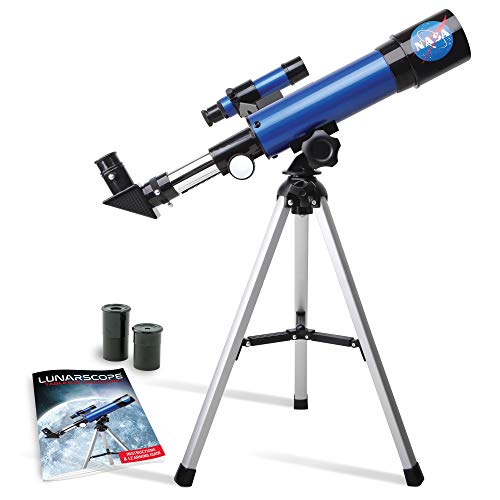


As an Amazon Associate we earn from qualifying purchases at no extra cost to you. Ratings are shown as listed on Amazon.
What matters most when choosing a telescope?
Aperture controls brightness and useful detail
Aperture is the diameter of the telescope’s main lens or mirror. It determines how much light the instrument gathers and how finely it can theoretically resolve detail. A 130 mm reflector gathers about 2.6 times as much light as an 80 mm refractor, calculated from the ratio of their circular areas: (130 ÷ 80)².
That extra light makes a noticeable difference on the Moon, Jupiter’s cloud bands, Saturn’s rings, double stars, and brighter nebulae. It does not guarantee a perfect view: atmospheric turbulence, poor collimation, urban light pollution, and an unstable mount can erase the advantage.
- 70–90 mm: lightweight and forgiving; best for the Moon, planets, bright star clusters, and casual backyard use.
- 100–130 mm: the most versatile beginner range; capable of meaningful views of planets and many brighter deep-sky objects.
- 150–200 mm: substantially brighter for galaxies, nebulae, and globular clusters, but bulkier and more demanding to transport or set up.
- Over 200 mm: excellent for committed observers, though storage, cooldown, collimation, and carrying weight become central buying considerations.
Mount quality is as important as optical size
The mount holds the optical tube and determines whether the image remains steady when you focus or adjust the telescope. A shaky mount can make a larger telescope frustrating, especially at high magnification.
An alt-azimuth mount moves up-down and left-right. It is intuitive and quick for beginners. A Dobsonian is a particularly efficient alt-azimuth design: its simple rocker box supports a large mirror without the cost or complexity of a tripod-based mount.
An equatorial mount is aligned with Earth’s rotation. It can track celestial objects smoothly, but polar alignment and counterweights add a learning curve. Equatorial mounts make more sense for observers who specifically want to learn manual tracking or pursue astrophotography.
A computerized GoTo mount can locate thousands of objects after alignment. It saves time under light-polluted skies, but it adds batteries, electronics, setup steps, and potential failure points. It also cannot compensate for a poor tripod or unrealistic expectations about what faint objects look like through a small telescope.
Best telescopes by observing situation
| Situation | Recommended type | Useful aperture | Typical weight | Why it fits |
|---|---|---|---|---|
| First telescope, limited storage | 70–90 mm refractor on alt-az mount | 70–90 mm | 3–7 kg | Quick setup, sealed optics, simple controls |
| Best visual value for a patio or balcony | Tabletop Dobsonian | 114–150 mm | 6–12 kg | Large aperture and stable mount for the money |
| Frequent travel to dark skies | Collapsible tabletop reflector | 100–130 mm | 4–8 kg | Compact storage with useful light-gathering power |
| Planet-focused observing | Longer-focus refractor or reflector | 90–150 mm | 5–15 kg | Higher magnification is easier to control |
| Convenience and object finding | Computerized GoTo telescope | 90–150 mm | 8–18 kg | Locates targets automatically after alignment |
| Experienced deep-sky observer | Full-size Dobsonian | 200–300 mm | 20–45+ kg | Strong light collection for faint objects |
Strong choices for beginners and experienced stargazers
Best all-around beginner value: 130 mm tabletop Dobsonian
A 130 mm tabletop Dobsonian, such as the Sky-Watcher Heritage-130P, is a compelling first telescope because it puts aperture ahead of decorative features. Its short tube is relatively easy to transport, while the mirror is large enough to show Jupiter’s main belts, Saturn’s rings, lunar craters, bright nebulae, and many star clusters.
The trade-off is that it needs a firm table, stand, or outdoor platform at a comfortable viewing height. Its open or collapsible tube also requires more care around dust and stray light than a sealed refractor. Reflectors may need occasional collimation, meaning adjustment of the mirrors so they line up precisely.
Best low-maintenance option: 80 mm refractor
An 80 mm refractor is a sensible choice for someone who wants to observe rather than maintain equipment. Models such as the Celestron StarSense Explorer LT 80AZ use a straightforward alt-azimuth setup, and the refractor design generally keeps its alignment without routine mirror adjustment.
Expect crisp, high-contrast lunar and planetary views when the mount is stable. An 80 mm aperture is less capable on faint galaxies and nebulae than a 130 mm reflector, and inexpensive short refractors can show colored fringes around very bright objects. This is a portability and simplicity choice, not the maximum-detail choice.
Best guided option: computerized 6-inch Schmidt-Cassegrain
A telescope such as the Celestron NexStar 6SE offers substantially more aperture in a compact optical tube and a computerized GoTo mount. It suits an observer who wants to find many targets without learning the sky manually, particularly from a suburban patio where faint guide stars may be difficult to see.
The setup is more involved: the tripod must be leveled, the telescope needs alignment, and the mount requires reliable power. A rechargeable power bank designed for telescope use or a properly secured external battery can be more dependable than repeatedly replacing small batteries. The narrow field of view also makes locating very large objects less convenient than with a short refractor.
Best upgrade for visual deep-sky observing: 8-inch Dobsonian
An 8-inch Dobsonian is often the point at which deep-sky observing becomes markedly more rewarding. Its 200 mm mirror gathers about 2.4 times as much light as a 130 mm mirror, using (200 ÷ 130)². Under dark skies, this can reveal more structure in nebulae and resolve more stars in globular clusters.
The ownership cost is usually reasonable because the mount is mechanically simple. The main disadvantages are size, storage, and transportation. Before buying, measure doorways, vehicle space, and the distance from storage to the observing area. A telescope that requires two people to move may be used less often than its specifications suggest.
How much setup should you expect?
- Choose a stable location. Avoid wooden decking that vibrates when someone walks nearby. Concrete, paving, or compact ground is better.
- Let the telescope reach outdoor temperature. Reflectors with larger mirrors can need roughly 20–60 minutes to cool in a major temperature change. This reduces internal air currents that soften the image.
- Install the lowest-power eyepiece first. A low-power eyepiece gives a wider field, making it easier to find the Moon or a bright star. Increase magnification only after the target is centered.
- Focus carefully. Turn the focuser slowly through the sharpest point. At high power, even a slight focus error is obvious.
- Check alignment when required. Equatorial and GoTo mounts need more alignment than manual alt-azimuth designs. Follow the mount’s process, and use a level, well-charged power source where applicable.
A useful magnification estimate is focal length divided by eyepiece focal length. A 650 mm telescope with a 25 mm eyepiece gives 26x; a 10 mm eyepiece gives 65x. Atmospheric conditions often limit practical magnification before the telescope’s theoretical limit does. More magnification is not automatically more detail.
Durability and ownership realities
Dust caps should be used whenever the telescope is stored. Do not routinely wipe optical surfaces: loose dust is usually less harmful than scratches caused by unnecessary cleaning. If cleaning becomes necessary, use the manufacturer’s recommended method and purpose-made optical supplies.
Reflector mirrors may need collimation after transport, especially in larger or frequently moved instruments. Tripod joints, altitude bearings, focuser mechanisms, and eyepiece retaining screws are the parts most likely to develop looseness or rough movement. Keep the telescope dry before covering it, and avoid leaving electronics or batteries in a damp outdoor storage area.
Budget separately for a red flashlight, a comfortable observing chair, a star chart or astronomy app, and perhaps one additional eyepiece. A chair is particularly valuable because steady seated observing reveals more detail than hurried viewing while standing.
Quick buying decision
- Choose a 70–90 mm refractor if simplicity, portability, and minimal maintenance matter most.
- Choose a 114–150 mm tabletop Dobsonian if visual performance per dollar is the priority.
- Choose a 6-inch GoTo telescope if you value automated object finding and accept electronic setup.
- Choose an 8-inch Dobsonian if you have storage space and expect to observe regularly from dark locations.
General market prices commonly range from about $150–$300 for basic small refractors, $250–$600 for capable tabletop Dobsonians, $700–$1,500 for computerized 6-inch systems, and $500–$1,000 for many 8-inch Dobsonians, depending on included accessories and local availability. Spend first on aperture and a stable mount, then add accessories as your observing habits become clear.


Write Your Review
No reviews yet. Be the first to share your experience!