
Our Short List of 3

- Best for: Home cooks who want one bag that handles beef, pork, poultry, and vegetables without swapping fuel.
- Bag weight: 20 lb
- Woods: hickory, maple, and cherry hardwood
- Material: all-natural hardwood pellets
- Use: grill, smoke, bake, roast, braise, and BBQ
- Best for: Regular weekend smokers who want a clean-burning blend that keeps ash and cleaning time down.
- Bag weight: 20 lb
- Woods: maple, hickory, and cherry hardwood
- Material: virgin hardwoods
- Additives: no oils, chemicals, or binders
- Best for: Frequent smokers with dry storage who want a large four-wood supply that lasts through many cooks.
- Bag weight: 40 lb
- Woods: hickory, cherry, hard maple, and apple
- Model number: 40PM
- Material: natural hardwood pellets
All 5 Picks at a Glance
| Product | Specs | Action |
|---|---|---|
| Traeger Signature Blend Hardwood Pellets, 20 lb Bag |
| Check price on Amazon |
| Camp Chef Competition Blend BBQ Pellets, 20 lb Bag |
| Check price on Amazon |
| CookinPellets Perfect Mix Hardwood Pellets, 40 lb Bag |
| Check price on Amazon |
 Pit Boss Competition Blend BBQ Pellets, 40 lb Bag |
| Check price on Amazon |
 Lumber Jack Competition Blend BBQ Pellets, 20 lb Bag |
| Check price on Amazon |
Key takeaways
- Compare the best smoker pellets for pellet grills, from hickory blends to bulk 40-pound bags, with real specs and clear advice for patio cooks.
A pellet grill only cooks as well as the fuel in its hopper, and the bag you pour in decides both flavor and how often you clean the fire pot. Cheap filler-heavy pellets burn fast, leave heavy ash, and can jam an auger, while a clean hardwood blend holds temperature, feeds smoothly, and lays down steady smoke. The real decision is not brand loyalty but the trade between flavor character, bag size, and how much ash you are willing to sweep out after a long cook.
This guide serves backyard cooks who run a pellet grill through the week, competition-style cooks chasing consistent bark, and anyone stocking a patio for a season of weekend smoking. Every bag below was chosen from the woods, weights, and features stated on its own Amazon listing, so you can match the pellet to your grill and your cooking habits.
Quick Picks
As an Amazon Associate we earn from qualifying purchases.
| Product | Best for | Key spec from title |
|---|---|---|
| Traeger Signature Blend Hardwood Pellets, 20 lb Bag | Everyday all-round cooking | Signature Blend 20 lb Bag |
| Camp Chef Competition Blend BBQ Pellets, 20 lb Bag | Low-ash everyday smoking | Competition Blend BBQ Pellets, 20 lb Bag |
| CookinPellets Perfect Mix Hardwood Pellets, 40 lb Bag | Frequent cooks who buy in bulk | Perfect Mix Hardwood Pellets, 40 lb Bag |
| Pit Boss Competition Blend BBQ Pellets, 40 lb Bag | High-volume cooking on a budget | Competition Blend BBQ Pellets, 40 lb Bag |
| Lumber Jack Competition Blend BBQ Pellets, 20 lb Bag | Cooks who want the exact wood ratio | Competition Blend Maple-Hickory-Cherry Pellets, 20 lb Bag |
How to Choose
Match the wood to the meat
Wood choice is the flavor decision, and it matters more than the brand on the bag. Hickory brings a strong, bacon-like smoke that suits pork shoulder and brisket, while cherry adds a mild fruit note and a deeper mahogany color on ribs and poultry. Maple is gentle and slightly sweet, which works well on vegetables, fish, and baked goods. A three-wood competition blend covers most cooks in one bag, but a cook who smokes mostly chicken or fish may prefer a lighter fruitwood, and anyone cooking beef all day will want hickory in the mix.
Check the bag weight against your hopper
A 20-pound bag suits most home cooks because it fills a standard hopper once or twice and stays fresh in storage, while a 40-pound bag only makes sense when you grill several times a week and have a dry place to keep it. Pellets absorb moisture from humid air, so a bag that sits open in a damp garage will swell, crumble, and feed poorly. Measure your hopper before ordering bulk, and remember that lifting a full 40-pound sack over a grill takes more effort than pouring from a smaller bag.
Look for clean hardwood with no fillers
The best pellets are made from hardwood with no added oils, binders, or flavor sprays, because fillers burn dirty and leave extra ash in the fire pot. Listings that name the actual woods in the blend give you something to judge, while vague descriptions hide the mix. Kiln-dried pellets carry less moisture, so they light faster and hold temperature with less fuel. If a listing does not state the woods or the drying process, treat that silence as a reason to choose a bag that does.
Think about ash and auger feed
Ash is the hidden cost of cheap pellets, since every long cook ends with cleaning the fire pot and the grill interior. Low-ash pellets stretch the time between cleanings and keep airflow steady during overnight smokes. Uniform pellet size matters too, because dust and broken pieces can bridge in the hopper and starve the auger. A bag with a reputation for consistent sizing and low dust feeds more reliably, which is exactly what you want when a brisket is six hours in and nobody is watching the grill.
The 5 Best Options
Traeger Signature Blend Hardwood Pellets, 20 lb Bag
- Best for: Home cooks who want one bag that handles beef, pork, poultry, and vegetables without swapping fuel.
- Bag weight: 20 lb
- Woods: hickory, maple, and cherry hardwood
- Material: all-natural hardwood pellets
- Use: grill, smoke, bake, roast, braise, and BBQ
Home cooks who want one bag that handles beef, pork, poultry, and vegetables without swapping fuel.
Traeger also sells this blend in an 18-pound bag under a different listing, so confirm the bag weight on the listing before ordering.
Traeger built its name on pellet grills, and the Signature Blend is the bag most owners reach for first because it suits nearly everything that goes on the grate. The mix of hickory, maple, and cherry gives a full-bodied smoke that is bold enough for pork and beef yet gentle enough for chicken, fish, and vegetables. It is the safe default for a household that cooks a little of everything and does not want a shelf full of single-wood bags.
Watch out for: Traeger also sells this blend in an 18-pound bag under a different listing, so confirm the bag weight on the listing before ordering.
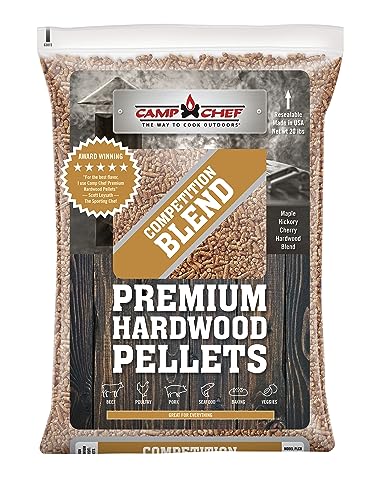
Camp Chef Competition Blend BBQ Pellets, 20 lb Bag
- Best for: Regular weekend smokers who want a clean-burning blend that keeps ash and cleaning time down.
- Bag weight: 20 lb
- Woods: maple, hickory, and cherry hardwood
- Material: virgin hardwoods
- Additives: no oils, chemicals, or binders
Regular weekend smokers who want a clean-burning blend that keeps ash and cleaning time down.
The flavor is deliberately balanced rather than bold, so cooks chasing a heavy hickory punch may want a single-wood bag alongside it.
Camp Chef earns its place as the everyday workhorse of this group, with kiln-dried pellets that light cleanly and leave less ash behind than many rivals. The maple, hickory, and cherry blend mirrors the classic competition mix, so it suits ribs, brisket, and pork shoulder without pushing any single flavor too hard. Cooks who smoke every weekend will notice the difference at cleaning time, when the fire pot holds noticeably less residue after a long cook.
Watch out for: The flavor is deliberately balanced rather than bold, so cooks chasing a heavy hickory punch may want a single-wood bag alongside it.
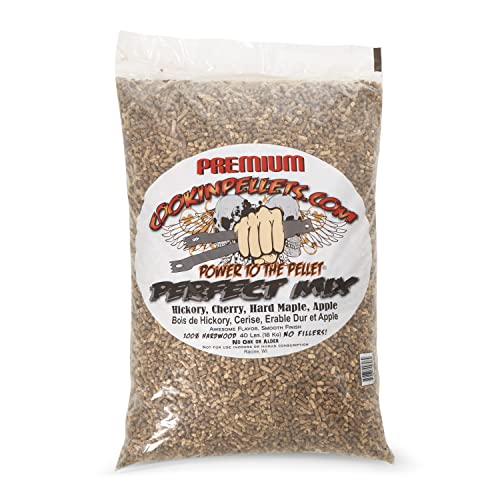
CookinPellets Perfect Mix Hardwood Pellets, 40 lb Bag
- Best for: Frequent smokers with dry storage who want a large four-wood supply that lasts through many cooks.
- Bag weight: 40 lb
- Woods: hickory, cherry, hard maple, and apple
- Model number: 40PM
- Material: natural hardwood pellets
Frequent smokers with dry storage who want a large four-wood supply that lasts through many cooks.
A 40-pound bag is heavy to lift and pour, and pellets left in a damp spot will absorb moisture, so plan dry storage before ordering.
CookinPellets takes the opposite approach from the small-batch crowd by selling a big 40-pound bag built for cooks who run their grill hard all season. The four-wood mix of hickory, cherry, hard maple, and apple adds a fruit note that the three-wood blends lack, and the brand states that it uses no filler woods. That bulk size is the whole point here: fewer orders, fewer trips to the store, and a hopper that stays full through a long stretch of weekend cooks.
Watch out for: A 40-pound bag is heavy to lift and pour, and pellets left in a damp spot will absorb moisture, so plan dry storage before ordering.
Pit Boss Competition Blend BBQ Pellets, 40 lb Bag
- Best for: High-volume cooks and large families who burn through pellets fast and want the lowest cost per cook.
- Bag weight: 40 lb
- Woods: hickory, cherry, maple, and oak
- Model number: 55435
- Material: all-natural hardwood pellets
High-volume cooks and large families who burn through pellets fast and want the lowest cost per cook.
Pit Boss does not publish the wood ratios in this blend, and the 40-pound sack is heavy to lift into a hopper, so decant into a smaller container if needed.
Pit Boss wins the value argument outright, because this 40-pound bag costs roughly what premium 20-pound bags sell for, which makes it the cheapest way to keep a grill fed. The blend of hickory, cherry, maple, and oak covers the same ground as the pricier competition blends, and Pit Boss rates it for beef, chicken, pork, and vegetables. It is the bag to buy when the grill runs several nights a week and the fuel budget matters as much as the flavor.
Watch out for: Pit Boss does not publish the wood ratios in this blend, and the 40-pound sack is heavy to lift into a hopper, so decant into a smaller container if needed.
Lumber Jack Competition Blend BBQ Pellets, 20 lb Bag
- Best for: Cooks who want to know exactly what is burning and learn how each wood shapes the finished flavor.
- Bag weight: 20 lb
- Woods: one third maple, one third hickory, one third cherry
- Material: all-natural hardwood pellets
- Grade: competition grade
Cooks who want to know exactly what is burning and learn how each wood shapes the finished flavor.
The 20-pound bag costs close to what a 40-pound budget bag sells for, so it is a flavor and transparency choice rather than a value buy.
Lumber Jack stands out for one honest reason: it prints the exact blend ratio on the bag, one third maple, one third hickory, and one third cherry, while most rivals keep their ratios vague. That transparency matters to cooks who are learning how wood affects flavor, because the result on the plate can be traced back to a known mix. The pellets are competition grade with no additives, and the balanced profile suits ribs, brisket, and poultry alike without favoring any single wood.
Watch out for: The 20-pound bag costs close to what a 40-pound budget bag sells for, so it is a flavor and transparency choice rather than a value buy.
Which One Fits Your Situation
You grill a little of everything each week
Start with the Traeger Signature Blend or the Camp Chef Competition Blend, since both cover beef, pork, poultry, and vegetables in a single bag. The Traeger leans slightly richer and more familiar, while the Camp Chef burns a touch cleaner and leaves less ash. Either one removes the guesswork from weeknight grilling, and you can branch into single woods later once you know which flavors your household prefers.
You smoke most weekends and hate cleaning ash
Pick the Camp Chef Competition Blend first, because kiln-dried pellets and low moisture mean less residue in the fire pot after long cooks. The CookinPellets Perfect Mix is the second choice if you also want bulk supply, since its large bag keeps you stocked through a busy season. Keep a small ash vacuum or brush near the grill either way, because even the cleanest pellets leave some residue behind.
You cook for a crowd and watch the fuel budget
The Pit Boss Competition Blend is built for this situation, with 40 pounds at roughly the cost of a premium 20-pound bag. It feeds a big hopper through long cooks and family gatherings without constant reordering. Store the open bag in a dry container with a tight lid, and pour only what each cook needs, so the remaining pellets stay dry and feed smoothly.
You want to learn wood flavor properly
Choose the Lumber Jack Competition Blend, because its published one-third-each ratio lets you connect the smoke you taste to a known mix of maple, hickory, and cherry. Cook the same cut with this bag and then with a single-wood bag, and the differences in sweetness, depth, and color become easy to spot. That kind of side-by-side learning is hard when the blend ratio stays a secret.
Common Mistakes
- Storing pellets in a damp garage or an open bag, where they absorb moisture, swell, and jam the auger.
- Buying heating pellets instead of food-grade grilling pellets, which may contain softwoods or binders meant for stoves.
- Pouring a whole 40-pound bag into a small hopper and leaving the rest exposed to humid patio air.
- Choosing a strong wood like mesquite for delicate fish or vegetables, where it overwhelms the food.
- Skipping fire-pot cleaning between long cooks, so ash chokes airflow and the grill struggles to hold temperature.
Frequently Asked Questions
How many pounds of pellets does a long smoke use?
A five-hour rib cook at moderate heat uses roughly 6 to 8 pounds of pellets, while an overnight brisket can use far more depending on temperature and weather. A 20-pound bag covers several shorter cooks, and a 40-pound bag suits a full season of regular smoking. Cold wind and rain raise consumption, so keep a spare bag on hand during winter cooks.
Can I mix different pellet flavors in one hopper?
Yes, mixing is common and works well when the woods complement each other, such as cherry with hickory for ribs or apple with maple for poultry. Pour the mix in layers rather than dumping one flavor on top, so the blend stays even as the auger feeds. Avoid mixing a very strong wood with a delicate one, since the stronger flavor usually dominates the finished food.
Do pellets go bad in storage?
Pellets last a long time when kept dry in a sealed container, but moisture is their main enemy. Swollen or crumbling pellets feed poorly and can clog an auger, so discard any that feel soft or dusty. Store bags off the floor in a cool, dry place, seal the bag between cooks, and use a lidded bin if your patio sees rain or heavy humidity.
Are all wood pellets safe for pellet grills?
No, only food-grade hardwood pellets made for grilling belong in a pellet grill hopper. Heating pellets may contain softwood, bark, or binders that burn dirty and can leave unwanted residue on food. Check the listing for a clear statement that the pellets are for grills or smokers, confirm the wood species named, and avoid any bag that does not describe its contents.
More from Amazon
Programs that pair well with the guide above. Offers and eligibility are set by Amazon and may change.
Collect the home and kitchen items you want in one registry that guests can shop from.
Create a wedding registrySet up recurring deliveries of everyday items on eligible products. Terms and savings are set by Amazon.
Explore Subscribe & SaveFree shipping on eligible items, Prime Video and more. Eligible new members can start with a free trial.
Start a Prime free trialAudiobooks and podcasts to listen to on the go. Eligible new members can start with a free trial.
Try Audible freeAs an Amazon Associate we earn from qualifying purchases.

Write Your Review
No reviews yet. Be the first to share your experience!