

The best gas fire pit depends on your fuel source: a natural gas fire pit gives the lowest running cost and no tanks if you have a gas line, while a propane model is portable and works anywhere. For most patios, a 30 to 40 inch round fire pit table with 40,000 to 60,000 BTU output balances heat and price. Check the BTU rating, fuel type and tank cover design first.
Our top picks



As an Amazon Associate we earn from qualifying purchases at no extra cost to you.
Quick comparison of gas fire pit options
| Pick | Best for | Typical output | Fuel | Price range |
|---|---|---|---|---|
| Best overall: 40 inch round fire table | Most patios | 40,000 to 50,000 BTU | Propane, convertible | Mid-range |
| Best natural gas: plumbed fire pit | Permanent installs | 50,000 to 100,000 BTU | Natural gas with kit | Upper-mid to premium |
| Best budget: 28 inch propane bowl | Small decks | 30,000 to 40,000 BTU | Propane | Budget |
| Best for conversation: rectangular table | Dining and lounging | 50,000 to 60,000 BTU | Propane or natural gas | Upper-mid |
| Best portable: tabletop gas pit | Apartments, patios | 10,000 to 20,000 BTU | Small propane cylinder | Budget |
Best overall: 40 inch round fire pit table
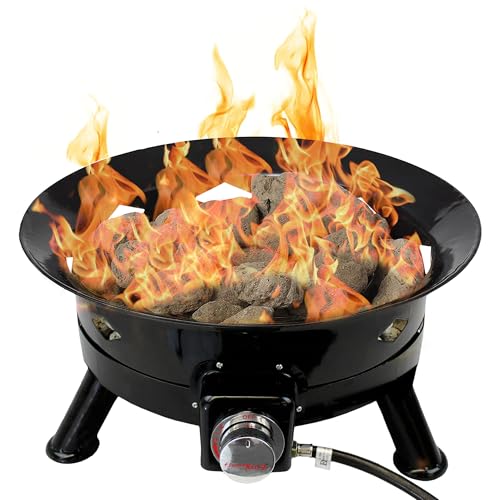
Round tables from brands such as Endless Summer and Outland Living hide a 20 pound propane tank, offer electronic ignition, and provide enough heat for four to six people. Most can be converted to natural gas with a kit. The trade-off is that tank access panels and heavy tops can make moving hard, and it needs clearance from combustible surfaces.
Best natural gas: plumbed fire pit
Natural gas costs less per hour than propane and removes tank swaps. Installation by a licensed plumber is required, and the unit is not portable. Consider a shutoff valve and a permit. Manufacturers such as The Outdoor GreatRoom Company make high-end gas tables.
Best budget: 28 inch propane bowl
A small steel bowl with a burner ring offers real flame for little money. It runs on a 20 pound tank outside the unit, which looks less polished. Heat output is lower and it is best used within 4 ft.
Best for conversation: rectangular table
A rectangular table lets people sit along a side and use the ledge for drinks. It takes more space and often needs a wind guard. Choose this when you entertain frequently.
Best portable: tabletop gas pit
Tabletop models run on small canisters and give ambience rather than warmth. They are suited to balconies if local rules allow gas flame.
How to choose a gas fire pit
- BTU: 40,000 BTU warms about a 6 ft circle in mild weather; larger groups want 50,000 or more.
- Fuel: natural gas for permanent installs; propane for flexibility.
- Burner and fill: lava rock or fire glass change flame look and heat reflection.
- Safety: look for flame-out safety, certification, and keep 10 ft clearance from structures where required.
- Material: powder-coated steel, aluminum or concrete resist weather differently.
Worked example: propane runtime
A 20 pound propane tank holds about 4.7 gallons, which is roughly 430,000 BTU. At a 50,000 BTU output, a full tank lasts around 8 hours on high. Running at half output doubles that. Natural gas costs less per BTU, so a plumbed pit saves money if you use it often.
Ownership realities
- Clean burner ports with a brush each season to prevent uneven flame.
- Use a fitted cover when not in use.
- Check hoses and regulators for cracks annually.
- Only use fire glass or lava rock rated for gas burners; river rock can trap moisture and crack.
Natural gas versus propane in practice
Propane carries about 91,500 BTU per gallon and is easy to carry, so a 20 pound cylinder is a flexible choice for a movable table. Natural gas is delivered by pipe, so it never runs out and generally costs less per unit of heat, but it has a lower energy density, which means burners are sized larger and the line must be installed by a licensed pro. If you may move or rent, propane is simpler. If the pit is a permanent fixture beside your grill, natural gas pays back over time.
Fire glass, lava rock and what goes on the burner
Tempered fire glass reflects light and heat and looks modern, while lava rock is cheaper and spreads flame more naturally. Either one sits over the burner pan, and the media should not block the burner holes. Never use river rock or sand from a yard, since trapped moisture can pop and throw fragments. Use only media the manufacturer approves, and keep it level and a bit below the burner edge.
Placement and safety checklist
- Keep at least 10 feet from the house siding, overhangs and trees unless the manual says otherwise.
- Do not use under covered roofs or enclosed porches without proper ventilation.
- Keep a fire extinguisher or hose within reach.
- Turn the tank valve off after each use.
- Check local burn rules, since gas pits are sometimes treated differently from wood.
Frequently Asked Questions
Is a gas fire pit better than wood?
Gas starts quickly with no smoke and ash, while wood offers crackle and fuller heat. Choose gas for convenience.
How many BTU do I need?
40,000 to 60,000 BTU suits a typical patio group. Windy locations benefit from higher output.
Can I convert propane to natural gas?
Many units sell a conversion kit, but have a licensed professional install the line and check compatibility.
Are gas fire pits safe on a deck?
Many are, if the manufacturer lists deck use and you follow clearance rules. Use a heat shield for added safety.
How long does a propane tank last?
About 8 hours at 50,000 BTU and longer at lower settings.





Write Your Review
No reviews yet. Be the first to share your experience!