

Key takeaways
- 304 stainless steel: The strongest choice for frequent outdoor use, humid climates, and coastal locations. It resists corrosion better than lower grades, but fingerprints, salt deposits, and tea staining still require cleaning.
- Powder-coated steel: Often the best value. It is rigid and attractive when intact, but chips and scratches can expose steel to rust. Touch up damaged areas promptly.
- Aluminum: Lightweight and naturally corrosion-resistant, though it can dent more easily and may flex under a heavy grill.
- Resin or HDPE: Practical for prep carts and storage tables. It will not rust, but prolonged ultraviolet exposure can fade or embrittle lower-quality plastic.
- Wood: Teak and acacia can look excellent, but they require periodic cleaning and oiling. Keep wood tops away from direct heat and standing water.
Best Grill Carts for Outdoor Cooking
The best grill cart for most patios is a weather-resistant steel or resin cart about 48–60 inches wide, with at least 400 square inches of usable prep space, locking casters, and storage for fuel, tools, and serving dishes.
The right choice depends less on the cart’s appearance than on four measurements: the grill’s footprint, the available patio space, the weight it must carry, and how much prep and storage you need beside the cooking surface. A cart designed for a compact tabletop grill will not safely support a full-size gas grill, while a large stainless-steel cart can overwhelm a small balcony.
Our top picks
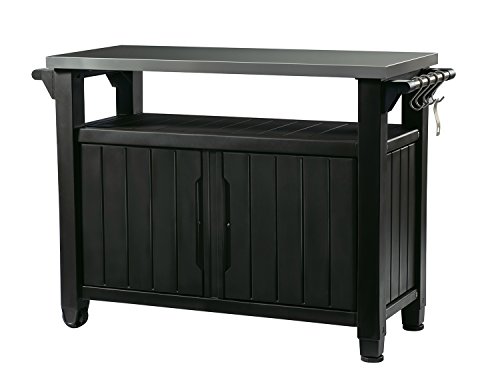


As an Amazon Associate we earn from qualifying purchases at no extra cost to you. Ratings are shown as listed on Amazon.
Best grill carts by situation
| Situation | Best cart type | What to prioritize | Typical budget range |
|---|---|---|---|
| Small balcony or apartment patio | Compact rolling prep cart | Under 30 inches wide, two locking casters, fold-down shelf | $100–$250 |
| Portable charcoal or tabletop gas grill | Universal grill-and-prep cart | Adjustable support surface, 150–250 lb capacity, heat clearance | $150–$350 |
| Weekly family cooking | Full-size grill cabinet cart | 48–60-inch width, enclosed storage, four locking casters | $300–$900 |
| Frequent cooking in wet or coastal weather | 304 stainless-steel cart | Welded construction, sealed drawers, corrosion-resistant hardware | $700–$2,000+ |
| Occasional hosting and buffet service | Large prep and serving cart | 500-plus square inches of work area, towel bar, bottle opener, locking wheels | $250–$700 |
Key comparison: size, compatibility, and working area
Dimensions listed for grill carts can be misleading because some manufacturers include handles, side shelves, or towel bars. Measure the cart’s main support frame and compare it with the grill’s legs or base—not only the cooking grate.
| Cart category | Typical overall dimensions | Usable prep area | Recommended grill load | Storage capacity | Assembly expectation |
|---|---|---|---|---|---|
| Compact prep cart | 24–32 W × 20–26 D × 34–38 H in. | 200–350 sq. in. | Up to 100 lb. | Open lower shelf or one cabinet | 30–60 minutes |
| Universal portable-grill cart | 30–42 W × 24–30 D × 32–40 H in. | 300–500 sq. in. | 100–200 lb. | Lower shelf, hooks, and side storage | 45–90 minutes |
| Full-size grill cart | 48–60 W × 24–30 D × 36–44 H in. | 500–800 sq. in. | 200–350 lb. | One or two cabinets plus drawers | 1–3 hours |
| Built-in-style outdoor cabinet cart | 60–72 W × 26–32 D × 34–38 H in. | 700–1,000 sq. in. | 300 lb. or more | Multiple drawers and enclosed cabinets | 2–5 hours |
For compact grills: choose a universal cart with restraints
A cart for a Weber Traveler, Weber Q, Napoleon TravelQ, or similar portable grill should have a flat, heat-tolerant platform and a way to prevent the grill from shifting. Straps, retaining lips, or a fitted lower frame are safer than simply placing the grill on a smooth tabletop. Check the grill manufacturer’s clearance requirements before using any non-dedicated cart.
The Cuisinart Deluxe Outdoor Grilling Prep Table is an example of the compact prep-cart format. It is intended primarily as a mobile work surface, so it suits a portable grill or a cook who needs room for trays, seasonings, and utensils. It is not a substitute for a dedicated heavy-duty cart unless its stated load rating and heat clearances match the grill.
For built-in or full-size grills: buy a matching cart
Gas grills such as the Weber Spirit and Genesis families are generally safest on their designated manufacturer carts. A matching cart accounts for the grill’s mounting points, gas-cylinder location, grease management, ventilation, and working height. Universal carts can work for some freestanding models, but compatibility should be confirmed by model number, not by width alone.
For example, a grill that is 52 inches wide may require side shelves to be removed before mounting, while its control panel or propane tank may still interfere with a generic cabinet. A cart that supports the weight but blocks ventilation is not a good match.
Materials: what survives outdoors
- 304 stainless steel: The strongest choice for frequent outdoor use, humid climates, and coastal locations. It resists corrosion better than lower grades, but fingerprints, salt deposits, and tea staining still require cleaning.
- Powder-coated steel: Often the best value. It is rigid and attractive when intact, but chips and scratches can expose steel to rust. Touch up damaged areas promptly.
- Aluminum: Lightweight and naturally corrosion-resistant, though it can dent more easily and may flex under a heavy grill.
- Resin or HDPE: Practical for prep carts and storage tables. It will not rust, but prolonged ultraviolet exposure can fade or embrittle lower-quality plastic.
- Wood: Teak and acacia can look excellent, but they require periodic cleaning and oiling. Keep wood tops away from direct heat and standing water.
Wheels deserve as much attention as the frame. Two-inch casters are adequate on smooth concrete, while three-inch or larger polyurethane casters roll better over pavers and expansion joints. At least two casters should lock; four locking casters are preferable when the grill is heavy or the patio slopes slightly. Small plastic wheels often wear out before the cart itself.
Storage and prep space: calculate before buying
A useful cart needs enough surface for the food leaving the grill, not merely enough room for a cutting board. A 12-by-16-inch tray occupies 192 square inches. Add a 12-by-12-inch seasoning area and a 10-by-14-inch landing area for cooked food, and the minimum practical workspace is about 476 square inches.
That calculation makes a 250-square-inch cart suitable for tools and ingredients but frustrating for a family meal. Look for a fold-down side shelf if patio space is limited. Enclosed cabinets protect cookware from rain and insects, while open shelves are easier to clean and ventilate. A propane compartment should be purpose-designed, ventilated, and compatible with the cylinder size you use; do not store a cylinder in an unventilated sealed cabinet.
Assembly requirements and common mistakes
Expect most grill carts to arrive flat-packed. The task is usually manageable, but heavy grill heads may require two people during installation. Before tightening every bolt, confirm that the frame is square and that the doors or drawers sit evenly.
- Inventory the hardware and identify the caster-locking mechanism before beginning.
- Assemble the frame loosely so its holes can align without forcing panels.
- Install casters with the brakes facing outward for easier access.
- Square the cart on a level surface, then tighten fasteners gradually.
- Attach shelves and handles only after checking door and drawer clearance.
- Mount the grill with a second person and verify heat clearance, ventilation, and stability.
A common mistake is tightening one corner completely before the opposite panels are installed. That can leave the cabinet twisted, causing doors to rub and casters to carry uneven loads.
Ownership realities: what wears first
Casters, drawer slides, shelf fasteners, and powder-coating around screw holes usually show wear before the main frame. Grease also accumulates beneath the grill, where it can trap moisture and accelerate corrosion. Clean spills promptly, keep the grease system maintained, and do not use abrasive pads on stainless steel.
A cover helps with dust and rain but should not be fitted over a hot grill. Remove it periodically so trapped condensation can evaporate. In freezing climates, drain water from shelves and avoid pushing a fully loaded cart across ice or cracked paving. If the cart will remain outdoors year-round, stainless hardware and replaceable casters are worth paying for.
Bottom line
Choose a compact resin or powder-coated prep cart for a portable grill and limited space; choose a dedicated manufacturer cart for a full-size gas grill; and choose welded 304 stainless steel when frequent use, salt air, or long-term ownership justifies the higher cost. Before buying, confirm the actual support dimensions, load rating, prep-area size, caster type, storage ventilation, and assembly requirements. Those details determine whether a grill cart becomes a useful outdoor workstation or an unstable table with wheels.





Write Your Review
No reviews yet. Be the first to share your experience!