

Key takeaways
- Silicone or rubber gasket: the best choice for keeping crisp cookies from softening and soft cookies from drying out quickly.
- Ungasketed ceramic lid: attractive and easy to clean, but better for short-term storage and frequently replenished snacks.
- Wood or bamboo lid: appealing on a counter, but it needs more careful drying and may absorb odors or moisture.
- Metal lid with a gasket: often seals well, though the underside should be checked for rust-resistant hardware and easy cleaning.
Best Ceramic Cookie Jars for Kitchen Counters
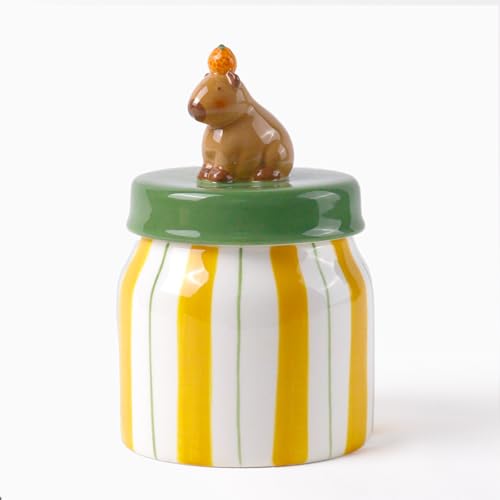
The best ceramic cookie jar for kitchen counter use is a medium canister measuring roughly 6 to 8 inches wide, holding 2 to 3 quarts, with a removable silicone or rubber gasket and a lid that is easy to lift with one hand.
That combination gives most households enough room for a standard batch of cookies without allowing the jar to dominate the worktop. The right choice depends less on decoration than on four practical details: whether the seal is genuinely airtight, how much counter depth it needs, how easily the ceramic can be cleaned, and whether the capacity matches how often the jar is opened.
Our top picks


As an Amazon Associate we earn from qualifying purchases at no extra cost to you. Ratings are shown as listed on Amazon.
Quick comparison: which ceramic cookie jar fits your counter?
| Jar type | Typical capacity | Typical footprint | Approximate empty weight | Seal and best use |
|---|---|---|---|---|
| Compact ceramic canister | 1 to 1.5 quarts | 5.5 to 6.5 inches wide | 2 to 3.5 pounds | Loose-fitting or gasketed lid; small counters and occasional snacks |
| Medium gasketed cookie jar | 2 to 3 quarts | 6.5 to 8 inches wide | 3 to 5 pounds | Silicone or rubber gasket; everyday family storage |
| Large ceramic cookie jar | 3.5 to 5 quarts | 8 to 10 inches wide | 5 to 8 pounds | Heavy lid and gasket; bulk storage or frequent baking |
| Decorative lidded crock | 1.5 to 3 quarts | 6 to 8 inches wide | 3 to 6 pounds | Usually a non-airtight lid; best for biscuits eaten within several days |
These are useful buying ranges rather than guaranteed measurements. Ceramic walls, lid shapes, and handles can add an inch or more to the stated width, so measure the actual counter area before ordering.
Best overall: a medium ceramic jar with a silicone-gasketed lid
For most kitchens, choose a 2- to 3-quart jar with a glazed interior, a broad base, and a fitted lid containing a replaceable silicone or rubber ring. This is the most balanced format for everyday cookies, crackers, snack bars, or individually wrapped treats.
A medium jar commonly fits about 18 to 30 average cookies, depending on their thickness and whether they are stacked or arranged upright. It is large enough to hold a standard home-baked batch but not so deep that older cookies disappear at the bottom.
Look for a lid with a knob or handle that provides enough clearance for your fingers. A completely flat lid may look cleaner, but it is less convenient when the jar is opened repeatedly. The base should be at least 1 inch wider than the narrowest part of the body when viewed from above; this reduces tipping when the lid is lifted.
Best for a small counter: a compact 1- to 1.5-quart jar
If your counter is shallow, a compact jar is a better choice than a tall, narrow model. A jar that projects only 6 inches from the backsplash leaves more usable space in front for preparation, while an unusually tall jar can collide with cabinets or become awkward to reach.
Compact jars work well for one or two people, households that buy small packages of cookies, or anyone who prefers to refill frequently. Their limitation is capacity: a thick ceramic wall and a wide lid can mean that a jar advertised as 1.5 quarts holds fewer cookies than expected.
Before buying, check the internal height rather than relying only on external dimensions. A 7-inch-tall jar may have just 5 inches of usable interior space once the lid and curved shoulder are taken into account.
Best for frequent bakers: a large jar, with one important warning
A 3.5- to 5-quart ceramic jar suits a household that keeps multiple batches on hand or stores bulky items such as biscotti, granola bars, and individually packaged snacks. The extra capacity reduces refilling, but it also increases weight and makes the contents more likely to sit for weeks.
Large jars are most useful when the household consumes cookies quickly. If a batch lasts a month, a large container may protect the outside of the stack while the cookies at the bottom gradually lose quality. In that situation, two medium jars are often more practical than one large jar: one can hold everyday treats and the other can remain closed as reserve storage.
Pay particular attention to the filled weight. Three quarts of cookies, plus a 5-pound ceramic container, can be difficult to move safely with one hand. A large jar should stay in a permanent location rather than being carried to the table.
Seal comparison: airtight is a feature, not a ceramic finish
Cookie jars often look airtight because their lids fit neatly, but a close-fitting ceramic lid without a gasket is usually only moisture-resistant. It can slow down exposure to air, yet it will not provide the same seal as a lid with a flexible ring.
- Silicone or rubber gasket: the best choice for keeping crisp cookies from softening and soft cookies from drying out quickly.
- Ungasketed ceramic lid: attractive and easy to clean, but better for short-term storage and frequently replenished snacks.
- Wood or bamboo lid: appealing on a counter, but it needs more careful drying and may absorb odors or moisture.
- Metal lid with a gasket: often seals well, though the underside should be checked for rust-resistant hardware and easy cleaning.
Do not overfill a gasketed jar. Crumbs caught between the rim and the seal can create a small leak, and a lid pressed against a full stack may not close evenly. Leave about half an inch of clearance above the food.
Ceramic finishes: glossy, matte, and reactive glaze
Glossy glazed ceramic
A glossy interior is usually the easiest to wipe clean because crumbs and grease are less likely to cling to the surface. It is the safest all-purpose finish for cookies containing chocolate, butter, or sticky fillings. Inspect the rim for a continuous glaze; an unglazed rim can absorb moisture and discolor over time.
Matte ceramic
Matte finishes hide fingerprints and create a softer, modern appearance, but their slight texture may hold fine crumbs. They still work well when the interior is glossy or smoothly sealed. Avoid assuming that a matte exterior means the entire jar is porous.
Reactive or speckled glaze
Reactive glazes vary from piece to piece and can make a jar distinctive. They may also show water spots, dark crumbs, or scratches more readily. Choose one with a smooth, continuous food-contact surface and no pinholes, rough patches, or glaze gaps inside the vessel.
Cleaning and durability: what wears first
The ceramic body is usually the most durable part. The gasket, wooden components, painted decoration, and lid hardware are more likely to show wear first.
- Remove all crumbs before washing; dry crumbs are easier to brush out than to dissolve.
- Wash the ceramic with warm water, mild dish soap, and a soft sponge.
- Remove the gasket if the lid design allows it, then wash the ring separately.
- Rinse thoroughly and dry every part completely before replacing the lid.
- Clean the jar whenever changing food types, especially after oily cookies or flavored snacks.
Dishwasher suitability varies by glaze, decoration, gasket, and lid material. Even when the ceramic body is dishwasher-safe, hand-washing is gentler on printed patterns, wooden lids, and flexible seals. Avoid sudden temperature changes: pouring hot water into a cold jar can cause thermal shock and cracking.
Common mistakes include using abrasive powder on a glossy glaze, soaking a wooden lid, storing warm cookies in a sealed container, and lifting a heavy jar by its lid knob. Let freshly baked cookies cool completely before storage; otherwise, trapped steam can soften crisp edges and create condensation.
Decision guide by kitchen situation
| Your situation | Recommended specification | Why it fits |
|---|---|---|
| Less than 7 inches of free counter depth | 1 to 1.5 quarts; broad, low profile | Reduces overhang and is easier to reach |
| Daily family use | 2 to 3 quarts; gasketed lid; 6.5 to 8-inch footprint | Balances capacity, freshness, and counter space |
| Frequent baking | 3.5 to 5 quarts, or two medium jars | Handles volume without forcing all cookies into one deep container |
| Cookies eaten within two or three days | Ungasketed decorative jar is acceptable | Convenience and appearance matter more than maximum seal strength |
| Limited lifting strength or mobility | 1 to 2 quarts; lightweight lid; stable base | Safer to open and move when full |
| Lowest maintenance | Glossy glazed interior; silicone gasket; no wood | Fewer absorbent or difficult-to-clean components |
How much capacity do you really need?
A practical estimate is to allow approximately 0.08 to 0.12 quart per average cookie when cookies are loosely stacked. For example, 24 medium cookies multiplied by 0.1 quart equals about 2.4 quarts. That calculation points toward a 2.5- to 3-quart jar, with a little headroom for easy removal.
For thin biscuits, the estimate can be lower. For chunky cookies, decorated cookies, or individually wrapped snacks, choose the next size up. Capacity figures describe the internal volume, not the number of cookies, so shape matters as much as the advertised quart rating.
Final recommendation
For the best combination of counter compatibility and everyday usefulness, choose a 2- to 3-quart ceramic cookie jar with a glossy glazed interior, a silicone-gasketed lid, a stable base, and an external width no greater than 8 inches. Choose a compact 1- to 1.5-quart model when space is tight or consumption is low; choose a large jar only when its contents will be replenished regularly. A beautiful finish attracts attention, but the gasket, interior surface, lid ergonomics, and cleanable construction determine whether the jar remains useful after the novelty wears off.





Write Your Review
No reviews yet. Be the first to share your experience!