

Key takeaways
- Compare the best outdoor tortoise houses for yards, from a modular fir classic to a two-story cedar house, with sizing, cleaning and shelter tips.
A tortoise house is not a decorative garden ornament with a pet inside it. The real decision is how the shelter handles the daily pattern of a ground-dwelling animal that needs a sunlit basking patch, a dark dry sleeping corner, and walls a raccoon cannot lift or chew through, all inside a footprint your yard can actually spare. Floor area, hide design, and how the floor copes with soaked substrate matter far more than paint color.
This guide serves three groups: first-time keepers housing a young Russian or Hermann’s tortoise outdoors, owners moving a growing animal out of an indoor table, and keepers who want a second yard shelter for warm months. Every product below was chosen from the names, dimensions, and specifications published on its Amazon page, and each one is a wooden tortoise house built for indoor and outdoor use.
Quick Picks
As an Amazon Associate we earn from qualifying purchases.
| Product | Best for | Key spec from title |
|---|---|---|
| Zoo Med Tortoise House | Keepers who may expand later | 36 x 24 x 12 in size |
| VEVOR 3-Room Tortoise House | Active tortoises that climb and explore | 44 x 25.6 x 24 in, 2 stories |
| Ogrmar Wooden Tortoise House | Simple two-room layouts on a budget of space | 38 x 13 x 24 in title size |
| AMZOSS 43″ Large Tortoise House | Keepers who want viewing windows on three sides | 43 in length |
| Aivituvin Tortoise Habitat (L with Legs) | Raised setups off damp ground | Large size with legs |
How to Choose
Floor Area and the Size of Your Species
Start with the animal, not the listing photo. A hatchling Russian tortoise fits almost anywhere, but an adult needs room to walk a straight line, turn without climbing the walls, and choose between warm and cool ends of the enclosure. Compare the published length and width of each house against your species at adult size, and remember that a two-level design only helps if your tortoise will actually use a ramp. Sulcatas and other large species outgrow every house in this guide, so buy for the tortoise you will have in five years, not the one in the box today.
A Real Hide, Not Just a Roof
Tortoises regulate temperature and stress by retreating somewhere dark, so the sleeping area is the most important room in the house. Look for a fully enclosed section with solid walls and its own door, separated from the open basking side by a divider or an upper floor. Houses that split the interior into a private zone and a sunlit zone let the animal follow its own rhythm through the day. Check how the hide opens for cleaning, because a sleeping corner you cannot reach will quietly become the dirtiest part of the enclosure.
Floors, Trays, and Wet Substrate
Outdoor substrate gets rained on, spilled on, and dug into, so the floor design decides how miserable your weekly cleanout feels. A removable tray or pull-out bottom lets you lift soiled bedding out in one motion instead of scooping around walls. Sealed or waterproof tray surfaces cope better with the damp corner under a water dish. If a house has a plain wooden floor, plan on lining it. Also think about placement: a house sitting directly on wet grass wicks moisture upward, while legs or a raised base keep the floor drier for longer.
Predator Security and Weather Exposure
A yard shelter has to resist two different threats: weather coming down and predators reaching in. Wire covers should lock, not just rest on top, because raccoons learn to lift loose lids quickly, and a determined dog can flip a light enclosure. Solid wood walls, a weatherproof sleeping section, and a roof that sheds rain all extend how much of the year the house can stay outside. In colder regions, treat these houses as three-season shelters and plan an indoor backup for freezing nights, since none of them is an insulated winter hibernation box.
The 5 Best Options
Zoo Med Tortoise House

The long-running benchmark in this category earns its place through one idea the others do not offer: the end panel removes so a second house can be joined on, doubling the floor area when a growing tortoise needs it. The layout pairs a private weatherproof sleeping area with an open side protected by a lockable wire safety cover, which suits keepers of Russian, Greek, and Hermann’s tortoises who want a proven single-level layout and a clear expansion path instead of a replacement purchase later.
Specs
- Dimensions: 36 x 24 x 12 in (size field; the listing’s item-dimensions field reads 37 x 25 x 13 in)
- Material: Wood (fir, per the manufacturer’s description)
- Weight: 19 lb
- Model number: TTH-1
- Sleeping area: Private weatherproof section
- Cover: Lockable wire safety cover
- Design: Modular, end panel removes to join a second house
Best for: Keepers of small Mediterranean species who want the option to expand the habitat later.
Watch out for: The listing publishes two slightly different dimension sets, so measure your space against the larger figures before ordering.
ASIN: B00167S5EY
VEVOR 3-Room Tortoise House

Where the Zoo Med stays flat, this cedar house builds upward: two stories, three rooms, a sunbathing balcony, and a metal ramp linking the levels, all inside the largest footprint in this group. The upper level holds a house-shaped sleeping area beside the balcony, while the ground floor works as the main activity space, and an openable roof plus a tray keep the extra height from making cleaning awkward. It fits keepers whose tortoises are confident climbers and who would rather give vertical variety than give up more yard to a longer single-story pen.
Specs
- Dimensions: 44 x 25.6 x 24 in
- Material: Cedar wood, ABS, and wire mesh
- Weight: 34.4 lb
- Levels: 2, with 3 rooms and a balcony
- Doors: 3
- Roof: Openable
- Tray: Included
- Color: Grey
Best for: Active, climbing tortoises that will use a ramp and a second level.
Watch out for: A two-story layout suits agile animals; a elderly or mobility-limited tortoise may ignore the upper floor entirely.
ASIN: B0DF2B9PB1
Ogrmar Wooden Tortoise House

Ogrmar keeps the formula simple: solid cedar construction split into a public observation area under wire and a dedicated rest area behind solid walls, with a removable bottom plate so the whole floor can come out for cleaning. A lockable latch on top guards the open side. The published figures need care, because the title and size chart give one set of dimensions while the product description gives a slightly smaller assembled size, but the two-room idea is executed cleanly for keepers who want a traditional single-level house without extra levels or legs.
Specs
- Dimensions: 38 x 13 x 24 in (title and size chart); description lists an assembled size of 36.2 x 24 x 14.2 in
- Material: Cedar wood
- Weight: 19.6 lb
- Layout: Two areas, observation and rest
- Bottom: Removable, described as leak-proof and anti-corrosion
- Security: Lockable top latch
- Use: Indoor and outdoor
Best for: Keepers who want a straightforward two-room cedar house with a pull-out floor.
Watch out for: The listing’s dimension figures conflict between its title, size chart, and description, so confirm the assembled footprint with the seller if your space is tight.
ASIN: B091GCZ33L
AMZOSS 43″ Large Tortoise House
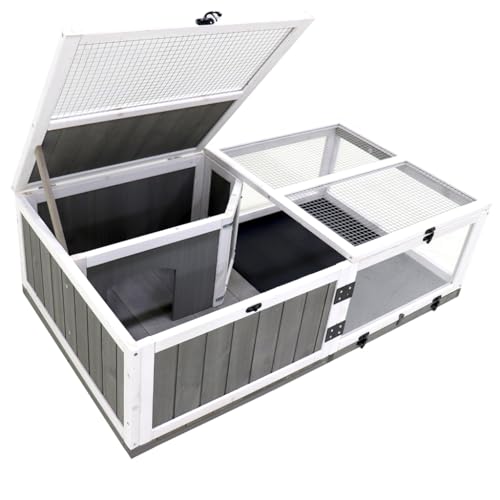
At 43 inches long, this fir house offers the longest single-level run in the group, arranged as two rooms under a dense wire top lid. One side is a public area that can receive ultraviolet light and heating, and the other is a weatherproof rest area fitted with waterproof trays. Three-sided viewing windows wrap the walls so you can watch the animal without lifting the lid, which suits keepers who check on a shy tortoise often. The listing names Russian tortoises among its suitable species and keeps the whole unit light enough to shift around a patio.
Specs
- Dimensions: 43 x 24 x 12.8 in
- Material: Fir wood
- Weight: 18.51 lb
- Layout: Two rooms, activity and sleeping areas of about 21.3 x 21.6 in each
- Tray: Removable waterproof tray
- Viewing: Three-sided large windows
- Seller named on the listing: Life-AMZOSS
Best for: Keepers who want the longest one-level floor and easy visual checks through the windows.
Watch out for: Check current availability on the listing before planning around it, and confirm the tray size matches the sleeping area when it arrives.
ASIN: B0CS6Q4J8N
Aivituvin Tortoise Habitat (L with Legs)

Aivituvin takes the house off the ground. The large grey version stands on removable legs, which lifts the floor away from wet soil and makes the habitat easier to work at on a patio or deck. Inside, a two-bedroom layout separates sleeping and activity space behind an acrylic viewing panel, and an adjustable lamp holder is included for keepers who add heat or ultraviolet lighting during shoulder seasons. The solid wood build and sealed, waterproof design target indoor and outdoor use, and the legs come off if you would rather set the house directly on a table or the ground.
Specs
- Dimensions: 80 x 57 x 100 cm (about 31.5 x 22.4 x 39.4 in, including legs)
- Material: Wood
- Model number: AIR70
- Layout: Two-bedroom design
- Viewing: Acrylic panel
- Legs: Removable, adjustable lamp holder included
- Color: Grey
Best for: Patio and deck keepers who want the floor raised off damp ground.
Watch out for: The published height includes the legs, so compare the house-only footprint against your tortoise’s turning room before choosing this over a longer ground-level model.
ASIN: B0C58NNQHD
Which One Fits Your Situation
You Keep a Young Tortoise That Will Grow
Start with the Zoo Med. Its single house covers a juvenile comfortably, and the removable end panel means a second unit can be attached when the animal outgrows the first, turning a starter purchase into a permanent habitat. The AMZOSS is the alternative if you would rather buy the longest fixed floor now and skip expansion hardware altogether.
Your Yard Gets Wet and Stays Damp
Raise the house or seal the floor. The Aivituvin on its legs keeps the base clear of standing moisture, while the AMZOSS answers the same problem with a removable waterproof tray under the sleeping area. The Ogrmar removable bottom helps here too, since a floor you can pull out dries faster than one you can only wipe in place.
Your Tortoise Is an Active Climber
The VEVOR is the only pick that treats climbing as a feature, with a ramp, a balcony, and a second level to patrol. Its 44-inch length is also the joint-largest footprint in the group, so active animals get both floor and height. Sedentary or older tortoises will use the ground floor only, which still works, but then a simpler house serves just as well.
You Worry About Raccoons and Neighborhood Dogs
Prioritize locking hardware and weight. The Zoo Med wire cover locks down, the Ogrmar top carries a lockable latch, and the VEVOR is the heaviest house here at 34.4 lb, making it the hardest to tip. Whichever you choose, site it inside a fenced area and bring small tortoises in at night where predator pressure is heavy.
Common Mistakes
- Sizing for the hatchling in front of you instead of the adult, then replacing the whole house within two years.
- Placing the house in full all-day sun with no shaded retreat, leaving the tortoise no way to cool down.
- Setting a wooden floor directly on wet grass, where it wicks moisture and rots from underneath.
- Trusting a loose-fitting wire lid in raccoon country instead of checking that the cover actually locks.
- Leaving a three-season wooden house outside through freezing weather and expecting it to work as a hibernation box.
Frequently Asked Questions
How much floor space does an adult tortoise need?
More than most starter houses suggest. A small adult Russian or Hermann’s tortoise should be able to walk several body lengths in a straight line, turn freely, and choose between a warm basking end and a cool hide. Treat the published dimensions of any house as a minimum check, and favor the longest footprint your yard allows.
Can these houses stay outside all year?
They are built for outdoor use through the warmer seasons, with weatherproof sleeping areas and rain-shedding construction. In regions with freezing winters, they are not insulated hibernation shelters, so plan to move the tortoise indoors or into a proper cold frame setup when temperatures drop hard, and bring the empty house under cover to extend its life.
Do tortoises actually use a second story?
Some do, and some ignore it completely. Confident, active animals often patrol a ramp and balcony, especially when food or a basking spot waits at the top. Older tortoises, heavy-bodied animals, and any tortoise with mobility problems usually stay on the ground floor, so never count upper-level area toward the minimum space a sedentary animal needs.
What should go on the floor of the house?
A diggable, moisture-holding substrate suits most yard tortoises better than bare wood or a tray alone. Where a house includes a removable tray or bottom, line it before adding substrate so cleanouts stay quick. Keep the area under the water dish drier than the rest, and replace soaked bedding in the sleeping corner promptly to stop mold taking hold.
More from Amazon
Programs that pair well with the guide above. Offers and eligibility are set by Amazon and may change.
Collect the home and kitchen items you want in one registry that guests can shop from.
Create a wedding registrySet up recurring deliveries of everyday items on eligible products. Terms and savings are set by Amazon.
Explore Subscribe & SaveFree shipping on eligible items, Prime Video and more. Eligible new members can start with a free trial.
Start a Prime free trialAudiobooks and podcasts to listen to on the go. Eligible new members can start with a free trial.
Try Audible freeAs an Amazon Associate we earn from qualifying purchases.







Write Your Review
No reviews yet. Be the first to share your experience!