

Key takeaways
- Compare the best loppers for thick branches, from geared bypass models for live wood to ratchet anvil picks for dead limbs, with honest sizing advice.
A hand pruner gives up somewhere around an inch of wood, and a pruning saw is slow work for the dozens of mid-size limbs a mature tree or overgrown shrub can produce in one session. Loppers fill that gap. Two long handles and a head built for leverage turn branches in the 1 to 2 inch range into a routine cut rather than a wrestling match, with both feet on the ground.
The catch is that loppers are not one tool. Bypass and anvil heads cut in opposite ways and suit different wood, and the geared, compound and ratchet mechanisms sold as power boosters each change how a cut feels. The five picks below cover the main designs, with head type, maker-rated capacity and handle setup spelled out for each.
As an Amazon Associate, we earn from qualifying purchases.
Quick answer
For most thick-branch pruning, pick a geared bypass lopper such as the Fiskars PowerGear2 for live wood up to 2 inches, and keep an anvil model for dead limbs. Gardeners with less grip strength should look at a ratchet anvil lopper, which trades several small squeezes for one hard cut.
How to choose
Head type comes first. A bypass lopper runs two curved blades past each other, much like scissors. The blade slices against a hooked counter blade, so the cut is clean and the bark around it stays intact. That makes bypass the right head for live wood, where a tidy cut seals faster and gives disease less damaged tissue to enter. An anvil lopper drives one straight blade onto a flat pad. The pad supports the branch and lets the blade punch through dry, dead wood that would tax a bypass head, but it crushes soft tissue on the pad side, so it is a poor choice for green growth you plan to keep.
Mechanisms multiply force in different ways. Plain loppers rely on handle length alone. Compound-action models add a linkage near the pivot, and geared models such as the PowerGear2 mesh teeth at the head, both raising the force at the blade for the same squeeze. A ratchet goes further: the blade advances in steps, so one thick cut becomes several short, easy squeezes. The trade-off is extra weight, extra moving parts and a slower cut.
Read capacity figures with suspicion. The inch rating on the box is a maker figure, normally measured on green wood in ideal conditions. Dry hardwood of the same diameter resists far harder, so treat the printed number as a ceiling rather than a working size. If most of your cutting sits close to 2 inches, choose a lopper rated above that or reach for a saw.
Match handle length to the job. Longer handles give leverage and reach but add weight and get clumsy inside a dense shrub; 24 to 32 inches covers most yard work. Telescoping handles extend for higher limbs and shorten for storage, with a small penalty in weight and stiffness. Hardened steel holds an edge longer, coatings shed sap, and replaceable blades and pads matter most on premium tools. Wipe sap off after a session and sharpen only the beveled side of a bypass blade; grinding the flat side opens a gap and ruins the scissor action.
Fiskars PowerGear2 Bypass Lopper, 32 Inch

This is the geared bypass pick for gardeners who cut a lot of live wood near the top of the size range. The head type is bypass, with a precision-ground steel blade that passes a hooked counter blade, and the PowerGear2 gear-and-cam mechanism at the pivot multiplies the force from the handles, which Fiskars rates at up to three times the power of a single-pivot lopper. The maker-rated capacity is 2 inches, and the fixed handles give a 32 inch overall length, enough to reach into a large shrub without leaning in.
The blade carries a low-friction coating that helps it through green wood and slows sap buildup, and replacement blades are sold for it, extending the tool’s life well past a worn edge. At just under 4 pounds it is not the lightest here, and the wide geared head can feel bulky in tight crotches. Treat the 2 inch rating honestly: on fresh green growth the gears make that cut realistic, but on dry hardwood of the same size you will lean on the handles hard, and the wiser move is to size up or switch to a saw. For routine live-wood pruning up to about 1.5 inches, though, this is the easiest cut in the group.
Felco 211-60 Bypass Lopper

The Felco is the precision option: a plain bypass head with no gears or links, built around blade geometry and build quality instead. Felco rates the capacity at 35 mm, a little under 1.4 inches, modest on paper next to the 2 inch claims elsewhere here. The handles are aluminum I-beam tubes 60 cm long, about 23.6 inches, and the tool weighs 885 grams, under 2 pounds, so it swings overhead and carries around an orchard or a long hedge line without tiring your shoulders.
The curved blade works with a hooked counter blade that pulls the branch in as the cut closes, and rubber shock absorbers soften the stop at the end of each cut. Every component, blade included, is replaceable, and blade tension adjusts with a micrometric system, which is why it costs what it does: it is built to be maintained for decades, not replaced. The limits are just as clear. There is no force multiplication, so your arms supply all the power, and the 35 mm ceiling is genuine. Pushing a bypass head through dead hardwood beyond its rating is how blades chip and the cutting gap opens up. Kept on live wood within its range, it leaves the cleanest cut here.
Corona DualLink Bypass Lopper SL 4364
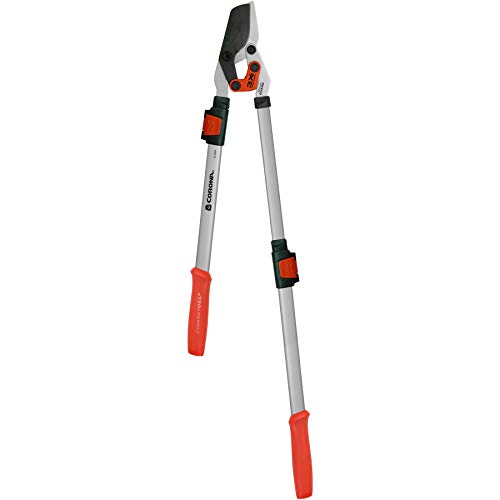
Corona’s DualLink design is a compound-action bypass lopper on telescoping handles, and it is the reach pick of the group. The DualLink linkage at the head compounds the force from each squeeze, which Corona says cuts the effort compared with a conventional lopper, and the maker-rated capacity is 1.75 inches. The handles extend out to 37.5 inches for limbs beyond a fixed tool’s reach, then slide back down for compact storage and normal-length work inside a shrub.
ComfortGEL grips and the ShockGUARD bumper system soften the jolt when a cut finishes, which matters during a long cleanup session. The blade is replaceable, a point in its favor at this level. The honest trade-offs come with the format: telescoping tubes add weight and a hint of flex a fixed handle does not have, the locking collars need an occasional check so a handle does not creep mid-cut, and a compound linkage has more pivots to keep clean and oiled than a plain head. If your pruning mixes ground-level work with limbs at the edge of reach and you want one lopper in the shed, this is the flexible answer.
Corona Compound Action Anvil Lopper FL 3420

The FL 3420 is the traditional dead-wood tool: a compound-action anvil head on 31 inch fiberglass handles. The single steel blade closes onto a replaceable anvil pad, and the compound linkage raises the force at the blade so dry, seasoned limbs up to the maker-rated 1.5 inches give way without the fight a plain anvil lopper puts up. Fiberglass handles keep it near 4 pounds and shrug off weather and truck-bed knocks better than wood.
Corona sells the anvil pad as a spare part, and the blade can be resharpened, so both wear items are serviceable. That matters because the pad is a consumable: once it grooves deeply, cut quality falls off and the blade edge suffers. A fresh pad is cheap maintenance that restores the tool. Keep this head off live wood you intend to keep, since the pad crushes the underside of every cut, and do not read the 1.5 inch rating as a promise on rock-hard dead oak, where the same cut takes far more force than on green growth. For storm cleanup and clearing dead limbs from hedges and fruit trees, it is a durable, simple answer.
Fiskars Ratchet Drive Anvil Lopper, 32 Inch

A ratchet head changes the deal for anyone whose hands give out before the pile of branches does. On this 32 inch anvil lopper, the blade does not need to finish the cut in one squeeze. You pump the handles in a series of short strokes and the ratchet holds the blade’s progress between them, so a dead limb at the maker-rated 2 inch capacity becomes a sequence of easy efforts instead of one maximal one. The blade presses onto a flat anvil, the right arrangement for dry, dead wood.
The handles are riveted steel with cushioned grips, the blade is hardened steel with a low-friction coating, and the tool carries the same lifetime warranty as the other Fiskars pick here. Two honest cautions apply. Ratcheting is slower than a single stroke, so on a big pile of mid-size limbs a geared bypass or compound anvil finishes sooner. And because the ratchet makes oversize cuts feel possible, it invites abuse: forcing it through wood well past 2 inches can damage the mechanism. Work within the rating and it is the most forgiving lopper here for smaller or tired hands, and a sensible second tool next to a bypass model.
Who should skip loppers
Skip loppers if the branches you cut most often run well past 2 inches, since that is saw work and forcing a lopper there damages blades and joints. Skip premium bypass models if everything you cut is dead wood; an anvil lopper costs less and suits the material better. If your pruning is one small shrub, a hand pruner covers it, and limbs high overhead call for a pole pruner rather than a lopper used at full stretch.
Frequently Asked Questions
Can I use an anvil lopper on live branches?
You can, but the pad crushes the tissue under the cut, which heals poorly and invites dieback. For a limb being removed entirely it hardly matters. For any cut that stays on a plant you are keeping, use a bypass lopper.
What is the largest branch a lopper can cut?
The picks here carry maker ratings from 35 mm up to 2 inches, measured on green wood. Dry hardwood cuts smaller than the rating suggests. If you have to throw your body weight into the handles, the branch is too big and a saw should take over.
How do I keep a lopper cutting cleanly?
Wipe sap off the blade after use, dry the head before storage, and sharpen only the beveled edge of a bypass blade, following the original angle. Oil the pivot now and then, and replace anvil pads once they groove.
Are telescoping handles worth it?
They earn their place when your work mixes low shrubs with limbs at the edge of reach, and they store in less space. The cost is extra weight, a little flex and collars that need checking. If nearly all your cutting happens at one height, a fixed handle is stiffer and simpler.
Final verdict
Match the head to the wood and the mechanism to your hands. The Fiskars PowerGear2 is the default pick for heavy live-wood pruning, the Felco 211-60 rewards anyone who values a light tool and a clean cut over raw capacity, and the Corona SL 4364 adds reach without a second tool. For dead wood, the Corona FL 3420 is the sturdy classic, while the Fiskars Ratchet Drive turns the thickest cuts into the least demanding ones.
Product and ASIN Reference
| Product | ASIN |
|---|---|
| Fiskars PowerGear2 Bypass Lopper, 32 Inch | B00QMWETPM |
| Felco 211-60 Bypass Lopper | B078771XHF |
| Corona DualLink Bypass Lopper SL 4364 | B00GZ4OJ4I |
| Corona Compound Action Anvil Lopper FL 3420 | B00004R9Y2 |
| Fiskars Ratchet Drive Anvil Lopper, 32 Inch | B0D88JR7B5 |
More from Amazon
Programs that pair well with the guide above. Offers and eligibility are set by Amazon and may change.
Collect the home and kitchen items you want in one registry that guests can shop from.
Create a wedding registrySet up recurring deliveries of everyday items on eligible products. Terms and savings are set by Amazon.
Explore Subscribe & SaveFree shipping on eligible items, Prime Video and more. Eligible new members can start with a free trial.
Start a Prime free trialAudiobooks and podcasts to listen to on the go. Eligible new members can start with a free trial.
Try Audible freeAs an Amazon Associate we earn from qualifying purchases.


Write Your Review
No reviews yet. Be the first to share your experience!