

Key takeaways
- Compare the best pruning saws for trees, shrubs and thick branches, with blade length, tooth count and format advice for cleaner, faster cuts.
A good pruning saw does the work loppers cannot. Once a branch gets past about two inches thick, bypass loppers strain, anvil loppers crush, and a chainsaw is more tool than the job needs and far less precise near a collar you want to keep. A hand pruning saw fills that gap: it cuts cleanly and works in tight crotches where a powered bar will not fit.
The five saws below cover the formats home orchardists and gardeners actually use, from a professional curved blade in a scabbard to compact folding saws that ride in a back pocket. Each pick lists its format, blade length and tooth count for the exact model.
As an Amazon Associate, we earn from qualifying purchases.
Quick answer
For most home pruning, pick a curved fixed-blade saw around 13 inches, such as the Silky Zubat 330 or the Samurai Ichiban GC-330, for fast cuts on branches up to about six inches. Choose a folding saw like the Silky GomBoy 240 or Bahco Laplander if you prune occasionally and want safe, compact carry. The Corona RazorTOOTH 14 inch is the straightforward big-branch option.
How to choose
Match the format to the work
Fixed straight blades are the simplest pattern: a rigid blade on a pistol or inline grip. They cut well in open space and track predictably, but they can wander on the far side of a thick limb. Curved blades are the arborist pattern. The curve keeps more teeth engaged through the stroke and pulls the blade into the cut, so they clear green branches noticeably faster and suit overhead work better. Folding saws trade some rigidity for safety and portability: the blade locks into the handle, so there is no exposed edge in a pocket or backpack, which makes them ideal for occasional pruning and trail work. Pole saws are a different tool altogether, built for reach rather than power; if most of your cuts are above head height, shop that category separately.
Blade length versus branch diameter
A useful rule is that the blade should be at least twice as long as the branch is thick, and it must exceed the branch width so the stroke can clear chips instead of binding halfway through. A 7 to 10 inch blade handles branches up to about four inches. A 13 to 14 inch blade is the sweet spot for limbs in the four to six inch range.
Teeth per inch and tooth style
Tooth count controls the trade between speed and finish. Coarse teeth, around 5 to 7 TPI, bite deep and clear soft, green wood quickly. Finer teeth, around 8 to 10 TPI, cut more slowly but leave a smoother face and handle dry, hard or dead wood with less chatter and tear-out. Japanese saws state tooth spacing in teeth per 30 mm; convert when you compare across brands.
Pull cut versus push cut
Most Japanese pruning saws cut on the pull stroke. Pulling keeps the thin blade in tension, so it resists buckling, needs less downward force, and leaves a cleaner kerf. Western-style saws traditionally cut on the push, or on both strokes like the Bahco below. With a pull-cut saw you draw the blade toward you and let the teeth work, easing off on the return; force it and the blade binds or hops out of the cut.
Replaceable blades
Hardened pruning teeth eventually dull, and on impulse-hardened blades there is no sharpening option. Check that the maker sells a replacement blade for the exact model before you buy; Silky, Samurai, Corona and Bahco all do. Sap buildup is the other quiet thief of cutting speed: resin coats the teeth and adds friction, so wipe the blade down after sappy work, following the maker’s cleaning guidance.
The 5 best pruning saws
Silky Zubat Professional 330

Format: fixed curved blade with scabbard | Blade: 13 inches (330 mm) | Teeth: about 6.4 TPI (7.5 teeth per 30 mm)
The Zubat 330 is the saw professional arborists most often carry, and it earns that place with a curved blade that cuts aggressively on the pull stroke. The 330 mm blade has large teeth that clear green wood quickly, and the curve keeps the cut tracking inside a crowded crown. The included polypropylene scabbard has rollers so the blade slides in and out without chewing the case, plus leg straps for climbers.
At 13 inches it is sized for branches roughly four to six inches thick. The blade is chrome-plated Japanese steel with impulse-hardened teeth, so it shrugs off sap and resists rust between uses, and replacement blades swap on with basic tools. It is more saw than a twice-a-year gardener needs, but for anyone who prunes fruit trees or storm damage regularly, it is the benchmark the others are measured against. Order the 270-33 model number to get this exact large-tooth version.
Samurai Ichiban GC-330-LH

Format: fixed curved blade with scabbard | Blade: 13 inches (330 mm) | Teeth: about 6.4 TPI (4 mm tooth pitch)
The Samurai Ichiban GC-330-LH delivers the same arborist pattern as the Zubat at a friendlier point in the range. Its 330 mm curved blade uses a 4 mm tooth pitch with impulse-hardened teeth, and it cuts on the pull stroke with the same self-feeding feel: set the teeth, draw back, and the curve does the positioning work for you. The hard scabbard with a belt loop keeps the edge covered while you move around the tree.
Samurai blades have a reputation for staying sharp through heavy green-wood work, and replacement blades for the GC-330 are widely stocked. It lacks some of the refinement of the Silky, such as the roller scabbard entry, but the cut itself is genuinely close. If you prune a home orchard or a few mature shade trees every season and want professional cutting speed without paying for the best-known name, this is the value pick in the fixed curved class.
Corona RazorTOOTH RS 7395
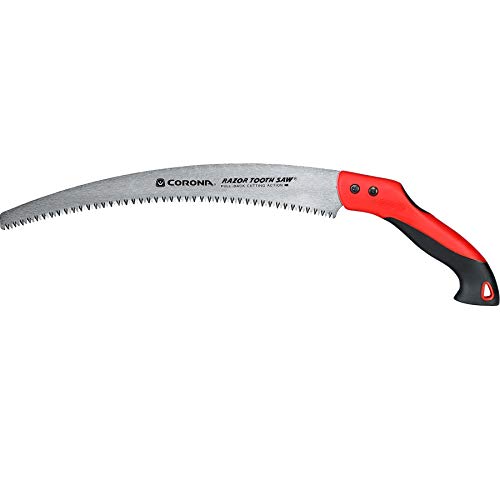
Format: fixed curved blade | Blade: 14 inches | Teeth: 6 TPI
Corona’s RazorTOOTH is the saw you will find in more American garden sheds than any other on this list. The 14 inch curved blade uses triple-ground, impulse-hardened teeth at 6 TPI, a coarse pattern tuned for fast cutting in green branches, and Corona rates the saw for limbs up to eight inches in diameter. The pistol grip is shaped for one-handed use, which helps when your other hand is steadying the branch.
It does not include a scabbard, so plan on a blade guard or careful storage, since those teeth are unforgiving in a crowded tool rack. Replacement RazorTOOTH blades are inexpensive and easy to find, and the coarse tooth geometry powers through softwood and fruit wood quickly. The finish it leaves is rougher than the Japanese saws manage, which is the honest trade for the speed. For big seasonal cleanups and storm-felled limbs, it is a dependable workhorse.
Silky GomBoy Professional 240

Format: folding straight blade | Blade: 9.5 inches (240 mm) | Teeth: 8.5 TPI (10 teeth per 30 mm), medium teeth
The GomBoy 240 is the folding saw to buy if you want Japanese cutting quality in a tool that disappears into a pocket or pack. The 240 mm blade is straight, taper-ground and chrome-plated, with medium teeth at 8.5 TPI that suit both green pruning cuts and drier wood around the yard or campsite. It locks open in two positions, the second, steeper angle helping with undercuts and flush cuts.
Because it folds, there is no scabbard to lose and no exposed edge in storage, which makes it the safest carry on this list. The rubber-clad handle is grippy even when wet, and a flip-lock case with a belt clip comes in the box. The finer teeth cut a touch slower in thick green limbs than the coarse fixed blades above, and 9.5 inches of blade caps you at branches around four to five inches. Within those limits, it is a beautifully made, versatile saw.
Bahco Laplander 396-LAP

Format: folding straight blade | Blade: 7.5 inches (190 mm) | Teeth: 7 TPI, XT hardpoint tooth pattern
The Laplander is the classic folding saw of the bushcraft and camping world. Its 7.5 inch blade uses Bahco’s XT toothing, which cuts on both the push and the pull stroke rather than the pull alone, so it feels familiar to anyone raised on Western saws. The blade has an anti-rust coating and locks open and closed with a positive safety catch.
At 7 TPI the teeth are a sensible middle ground: quick in green wood, civilized in dry wood. The short blade is the limit here; it is happiest on branches up to about three or four inches, and it will feel slow on the six inch limbs the 13 inch saws shrug off. In exchange you get a saw that weighs almost nothing and folds to nine inches, small enough to live in a jacket pocket during a day of shrub work. Bahco sells replacement blades for it, so it is a long-term keeper rather than a disposable.
Who should skip a pruning saw
Skip the hand saw if your cutting is mostly above head height; a pole saw or a professional crew is the right answer there, and never stand under a branch you are cutting, whatever the tool. Skip it, too, if you regularly buck logs well over eight inches, where a chainsaw earns its keep, or if your pruning is all thin growth under two inches, where bypass loppers are faster and cleaner. And if the branches hang anywhere near a power line, skip the DIY job entirely: that work belongs to a utility or a licensed arborist, full stop.
Frequently Asked Questions
How thick a branch can a pruning saw cut?
As a working guide, match the blade to roughly twice the branch diameter. A 7.5 inch folding saw handles branches up to about three or four inches, a 9.5 inch blade manages four to five inches, and a 13 to 14 inch curved saw works through six inches comfortably. Technique matters as much as size: undercut first, then finish from the top so the bark does not tear.
Should I choose a curved or straight blade?
Choose a curved blade for speed on live branches; the curve keeps teeth engaged and pulls the blade into the cut. Choose a straight blade for controlled cuts in open space, finer finish work, and most folding saws. Gardeners who prune a lot usually end up owning one of each.
Can pruning saw blades be sharpened?
Conventional teeth can be touched up with a slim taper file, but most modern pruning saws use impulse-hardened teeth, which are too hard to file and are designed to be replaced instead. When a hardened blade slows down, fit the maker’s replacement blade for your exact model.
How do I keep a pruning saw cutting well?
Wipe sap and resin off the blade after use, because buildup adds friction and makes the saw feel dull long before the teeth are worn. Store the blade covered or folded, keep it dry, and let the teeth do the work: forcing a pull-cut saw on the push stroke bends blades and breaks teeth.
Final verdict
For a single saw that will handle nearly everything a home orchard or mature garden tree can present, the Silky Zubat 330 is the standout: fast, durable and built around a replaceable professional blade. The Samurai Ichiban GC-330-LH gets you most of that performance for less, and the Corona RazorTOOTH RS 7395 is the rugged option for heavy cleanup. If safe carry matters more than outright speed, the Silky GomBoy 240 and the Bahco Laplander fold the same job into your pocket.
Product and ASIN Reference
| Product | ASIN |
|---|---|
| Silky Zubat Professional 330 (270-33) | B0014C4QMG |
| Samurai Ichiban GC-330-LH | B001BAFD6E |
| Corona RazorTOOTH RS 7395 | B000GIIQFC |
| Silky GomBoy Professional 240 (121-24) | B000CED1OG |
| Bahco Laplander 396-LAP | B002O6QJAS |
More from Amazon
Programs that pair well with the guide above. Offers and eligibility are set by Amazon and may change.
Collect the home and kitchen items you want in one registry that guests can shop from.
Create a wedding registrySet up recurring deliveries of everyday items on eligible products. Terms and savings are set by Amazon.
Explore Subscribe & SaveFree shipping on eligible items, Prime Video and more. Eligible new members can start with a free trial.
Start a Prime free trialAudiobooks and podcasts to listen to on the go. Eligible new members can start with a free trial.
Try Audible freeAs an Amazon Associate we earn from qualifying purchases.





Write Your Review
No reviews yet. Be the first to share your experience!