

Key takeaways
- Compare five honey extractors for backyard beekeepers, from a two-frame hand-crank drum to electric four-frame spinners, with capacities, motors and gates.
Buying an extractor is really a decision about harvest day, not about machinery. The choice is how many frames you will spin each season, whether your arms or a motor supply the effort, and how much of the day goes to uncapping, flipping and draining rather than spinning. A drum that is too small turns a pleasant afternoon into a two-day chore, while an oversized electric unit spends eleven months of the year taking up floor space in the garage.
This guide is for backyard beekeepers running anywhere from one hive to a growing row of five or six, including first-year keepers planning their first harvest and manual-crank owners ready to motorize. The five extractors below were chosen from the frame counts, drive types, materials and dimensions stated in the product names and specifications on their Amazon pages, so the comparison rests on what each listing actually promises.
Quick Picks
As an Amazon Associate we earn from qualifying purchases.
| Product | Best for | Key spec from title |
|---|---|---|
| VIVO Electric Honey Extractor BEE-V004E | Three to five hives when you are done hand-cranking | 8 Frame Rack (4 Deep Frames) |
| VEVOR Electric Honey Extractor, 4/8 Frame | Growing apiaries that want speed and height adjustment | 4/8 Frame |
| VIVO Honey Extractor BEE-V004B | The big drum without a motor, for patient spinners | 8 Frame Rack (4 Deep Frames) |
| VINGLI Upgraded Electric 4 Frame Honey Extractor | Four-frame electric spinning with a stainless honey gate | Electric 4 Frame |
| VIVO Honey Extractor BEE-V002 | One or two hives and a first harvest | 2 Frame Rack |
How to Choose
Hand crank or electric motor
A manual extractor costs less, has almost nothing to break, and gives you direct feel for how hard the comb is being spun, which protects fresh foundation from blowouts. The effort is real, though: a full super run through a two-frame crank is an hour of steady turning. Electric models trade that labor for a motor, a speed dial and a power cord, and they let you uncap the next frames while the current load spins. As a rough guide, one or two hives stay pleasant by hand, while three or more hives push most keepers toward a motor.
Frame capacity and your hive count
Capacity is quoted two ways, and the listings reward careful reading. A drum rated for eight frames usually means eight shallow or medium frames, or four deep frames, because the basket is sized by volume rather than count. Work backward from your harvest: a productive hive gives up one or two supers of eight to ten frames each, so a two-hive keeper faces roughly twenty frames a season, while five hives can mean sixty or more. Small drums simply repeat the load cycle more times, so match the basket to the biggest harvest you expect in the next few seasons.
Tangential or radial basket layout
In a tangential extractor the frames sit flat against the drum wall, so centrifugal force empties only the outward-facing side of each comb. You spin, stop, flip every frame, and spin again. Radial baskets hold frames like spokes, with the top bar pointing outward, and clear both sides in one run. Most small manual drums are tangential, and at two frames per load the flipping is a minor pause. In larger drums the layout matters more, because flipping eight frames per load doubles the handling on the busiest day of your beekeeping year.
Drum steel, honey gate and drainage
Every extractor here is stainless steel, which is what you want for a food-contact drum that gets hosed out after each use: it resists rust, does not hold odors, and survives sticky residue being scrubbed off. The details that separate good drums from annoying ones are at the bottom. A conical drum floor drains toward the gate instead of pooling honey in a flat corner, and the gate itself should sit low and be wide enough to run a steady stream into a bucket or bottling tank without constant tilting and scraping.
The 5 Best Options
VIVO Electric Honey Extractor BEE-V004E

VIVO’s electric drum is the extractor most backyard keepers end up describing when they say they have stopped dreading harvest day. The motor spins four deep frames or eight mediums at once, the clear lid lets you watch the honey sheet off the comb, and a safety switch cuts the motor when a lid is lifted, so checking progress mid-run is not a hazard. It suits the three-to-five-hive keeper whose supers stack up faster than a hand crank can clear them, and who would rather spend harvest afternoon uncapping than turning a handle.
Specs
- Capacity: 8 small or medium frames, or 4 large (deep) frames
- Drive: electric, 120V AC motor with built-in cooling fan
- Material: 201 stainless steel
- Drum diameter: 18.5 in
- Total height: 43.25 in
- Lid: transparent, with a safety switch that stops the motor when opened
- Item model number: BEE-V004E
Best for: keepers with three to five hives who want the motor to do the spinning.
Watch out for: the listing describes a tangential basket, so deep frames still need flipping halfway through each load.
ASIN: B00SNEZVVI
VEVOR Electric Honey Extractor, 4/8 Frame

VEVOR’s 4/8 electric is built around adjustment. The 140W motor has a speed dial that runs up to 1300 rpm, so a load can start gently on fragile new comb and finish fast, and the three legs telescope through a working-height range that lets a tall bottling bucket slide under the gate. The transparent lid carries a safety interlock that stops the drum if it is opened mid-spin. This is the pick for a growing apiary that expects to add hives, because the same drum that handles a small harvest this year still has headroom when the supers double.
Specs
- Capacity: 4 deep frames, or 8 small or medium frames
- Motor: 140W, 110-120V/60Hz, adjustable speed up to 1300 rpm
- Material: food-grade stainless steel
- Dimensions: 18.5 x 18.5 x 33.7 in
- Item weight: 44.1 lb
- Legs: height adjustable from 39.3 to 42.5 in
- Honey gate: 1.8 in (45 mm)
- Lid: transparent, with safety interlock
Best for: beekeepers adding hives who want speed control and a gate height that fits their bucket.
Watch out for: at 44.1 lb before any honey goes in, plan a permanent spot or a dolly rather than carrying it far.
ASIN: B0BZD3MPKW
VIVO Honey Extractor BEE-V004B

The BEE-V004B is the manual twin of VIVO’s electric drum: the same wide stainless tank, the same four-deep or eight-medium basket, but driven by a hand crank through metal gears. That makes it the choice for keepers who want big-drum capacity without a motor to store, wire or eventually repair, and for bee yards where the extractor works far from an outlet. Cranking a drum this size is a two-person rhythm at full load, one turning and one uncapping, but the polished drum and clear lids keep the process clean and easy to monitor.
Specs
- Capacity: 8 small or medium frames, or 4 large (deep) frames
- Drive: manual crank with metal gears
- Material: 201 stainless steel, polished finish
- Drum diameter: 18.5 in
- Item weight: 34 lb
- Included components: clear lid and honey gate, per the listing
- Item model number: BEE-V004B
Best for: keepers who want four-deep capacity and no motor, and have a helper on harvest day.
Watch out for: the crank effort scales with load size, so a full eight-medium run is a workout, not a warm-up.
ASIN: B0163AVOVY
VINGLI Upgraded Electric 4 Frame Honey Extractor

VINGLI’s electric four-frame takes a slightly different route on the details. Its honey gate is stainless steel rather than plastic, a small upgrade that matters when a gate gets knocked by a bucket rim season after season, and the stand adjusts in height so the gate can clear the container you actually own. The 110V motor turns the work into a load, close, and switch-on routine. It fits the keeper with two to four hives who wants electric convenience in a mid-size drum and cares about the fittings lasting as long as the tank.
Specs
- Capacity: 4 frames, electric 4-frame variant
- Motor: 110V AC
- Honey gate: food-grade stainless steel
- Stand: adjustable height legs
- Material: stainless steel
- Item weight: 40.1 lb
- Manufacturer: VINGLI
Best for: two-to-four-hive keepers who want a motor and a metal gate at a mid-size footprint.
Watch out for: the same listing family also sells manual and two-frame variants, so confirm the electric 4-frame option is selected before ordering.
ASIN: B07VGW2B6Y
VIVO Honey Extractor BEE-V002
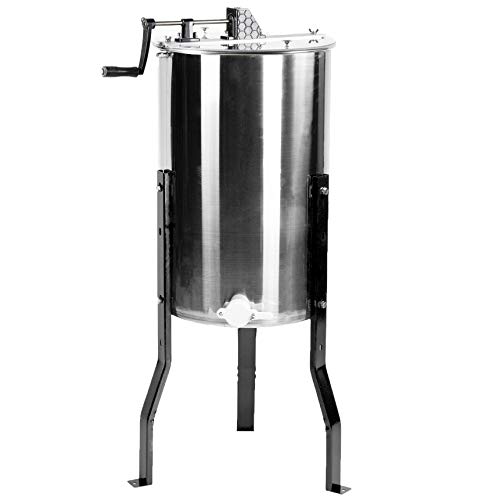
The BEE-V002 is the honest first extractor. Two frames at a time is all it holds, and for one or two hives that is genuinely enough: a season’s supers become a series of short spins rather than one long session. The drum bottom is conical, so honey runs to the two-inch outlet instead of stranding in the corners, a raised bottom bearing keeps the mechanism up out of the pooled honey, and two clear lids plus side handles make the small drum easy to carry to wherever the harvest happens.
Specs
- Capacity: 2 frames, deep, medium or shallow
- Drive: manual crank
- Material: 201 stainless steel
- Drum bottom: conical, draining to a 2-inch outlet with stopper and honey gate
- Lids: 2 clear lids, with side handles for carrying
- Item weight: 20 lb
- Item model number: BEE-V002
Best for: a first harvest from one or two hives, or a spare drum for small batches.
Watch out for: two frames per load means a three-hive harvest becomes an all-day rotation of spinning and flipping.
ASIN: B00A4KHBSK
Which One Fits Your Situation
Your first harvest is coming from one or two hives
Start with the VIVO BEE-V002. Twenty frames a season is a relaxed afternoon in a two-frame drum, and the money you do not spend on capacity can go to supers, jars and a good uncapping knife. If you already know a third hive is coming in spring, skip straight to one of the four-frame drums instead of buying twice.
You run three to five hives and harvest day keeps getting longer
This is electric territory. The VIVO BEE-V004E and the VEVOR 4/8 both clear four deep frames per load under power, and the VINGLI electric four-frame covers the same ground with its stainless gate. Any of the three turns the bottleneck back into uncapping, which is where harvest time should be spent.
There is no outlet where you extract
Choose between the two manual drums by load size, not by features. The VIVO BEE-V002 covers a hive or two with the least storage space, while the BEE-V004B gives you the four-deep basket for bigger days and a helper’s worth of cranking. Both drain, clean and store exactly like their electric counterparts.
You expect the apiary to keep growing
Buy the drum for the apiary you will have in three seasons, not this one. The VEVOR 4/8’s adjustable legs and speed dial adapt as your containers and frame counts change, and the VIVO electric’s eight-medium capacity absorbs extra supers without a second machine. Extractors are bought rarely, so headroom beats a small saving now.
Common Mistakes
- Sizing the extractor to this year’s hive count, then outgrowing a two-frame drum the season a third and fourth hive arrive.
- Spinning frames that were only uncapped on one side, which leaves half the honey in the comb on a tangential machine.
- Forgetting to check gate clearance, then finding the extractor’s legs are too short for the bucket or bottling tank you own.
- Cranking or motoring straight to full speed on brand-new comb, which can blow the foundation out of the frame.
- Putting the drum away damp or unwashed, so old honey ferments and the next harvest picks up off flavors.
Frequently Asked Questions
Does an extractor damage the honeycomb?
No, and that is the point of the machine. Spinning throws the honey out of the cells while leaving the drawn comb intact, so the frames go straight back onto the hive and the bees refill them instead of spending weeks and honey rebuilding wax. Damage only happens when fresh, soft comb is spun too fast too early, which is why loads should start slowly.
How big an extractor do two hives need?
A two-frame manual drum is enough. Two hives usually produce somewhere around sixteen to twenty medium frames in a decent season, and a small tangential extractor clears that in an afternoon of short loads. The trade-off is flipping: every frame gets spun twice, once per side. Keepers who dislike that rhythm should look at the four-frame drums instead.
Can I harvest honey without an extractor?
Yes, with the crush-and-strain method: cut the comb from the frame, crush it, and let the honey drain through a strainer. It works for a frame or two and for comb honey, but it destroys the drawn comb, and the bees must rebuild it from scratch. For anything beyond a taste of the first harvest, an extractor pays for itself in comb the colony does not have to replace.
How do I clean an extractor after harvest day?
Most keepers set the drum where bees can clean up the residue from a distance from the hives, then wash it with warm water and dry it completely before storage. Stainless steel drums need no soap beyond a mild wash for stubborn wax, and harsh detergents should stay away from food-contact surfaces. Drying matters most: a drum stored wet is the one that smells stale next season.
More from Amazon
Programs that pair well with the guide above. Offers and eligibility are set by Amazon and may change.
Collect the home and kitchen items you want in one registry that guests can shop from.
Create a wedding registrySet up recurring deliveries of everyday items on eligible products. Terms and savings are set by Amazon.
Explore Subscribe & SaveFree shipping on eligible items, Prime Video and more. Eligible new members can start with a free trial.
Start a Prime free trialAudiobooks and podcasts to listen to on the go. Eligible new members can start with a free trial.
Try Audible freeAs an Amazon Associate we earn from qualifying purchases.


Write Your Review
No reviews yet. Be the first to share your experience!