

Key takeaways
- Pin and pinless firewood moisture meters compared: ranges, species scales and scan depths from General Tools, TopTes, Tavool, Klein Tools and Dr.meter.
Buying a firewood moisture meter is really a decision about trust: whether you can believe a split is dry through its middle, not just on the sun-baked surface. Burn wood that is still wet inside and you lose heat to steam, smoke up the room, and coat the flue with creosote. The meter you choose decides how honestly that number gets taken, because a pin pushed into a fresh split face and a pinless pad pressed against bark are measuring two different things.
This guide serves three kinds of buyers: stove and fireplace owners checking a delivered cord before they pay for it, people seasoning their own woodpile through the year, and anyone who also wants one tool for quick damp checks around the house. The five meters below were chosen from the names and specifications on their Amazon product pages, and they split into pin models that read a point inside the wood and pinless models that scan without leaving holes.
Quick Picks
As an Amazon Associate we earn from qualifying purchases.
| Product | Best for | Key spec from title |
|---|---|---|
| General Tools MMD4E | A first meter for routine stove-wood checks | Pin type with backlit LCD and audible alerts |
| TopTes TS-630 | Reading splits at a glance in a dim woodshed | 2.25-inch LCD display with tricolor backlight |
| Tavool MT270 | Mixed piles of hardwood and softwood | Pin type with backlit LED screen and two modes |
| Klein Tools ET140 | Scanning firewood and walls without pin holes | Pinless, detects up to 3/4 inch below surface |
| Dr.meter MD918 | Buyers who sort many species by density | Pinless, range 4 to 80 percent, 10 density grades |
How to Choose
Pin or pinless decides what the number means
A pin meter drives two probes into the wood and reads resistance between them, so the number describes the exact spot the pins reached. That is the honest way to test firewood, because you split a log, push the pins into the fresh face, and read the damp core directly. A pinless meter presses a flat sensor against the surface and scans a shallow field beneath it, which is fast and leaves no holes, but the reading is an average over that field and bark, roughness, or an air gap can skew it. Choose pins for verdicts, pinless for quick sorting.
Match the range and scales to your woodpile
Firewood is ready to burn at roughly 20 percent moisture or below, and freshly cut wood can start above 50 percent, so a useful meter must cover both ends of that journey. The General Tools MMD4E reads wood from 5 to 50 percent, the Tavool MT270 stretches from 6 to 60 percent, and the pinless Dr.meter MD918 spans 4 to 80 percent. Species matter too: dense oak and light pine conduct differently, so meters with calibration scales or density grades, like the seven scales on the TopTes TS-630 or the ten density grades on the MD918, correct for the wood in front of you instead of guessing.
Read the display where you actually work
Most firewood testing happens in a cold shed, a garage, or beside an outdoor stack at dusk, not under bright kitchen lights. A backlit screen is therefore a practical feature rather than a luxury. The TopTes TS-630 goes further with a tricolor backlight that shifts color as the wood moves from dry to moist to wet, so a stack can be sorted by glancing rather than reading digits. The Klein ET140 uses a reverse-contrast display with a nine-bar LED indicator, which stays legible in strong daylight. Also look for a hold function, which freezes a reading while you pull the pins out of an awkward split.
Check pin length, scan depth, and power before buying
Specs that look minor on the page decide whether the meter works on your logs. Pin meters are only as deep as their probes: the MMD4E uses 8 millimeter stainless pins, fine for split faces but too short to reach the center of an unsplit round. Pinless models trade that for a fixed scan depth, 3/4 inch on the Klein ET140, so very thick bark eats into the useful range. Power is the last check. Most of these meters run on a 9 volt battery, while the MD918 uses three AAA cells; a spare in the shed drawer saves a testing session, and auto shutoff protects whichever battery you choose.
The 5 Best Options
General Tools MMD4E
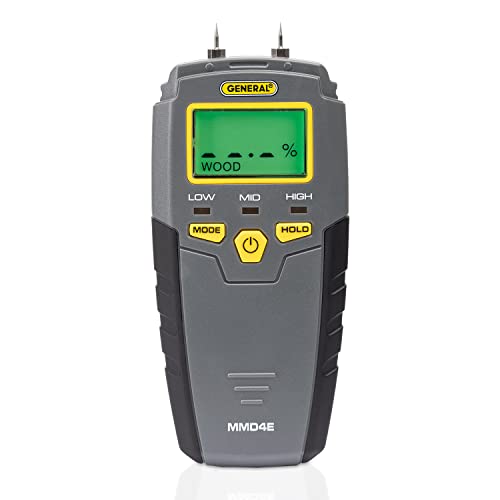
The MMD4E is the straightforward pin meter for a household that burns wood all winter and wants a clear answer at the woodpile. Two stainless pins go into a freshly split face, and the backlit screen reports the core moisture while audible and visual alerts sort the result into low, medium, and high bands. It suits stove owners who test a sample from every delivery and every stack, because the routine takes seconds per split. The included cap doubles as a calibration checker, and spare pins are in the box, so a bent probe does not end the meter’s working life.
Specs
- Measurement type: Pin type, two stainless steel pins, 8 millimeter
- Wood measurement range: 5 to 50 percent
- Building material range: 1.5 to 33 percent
- Display: Backlit LCD with high, medium, and low moisture alerts
- Extra features: Reading hold button, audible and visual alerts
- Power: 9 volt battery, included
- Included in the box: Extra pins and a protective cap that doubles as a calibration checker
- Item weight: 5.6 ounces
Best for: Stove and fireplace owners who want one dependable pin meter for delivery checks and routine stack testing.
Watch out for: The pins read only where they reach, so always split a piece and test the fresh face rather than the bark or the log end.
ASIN: B00275F5O2
TopTes TS-630

The TS-630 is built around speed of interpretation. Its wide 2.25-inch screen changes backlight color with the dampness band, so a buyer working through a whole cord can sort splits into burn-now and leave-to-season piles without studying digits on every piece. Two measurement modes and seven calibration scales let the reading adjust for different wood types, which matters when a delivery mixes dense and light species in the same load. This is the meter for someone who tests in bulk, in a dim shed or at the tailgate, and wants the verdict to be obvious from a step away.
Specs
- Measurement type: Pin type, DC resistance
- Display: 2.25-inch LCD with tricolor backlight showing dry, moist, and wet bands
- Calibration: 2 modes with 7 calibration scales
- Materials named on the listing: Firewood and drywall
- Model number: TS-630OR0017
- Measurement range: not stated
Best for: Buyers sorting a full cord quickly who want a color-coded verdict instead of reading a number on every split.
Watch out for: Confirm which calibration scale matches your species before a session, because the wrong scale quietly shifts every reading in the pile.
ASIN: B0BF9759C8
Tavool MT270

Mixed woodpiles are where single-scale meters start to lie, and the MT270 answers with eight calibration scales covering groups from teak and oak through pine and birch. Its wood range runs from 6 to 60 percent, wide enough to follow a stack from the day it is cut to the day it burns, and a second mode covers building materials for damp checks indoors. The screen also shows temperature, and the memory with maximum and minimum recall helps track a stack across a season. It fits the burner who cuts or buys several species and wants the meter set correctly for each one.
Specs
- Measurement type: Pin type, two stainless steel pins
- Wood measurement range: 6 to 60 percent
- Building material range: 0.2 to 2.9 percent
- Calibration: 8 wood calibration scales, plus a building material mode
- Display: Backlit LED with hold, memory, maximum and minimum recall, and temperature in Celsius or Fahrenheit
- Power: 9 volt battery, included
- Item weight: 7 ounces
- Dimensions: 3.54 x 5.91 x 1.18 inches
Best for: Households burning mixed species who want a species scale matched to each type of wood in the pile.
Watch out for: The species table in the manual uses botanical names for some woods, so look up your species and note its scale letter before the first session.
ASIN: B07VHJTHBP
Klein Tools ET140

The ET140 takes the opposite approach to pins: it never breaks the surface. Its electromagnetic sensor reads relative moisture up to 3/4 inch below the face of the wood, with modes for drywall, masonry, hardwood, and softwood, and it shows the result on a reverse-contrast display backed by a nine-bar LED indicator. For firewood, that makes it a fast screening tool across a whole stack, and the same meter then walks indoors to trace a damp patch on a wall. It suits the homeowner who wants one moisture tool for the woodpile and the house, and who would rather scan ten splits quickly than puncture each one.
Specs
- Measurement type: Pinless, electromagnetic field sensing
- Detection depth: Up to 3/4 inch (19 millimeter) below the surface
- Material modes: Drywall, masonry, hardwood, and softwood
- Display: Reverse-contrast display with a nine LED bar indicator
- Power: 9 volt battery, included
- Item weight: 7 ounces
- Item model number: ET140
Best for: Homeowners who want one pinless meter for quick firewood screening plus leak and damp checks on walls and floors.
Watch out for: Pinless readings are relative and average the scanned field, so confirm a borderline split with a second spot before deciding the whole stack is ready.
ASIN: B07SZX8QXH
Dr.meter MD918
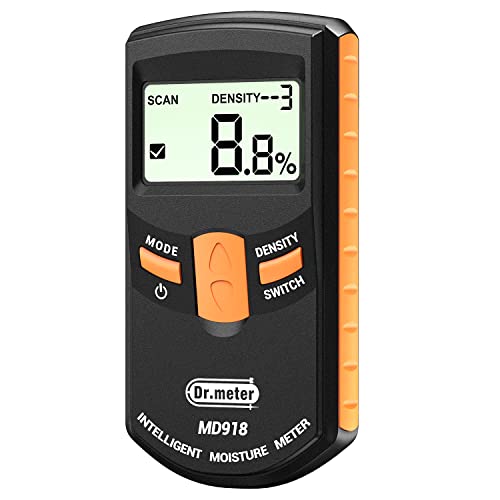
The MD918 is a pinless meter aimed squarely at wood rather than walls. It scans with a high-frequency electromagnetic field and reports across a 4 to 80 percent range, the widest span in this lineup, with ten selectable timber density grades so the reading can be tuned to the species being checked. Because nothing pierces the surface, it moves quickly along a stack and leaves finished lumber unmarked, which woodworkers checking boards as well as firewood will appreciate. A carrying pouch is included. It fits buyers who sort large volumes of wood, or who split their time between the woodpile and the workshop bench.
Specs
- Measurement type: Pinless, inductive high-frequency electromagnetic sensing
- Measurement range: 4 to 80 percent
- Stated accuracy: 0.5 percent
- Density settings: 10 timber density grades
- Materials named on the listing: Wood
- Power: 3 AAA batteries
- Included in the box: Carrying pouch
Best for: High-volume sorters and woodworkers who want density-matched pinless readings across many species without leaving pin holes.
Watch out for: It is a wood-only instrument with no drywall or masonry mode, so it will not double as a household leak detector.
ASIN: B017D6U2DS
Which One Fits Your Situation
A delivered cord you did not season yourself
Trust needs evidence here, and a pin meter gives it. Split three or four pieces from different parts of the load and test the fresh faces with the General Tools MMD4E or the TopTes TS-630. If the cores read at or under the burn-ready band, accept the load; if they run wet, you have numbers for the conversation with the seller rather than a guess based on how the bark felt.
A mixed pile of oak, maple, and pine
Species correction matters most in this stack, because one scale cannot read dense hardwood and light softwood equally well. The Tavool MT270, with eight calibration scales, or the Dr.meter MD918, with ten density grades, lets you set the meter for the split in your hand. Pick the Tavool if you prefer a direct pin reading, and the MD918 if you are scanning many pieces and want to leave the surfaces unmarked.
Checking the pile and the house with one tool
Some buyers want the meter to earn its drawer space all year. The Klein Tools ET140 scans firewood without holes, then switches to its drywall and masonry modes when a wall stain or a musty corner needs investigating. The Tavool MT270 also covers building materials in its second mode, though its pins will mark a finished wall, so the Klein is the calmer choice anywhere the surface has to stay clean.
Sorting a big stack fast before winter
Volume changes the priority from precision on one split to a quick verdict on fifty. The TopTes TS-630 earns its place with the tricolor backlight that flags wet pieces by color, while the Dr.meter MD918 sweeps along split faces without stopping to push pins in and pull them out. Either turns an afternoon of guessing into a sorted pair of piles, one ready to burn and one left to season.
Common Mistakes
- Testing through the bark or on the end grain, which reads the driest part of the log instead of the core that actually burns.
- Judging a whole cord by one split, when moisture varies widely between the top of the stack, the middle, and pieces that sat on the ground.
- Leaving the meter on the wrong species scale or density grade, so every reading in the session is shifted without any warning on screen.
- Pressing a pinless meter against rough, uneven bark and treating the averaged number as exact, instead of moving to a flat split face.
- Storing the meter all summer with a dying battery, then trusting the first low readings of autumn before checking the battery indicator.
Frequently Asked Questions
How dry should firewood be before it burns well?
The widely used target is 20 percent moisture or below, measured on a freshly split face. Wood in that range lights readily, gives its heat to the room instead of boiling off water, and produces far less smoke and creosote. Splits reading in the low twenties will still burn, but anything much above that belongs back on the seasoning stack.
Where on the log should the reading be taken?
Split the piece first, then test the center of the freshly exposed face, pushing pin probes in along the grain or pressing a pinless sensor flat against that same face. The outside of a log dries months ahead of the core, and end grain dries fastest of all, so readings from bark, rind, or log ends flatter the wood and mislead the decision.
Do pinless meters work on firewood, or only on lumber?
They work on firewood, with a caveat about what the number means. A pinless meter averages moisture across the field it scans, so a flat split face gives a fair screening result, while thick or loose bark distorts it. Use pinless models like the Klein ET140 or Dr.meter MD918 to sort quickly, then confirm borderline splits with a pin reading before burning.
Why do two meters disagree on the same split?
Usually they are measuring different things. A pin meter reports the wood between its probe tips, while a pinless meter averages a shallow volume under its pad, and the two spots rarely hold identical moisture. Species settings widen the gap further: a meter left on a softwood scale will read a dense oak split differently from one set correctly, even at the same spot.
More from Amazon
Programs that pair well with the guide above. Offers and eligibility are set by Amazon and may change.
Collect the home and kitchen items you want in one registry that guests can shop from.
Create a wedding registrySet up recurring deliveries of everyday items on eligible products. Terms and savings are set by Amazon.
Explore Subscribe & SaveFree shipping on eligible items, Prime Video and more. Eligible new members can start with a free trial.
Start a Prime free trialAudiobooks and podcasts to listen to on the go. Eligible new members can start with a free trial.
Try Audible freeAs an Amazon Associate we earn from qualifying purchases.


Write Your Review
No reviews yet. Be the first to share your experience!