

Key takeaways
- Compare the best nature explorer kits for kids, from a magnified bug habitat to backpack sets with binoculars, nets, compasses and catching tools.
Nature explorer kits split into two camps, and picking the wrong one is the main way this purchase disappoints. Catch-and-observe sets are built around a habitat: the child nets an insect, moves it into a ventilated box and studies it through a magnified viewer. Roam-and-explore sets skip the cage and load a backpack with binoculars, a compass, a flashlight and a magnifying glass for walks and pretend expeditions. Piece counts blur the line further, since some brands pad the number with stickers and plastic toy bugs.
This roundup serves both camps: parents kitting out a preschooler’s first bug hunts, gift buyers after a complete boxed set, and families whose kids range from catchers to watchers. Every product below was chosen from the contents, magnifications and dimensions stated on its Amazon page, so the kit that arrives should match the kit described here.
Quick Picks
As an Amazon Associate we earn from qualifying purchases.
| Product | Best for | Key spec from title |
|---|---|---|
| National Geographic Bug Catcher Kit for Kids | Studying each catch up close | Habitat with magnified viewer |
| ESSENSON Outdoor Explorer Kit & Bug Catcher Kit | A complete gift-ready bundle | Critter case and butterfly net |
| TOY Life Bug Catcher for Kids | First bug hunts at age 3 and up | Bug net, binoculars and magnifying glass |
| Adventure Kidz Outdoor Exploration Kit | Nature walks and pretend treks | Binoculars, compass and backpack |
| Kaqinu 24 Pcs Kids Explorer Kit & Bug Catcher Kit | Siblings sharing one large kit | 24 pieces with butterfly net |
How to Choose
Decide Whether Your Child Catches or Watches
The sharpest divide in this category is what the child does in the first five minutes outside. Catchers need a net, a pair of tweezers or a scissor-style grabber, and somewhere safe to put the insect once caught. Watchers are happier scanning the hedge with binoculars and checking a compass. Some kits do both jobs passably, but most lean one way: habitat sets often include only a small hand net, while backpack sets frequently leave out the cage entirely. Match the kit to the activity your child already gravitates toward in the yard.
Look Closely at the Habitat and Viewer
A habitat earns its keep after the catch, not during it. Lids that latch shut matter when a grasshopper starts jumping, and a removable base makes cleaning out leaf litter far less of a chore. Magnified viewers built into the lid beat a separate loose magnifier for younger kids, because the insect stays put while they look. Check whether the viewing window is fixed or moves: a telescoping or sliding viewer follows a crawling beetle across the floor of the box instead of forcing the child to keep repositioning the whole habitat.
Read the Optics Specs Instead of the Box Art
Binocular and magnifier numbers vary wildly between listings, and some brands never state them at all. A listing that prints a magnification and an objective size, such as 5×30, is telling you something checkable; one that just says “high definition” is not. Glass lenses appear in a few kits and are worth having for bird watching, while basic plastic toy binoculars still work for spotting squirrels at fence distance. Magnifying glasses in these sets typically run 3x to 4x, sometimes with a small 10x inset lens for leaf veins and wing patterns.
Count Real Tools, Then Check the Carry Bag
Headline piece counts reward skepticism. A 24-piece kit might include three magnifying collectors and a whistle with its lanyard counted separately, while a 10-piece set could hold more actual field tools. Read the included-components list and tally the items your child will genuinely use: net, container, tweezers, magnifier, binoculars. Then look at how it all travels. A structured backpack keeps binoculars from being crushed under a habitat, while a drawstring bag is lighter for small kids but lets loose pieces tangle together at the bottom.
The 5 Best Options
National Geographic Bug Catcher Kit for Kids

This is the observation specialist of the group. The clear habitat is the centerpiece: its latching lid carries two magnified viewers, one fixed and one that telescopes and slides, so a child can track a moving insect without opening the box. The scissor-style catcher keeps fingers away from legs and wings during the transfer, and the included net and tweezers round out the catching side. A Learning Guide gives the set some structure beyond free play. It suits the kid who brings every find back to the patio table for a long, careful look.
Specs
- Included components: clear bug habitat, removable base, latching lid with two magnified viewers, scissor-style bug catcher, net, tweezers, instructions and Learning Guide
- Magnified viewers: one stationary and one telescoping, both built into the lid
- Item dimensions: 9.02 x 5.08 x 5.43 inches
- Recommended age: 4 years and up
- Material: not stated
- Carry bag or backpack: not stated
Best for: young naturalists who study each specimen at length before releasing it.
Watch out for: the kit is habitat-led, so the net is a simple hand net rather than a long telescopic one for chasing butterflies across the yard.
ASIN: B0C4G5G44R
ESSENSON Outdoor Explorer Kit & Bug Catcher Kit

ESSENSON bundles the catching tools and the explorer gear into one gift box, then adds the extras most kits skip: a hat and an insect book. The critter case has a built-in magnifier for quick checks, the butterfly net handles flying insects, and the 5x binoculars with a 30mm objective lens are a step up from the unbranded pairs in many sets. Tweezers, bug containers and toy bugs give younger kids a way to practice handling before they meet the real thing. It is the easiest single purchase for a birthday or holiday gift.
Specs
- Package contents per the Amazon page: binoculars, compass, butterfly net, magnifying glass, critter case, whistle, tweezers, bug containers, bug toys, hat, insect book and backpack
- Binoculars: 5x magnification, 30mm objective lens, rubber eyepieces, neck string and carrying case
- Magnifying glass: 4x magnification
- Product dimensions: 10 x 7.8 x 6.5 inches
- Item weight: 11.4 ounces
- Model number: EK-110
- Age range in the listing title: 3 to 12 years
Best for: gift buyers who want catching gear, explorer gear and a backpack in one box.
Watch out for: the set has many small loose pieces, so check the hat size and confirm the backpack pockets close before the first outing.
ASIN: B07QLM375B
TOY Life Bug Catcher for Kids

TOY Life’s 12-piece set is built around gentle handling for the youngest explorers. Alongside the net and magnifying glass it includes both a bug jar and a collection box, so a child can move a find from a quick look to a slightly longer stay, plus a dropper and clamp for careful transfers. The kids binoculars are a basic toy pair, which fits the age group: the listing starts at 36 months. Bug toy stickers and a drawstring bag finish the set. For a first kit that a three- or four-year-old can operate without help, this is the natural starting point.
Specs
- Unit count: 12 pieces
- Included components per the Amazon page: bug container with tweezers, bug net, bug jar, collection box, dropper, bug toy stickers, drawstring bag, clamp, kids binoculars and magnifying glass
- Item dimensions: 9.06 x 8.82 x 5.12 inches
- Model number: PS0105020
- Manufacturer minimum age: 36 months
- Binoculars magnification: not stated
Best for: preschoolers on their first supervised bug hunts in the backyard or garden.
Watch out for: the listing does not state the binoculars’ magnification, so treat them as a starter toy pair rather than a birding tool.
ASIN: B0F42KMMW4
Adventure Kidz Outdoor Exploration Kit

Adventure Kidz takes the opposite approach to the habitat sets: there is no cage at all. This is a trek kit, with 5×30 binoculars that use glass optical lenses, a lensatic compass, an LED flashlight, a fox whistle and a proper backpack to carry it in. The magnifying glass has a 2.5-inch lens at 3x, sized for leaves, bark and the occasional cooperative beetle. Nothing here catches anything, which makes it the right fit for kids who prefer hiking, bird watching and expedition games over collecting specimens in a box.
Specs
- Included components: binoculars with protective case, LED flashlight, lensatic compass, fox whistle, magnifying glass and backpack
- Binoculars: 5×30 glass optical lenses, 4.5 inches long, flexible rubber eyepieces, lanyard and soft case
- Magnifying glass: 3x magnification, 2.5-inch diameter lens
- Item weight: 14.4 ounces
- Manufacturer part number: AD1005B
- Bug-catching tools: none included
- Age range: not stated
Best for: children who would rather roam, spot birds and navigate than catch and contain.
Watch out for: with no net, tweezers or critter case, you will need a separate bug container if your child later wants to catch and observe.
ASIN: B0B1TNX5PT
Kaqinu 24 Pcs Kids Explorer Kit & Bug Catcher Kit
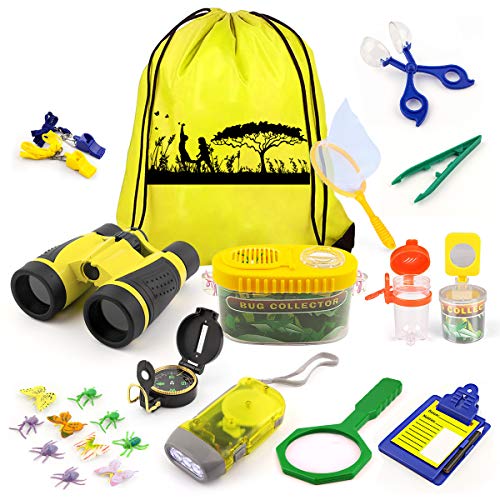
Kaqinu wins on sheer inventory. Twenty-four pieces cover both camps: a butterfly net, insect clamp and three different-sized magnifying bug collectors for catching, plus 4×30 binoculars, a lensatic compass, a hand-cranked flashlight with three LEDs and a whistle for exploring. The magnifying glass carries both 3x and 10x lenses, the strongest close-up spec in this roundup. Because there are multiple collectors and tools, two or three kids can work the same flower bed without negotiating over a single container. Everything packs into the included drawstring bag.
Specs
- Piece count: 24 pieces
- Binoculars: 4x magnification, 30mm objective lens, soft rubber eyepieces
- Magnifying glass: 3x and 10x magnification
- Compass: lensatic style, 3 x 2.08 inches
- Flashlight: hand-cranked, 3 LED lights, no batteries required
- Also included: butterfly net, insect clamp, three magnifying bug collectors, whistle with lanyard and drawstring bag
- Item dimensions: 8 x 7.7 x 3.8 inches
- Item weight: 0.69 kilograms
- Material: plastic
- Manufacturer minimum age: 36 months
Best for: siblings or friends sharing one kit on camping trips and long backyard sessions.
Watch out for: with this many small pieces, inventory everything back into the drawstring bag after each outing or the collectors will scatter.
ASIN: B07VHPJDTL
Which One Fits Your Situation
For a Preschooler’s First Bug Hunts
Start with the TOY Life set. Its 36-month minimum age is the lowest here, the handling tools are sized for small hands, and having both a bug jar and a collection box teaches the catch, look and release routine gently. The ESSENSON kit is the step up when the same child starts asking for binoculars and a backpack of their own.
For the Kid Who Studies Every Specimen
Choose the National Geographic kit. The habitat’s two built-in magnified viewers, one of them telescoping, are designed for long observation sessions, and the scissor-style catcher makes transfers less stressful for both child and insect. The Learning Guide adds identification prompts that pure gear sets do not offer, which keeps the interest going after the novelty of catching wears off.
For Nature Walks, Birding and Pretend Treks
The Adventure Kidz kit is the one built for movement. Glass-lens 5×30 binoculars, a lensatic compass and a flashlight in a real backpack suit trail walks, park expeditions and backyard camp-outs. It deliberately skips catching gear, so it pairs well with a child who prefers spotting wildlife to handling it, or as a second kit alongside a habitat set.
For Siblings Sharing One Kit
The Kaqinu 24-piece set avoids the usual fights. Three magnifying bug collectors mean each child can hold a specimen at the same time, and there are enough tools — net, clamp, compass, flashlight, whistle — for everyone to have a job. The drawstring bag keeps the whole shared inventory in one place between outings.
Common Mistakes
- Buying a backpack explorer kit for a child who actually wants to catch bugs, then discovering it has no net, tweezers or container.
- Keeping insects in the habitat for days instead of observing and releasing them the same day, especially in direct sun on a hot patio.
- Judging kits by headline piece counts that include stickers, toy bugs and lanyards rather than counting the real field tools.
- Assuming toy binoculars perform like real ones without checking whether the listing states a magnification or lens type.
- Leaving the kit outside overnight, where dew warps paper guidebooks and leaves nets and fabric bags mildewed.
Frequently Asked Questions
What age are nature explorer kits best for?
Most sets in this roundup start at 36 months, with the National Geographic habitat kit listing 4 years and up and the ESSENSON title covering ages 3 to 12. In practice, three- and four-year-olds do best with simple nets and containers, while the compass, flashlight and stronger magnifiers reward kids from about six onward.
Are the binoculars in these kits real binoculars?
They are working binoculars, but sized and priced as toys. Some listings state proper figures — the Adventure Kidz and ESSENSON pairs are 5×30, the Kaqinu pair is 4×30 — while the TOY Life listing does not state a magnification at all. Expect fence-and-tree distances for birds and squirrels, not detailed long-range viewing.
How long can a child keep a bug in the habitat?
Treat the habitat as an observation stop, not a home. A few hours in shade with a leaf or two inside is plenty for watching how an insect moves and feeds. Release it where it was caught the same day, and never leave the container in direct sun, where it heats up quickly.
What is the difference between a bug catcher kit and an explorer kit?
A bug catcher kit centers on collecting: a net or grabber, tweezers and a ventilated habitat or jar for close study. An explorer kit centers on moving through the outdoors, with binoculars, a compass, a flashlight and a bag. Hybrid sets like the ESSENSON and Kaqinu kits include both tool groups in one box.
More from Amazon
Programs that pair well with the guide above. Offers and eligibility are set by Amazon and may change.
Collect the home and kitchen items you want in one registry that guests can shop from.
Create a wedding registrySet up recurring deliveries of everyday items on eligible products. Terms and savings are set by Amazon.
Explore Subscribe & SaveFree shipping on eligible items, Prime Video and more. Eligible new members can start with a free trial.
Start a Prime free trialAudiobooks and podcasts to listen to on the go. Eligible new members can start with a free trial.
Try Audible freeAs an Amazon Associate we earn from qualifying purchases.

Write Your Review
No reviews yet. Be the first to share your experience!