

Key takeaways
- Five toy cash registers for kids compared on piece counts, scanners, coin readers and calculators, from a solar classic to talking toddler registers.
A toy cash register looks like a simple purchase until you compare what each one actually does at the checkout. Some registers only beep and open a drawer, while others read coins, run a working calculator, weigh pretend groceries or talk a toddler through counting to ten. The real decision is how much of the checkout your child will run themselves: scanning, totaling, paying and making change are separate skills, and no single register teaches all of them equally well.
This guide serves parents of toddlers taking their first pretend-shopping steps and families with preschoolers or early elementary children ready for real adding and coin play. Every product below was chosen from the details published on its own Amazon page, including piece counts, model numbers, battery needs and age ranges, so the comparisons rest on listing facts rather than box art.
Quick Picks
As an Amazon Associate we earn from qualifying purchases.
| Product | Best for | Key spec from title |
|---|---|---|
| Learning Resources Pretend & Play Calculator Cash Register | A first register that needs no batteries | 73 pieces, solar powered |
| Learning Resources Pretend & Play Teaching Cash Register | Coin recognition and checkout games | Talking register with coin reader |
| Battat Interactive Kids Cash Register | A full checkout counter in miniature | 26 pieces, light-up scanner |
| Fisher-Price Laugh & Learn Count & Shop Cash Register | Toddlers who learn through songs | 20 play pieces |
| LeapFrog Count Along Cash Register | Guided counting for ages two to four | 20-piece set, talking and singing |
How to Choose
Match the register to your child’s age band
Age ranges on these listings are functional, not decorative. Registers built for ages two to four keep buttons large, cap counting at ten and use chunky coins that small hands can slot without help. Models aimed at ages three to eight add multi-digit calculators, coin identification and games with difficulty levels, which frustrate a two-year-old but hold a six-year-old’s attention. Start from the manufacturer’s stated range on the listing, then sanity-check it against your child’s patience for small pieces: a register with dozens of bills and coins suits a child who already puts toys back in a bin.
Decide how real the money handling should feel
Pretend registers split into two camps. Simple models treat money as props: press a button, hear a sound, slide the card. Skill-building models make the money part of the play, with coin readers that identify what was inserted, working calculators for adding prices, and drawers that organize bills and coins into slots. If your goal is early math practice, the coin reader and calculator matter more than lights or songs. If the register is mainly a prop for an imaginary farmers market, a simpler and sturdier unit will survive more enthusiastic role play.
Count the pieces, then plan where they will live
Piece counts in these titles range from twenty to seventy-three, and every piece is a small object that will migrate around your home. Food items, coins, bills, cards and baskets make a play store feel complete, yet they also decide whether the set works on a patio table or needs a whole play kitchen corner. Check the listed dimensions before ordering, and picture the set stored: registers with a lockable drawer or a basket that holds the accessories corral the mess. Families with younger siblings should also weigh how many tiny coins they want in circulation.
Sort out batteries and volume before the first checkout
Battery needs vary more than parents expect. One register here runs its calculator on solar power and needs no batteries at all, one ships with batteries included, and others ask for C or AA cells that are not in the box. Note the exact battery type and count from the listing so the register works on day one. Sound is the other household factor: talking and singing registers are engaging in a playroom and wearing in a quiet living room, so check whether the listing mentions an automatic shutoff or volume-friendly features before it becomes the soundtrack of your afternoons.
The 5 Best Options
Learning Resources Pretend & Play Calculator Cash Register

This is the register that has anchored pretend stores for years, and its appeal is mechanical honesty. The calculator genuinely works and runs on solar power, so there are no batteries to replace before a birthday party. Seventy-three pieces give a child bills, coins and a pretend credit card to sort into the drawer, and the oversized buttons and large display suit small fingers that are still learning to aim. It fits families who want one durable register that a three-year-old can mash and a six-year-old can still use for real adding practice.
Specs
- Pieces: 73
- Power: Solar-powered calculator, no batteries required
- Included money: Play bills, coins and a pretend credit card
- Drawer: Pop-open drawer with a ka-ching sound
- Dimensions: 10.5 x 9.5 x 5.75 in
- Material: Plastic
- Model number: LER2629
- Ages: 3 years and up
Best for: Families who want a battery-free register that still teaches real calculator skills.
Watch out for: A newer listing with a similar name carries model LSP2629-AMZ, so confirm model LER2629 on the page before ordering.
ASIN: B00000DMD2
Learning Resources Pretend & Play Teaching Cash Register

Where the Calculator model keeps things simple, the Teaching register turns checkout into a lesson. Its coin reader identifies both the included plastic coins and real coins, the checkout scanner sounds off as items pass, and a working scale lets a shopkeeper weigh pretend produce before ringing it up. Four interactive games in three difficulty levels stretch the play value well past the novelty stage, and the large LCD screen keeps totals readable across a play table. It suits children at the older end of the range who want the register to respond to what they actually do.
Specs
- Model number: LER2690
- Dimensions: 14.4 x 10.1 x 8.1 in
- Item weight: 2 lb
- Ages: 3 to 8 years
- Batteries: 3 C batteries required, not included
- Coin reader: Identifies real and plastic coins
- Extra features: Checkout scanner with sound, working scale, large LCD screen
- Games: 4 interactive games in 3 difficulty levels
- Included: Play money, credit card and coupon card
- Automatic shutoff: Yes
Best for: Children ready for coin recognition, simple totals and game-based math practice.
Watch out for: The 3 C batteries are not in the box, so add them to the same order or the register stays silent on arrival.
ASIN: B0006N8X3M
Battat Interactive Kids Cash Register

Battat packs an entire checkout lane into a compact footprint. Groceries ride the moving conveyor belt, the light-up scanner beeps each item through, and the pretend credit card reader handles customers who are not carrying cash. The drawer locks, which sounds like a small detail until a younger sibling discovers how fun an open cash drawer is. Twenty-six pieces include toy vegetables and a shopping basket, so the set works as a standalone mini market without buying extra food sets. It fits households that want scanning, paying and bagging in one tidy unit for a patio table or playroom corner.
Specs
- Model number: BT4666Z
- Pieces: 26
- Scanner: Light-up scanner with beeps
- Checkout features: Working calculator, pretend credit card reader, moving conveyor belt
- Drawer: Lockable, with a cha-ching sound
- Included: Play money and coins, toy vegetables, shopping basket
- Dimensions: 11.89 x 4.92 x 7.09 in
- Item weight: 1 lb
- Ages: 3 to 8 years
- Batteries: 2 AA required, included
Best for: Kids who want the full scan, pay and bag routine in a set that stores easily.
Watch out for: Battat also sells a larger 49-piece register set under a similar name, so check the piece count and model BT4666Z before ordering.
ASIN: B01G65WWVW
Fisher-Price Laugh & Learn Count & Shop Cash Register

This register is built for the youngest cashiers. Fifteen chunky buttons trigger more than a hundred and fifty songs, sounds and phrases, and three Smart Stages levels shift the content from simple discovery for a two-year-old toward prompted counting and imaginative store play for older preschoolers. The money is tear-free, which matters when toddlers handle bills roughly, and swiping the credit card produces a satisfying sound without any card slot to jam. Twenty play pieces include groceries to line up on the counter. It fits toddlers who learn by pressing, hearing and repeating rather than by reading a display.
Specs
- Model number: JDL62
- Pieces: 20 play pieces
- Sound content: 150+ songs, sounds and phrases
- Buttons: 15
- Learning levels: 3 Smart Stages levels
- Money: Tear-free play money, credit card swipe with sound
- Scanner: Included for ringing up items
- Batteries: 3 AA, included
- Material: Plastic
- Item weight: 1.04 kg
- Dimensions: not stated
- Ages: 24 months and up
Best for: Toddlers and young preschoolers who engage through music, phrases and big buttons.
Watch out for: The listing’s item-dimension field appears garbled, so judge the footprint by the piece count and photos rather than that field.
ASIN: B0DR3XSJR8
LeapFrog Count Along Cash Register
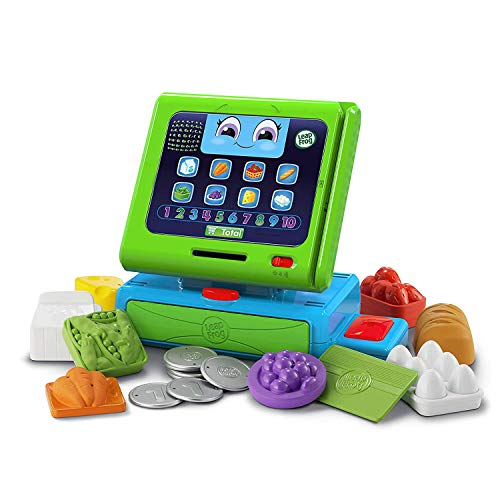
LeapFrog gives its register a face and a personality, and the coaching is the point. After scanning, pressing the total button tells your child exactly how many coins to insert, which turns payment into a counting exercise instead of a guessing game. The twenty-piece set includes eight food items, ten count-along coins and a shopping card, and the register talks and sings through more than fifty phrases and songs while its face lights up. It fits two- to four-year-olds who are learning numbers to ten and respond well to a toy that talks back and keeps the game moving.
Specs
- Model number: 80-19306E
- Pieces: 20 (register, 8 food items, 10 count-along coins, shopping card)
- Sound: Talking and singing register with a light-up face, 50+ phrases and songs
- Scanner: Scanner with beeps
- Coin play: Total button states how many coins to insert
- Ages: 24 months to 4 years
- Batteries: 3 AAA, demo batteries included
- Dimensions: 5.5 x 8.8 x 7.45 in
- Item weight: 2.13 lb
- Material: Plastic
Best for: Preschoolers learning to count to ten with spoken prompts guiding each step.
Watch out for: The included AAA cells are demo batteries, so keep a fresh set ready for when the songs start slowing down.
ASIN: B01CXSZU8I
Which One Fits Your Situation
Your toddler is just starting pretend play
Start with the Fisher-Price Count & Shop or the LeapFrog Count Along. Both are rated from twenty-four months, both talk and sing, and both keep counting small and friendly. The Fisher-Price leans on songs and big buttons across three learning levels, while the LeapFrog coaches the payment step by announcing how many coins to insert. Either one works on a lap or a low table, and neither asks a two-year-old to read numbers off a screen.
Your preschooler wants a checkout that feels real
Choose the Battat Interactive or the Learning Resources Teaching register. Battat reproduces the whole lane, with a conveyor belt, a light-up scanner and a card reader, so the routine of a real store is all there. The Teaching register answers back instead: its coin reader recognizes what gets inserted, and the scale and scanner make prices feel earned. Both reward children who have moved past random button pressing and want the register to react to correct actions.
You are stocking a play store for siblings or a classroom corner
The Learning Resources Calculator Cash Register carries the biggest inventory, with seventy-three pieces of bills, coins and a card to go around, and its solar calculator never needs a battery swap mid-playdate. The Battat set is the other strong group pick because the basket, vegetables and lockable drawer keep a shared set organized between sessions. Either gives several children defined roles as cashier, shopper and bagger without running short of props.
You want the register to double as early math practice
The Teaching Cash Register is the most deliberate teacher here, with its coin reader, working scale and four games across three difficulty levels. The Calculator model is the quieter alternative: a genuine solar calculator and a large display let children add real prices and check their own totals. The LeapFrog Count Along covers the earlier stage of the same path, drilling counting to ten with spoken prompts before a child is ready for written sums.
Common Mistakes
- Buying for the age on the box art instead of the manufacturer’s stated age range, then finding the coins too small or the games too simple.
- Forgetting to check the battery type, so a register that needs C batteries sits silent while every other gift gets played with.
- Assuming a bigger piece count is better, when dozens of loose bills and coins mostly end up scattered across the patio.
- Overlooking the near-identical sibling listings several brands sell, and ordering the wrong piece count or an older model by mistake.
- Skipping the dimension check and discovering the register with its food set does not fit the shelf or play table you had in mind.
Frequently Asked Questions
Do toy cash registers actually help with math?
They help with the earliest layer of it. Counting coins, matching a spoken total and sorting bills into drawer slots all rehearse number sense in a setting children enjoy. Registers with working calculators and coin readers, like the two Learning Resources models here, go further by checking what a child inserts and letting them add real prices. They are practice through play, not a substitute for schoolwork.
What age is right for a first cash register?
Most children engage with a simple register around age two, when pretend shopping starts, and listings for toddler models begin at twenty-four months. Registers with calculators, coin readers and multi-step games are usually rated from age three and hold interest longer. Match the stated range to your child rather than stretching it: small coins and layered games frustrate toddlers, while song-only registers bore most five-year-olds quickly.
Are the play coins and bills a choking concern for younger siblings?
The sets here are rated for ages two or three and up, and their coins are sized for those hands, but ratings assume the set is used by the stated age group. If a baby or young toddler shares the play space, count the small coins and cards as pieces to supervise, and store the set in its drawer or basket between sessions rather than leaving the money scattered.
How do I keep all the pieces together?
Choose storage before the set spreads out. A lockable drawer, like the Battat’s, keeps money inside the register itself, and a set with a shopping basket gives food pieces a home. A quick count at cleanup helps too: the listings state exact piece counts, from twenty to seventy-three, so you can check a set back in like library books until the routine sticks.
More from Amazon
Programs that pair well with the guide above. Offers and eligibility are set by Amazon and may change.
Collect the home and kitchen items you want in one registry that guests can shop from.
Create a wedding registrySet up recurring deliveries of everyday items on eligible products. Terms and savings are set by Amazon.
Explore Subscribe & SaveFree shipping on eligible items, Prime Video and more. Eligible new members can start with a free trial.
Start a Prime free trialAudiobooks and podcasts to listen to on the go. Eligible new members can start with a free trial.
Try Audible freeAs an Amazon Associate we earn from qualifying purchases.








Write Your Review
No reviews yet. Be the first to share your experience!