

Key takeaways
- 30–36 inches: best for two to four seats, narrow patios, and occasional use.
- 42–48 inches: the most versatile range for four to six seats.
- 48–60 inches: better for six or more people, but check weight and clearance carefully.
- Rectangular tables: use space efficiently on long patios and work well with benches or sofas.
- Round tables: encourage conversation and avoid sharp corners, but need a circular seating area.
Best Fire Pit Tables for Every Patio
The best fire pit tables are the ones whose footprint, heat output, fuel system, clearance requirements, and tabletop material fit your patio rather than simply producing the most flame. For most homeowners, a 42- to 48-inch propane table rated around 40,000 to 50,000 BTU offers the most useful balance of seating space, warmth, and manageable installation; smaller patios usually benefit from a 30- to 36-inch model, while large entertaining areas can justify a 60-inch table or a natural-gas installation.
Quick picks by patio situation
| Patio situation | Best table type | Useful specifications | Why it fits |
|---|---|---|---|
| Small balcony or compact deck | Square or round compact propane table | 30–36 inches wide; 25,000–40,000 BTU; 70–110 lb | Leaves room for chairs and walking paths without overwhelming the layout |
| Typical four- to six-seat patio | Propane fire pit table | 42–48 inches wide; 40,000–50,000 BTU; 100–180 lb | Provides a practical surface around the burner and simple fuel installation |
| Frequent entertaining | Large rectangular propane or natural-gas table | 48–60 inches long; 50,000–65,000 BTU; 150–300 lb | Creates a stronger visual centerpiece and accommodates more guests |
| Existing gas connection | Natural-gas fire pit table | 40,000–65,000 BTU; permanently plumbed; professional installation often needed | Eliminates cylinder storage and refilling, but sacrifices portability |
| Occasional use or renters | Portable propane table with removable tank | 28–40 inches wide; 25,000–45,000 BTU; typically under 120 lb | Can be moved or stored, provided the manufacturer permits that use |
Choose the right size before comparing features
Measure the usable patio area, not just the empty center. A fire pit table needs its own footprint, space for chairs, room to pull chairs back, and a clear route around the seating area. As a planning rule, allow at least 24 inches from the table edge to the front legs of a chair. Add another 30 to 36 inches behind each chair for people to walk past comfortably.
Our top picks


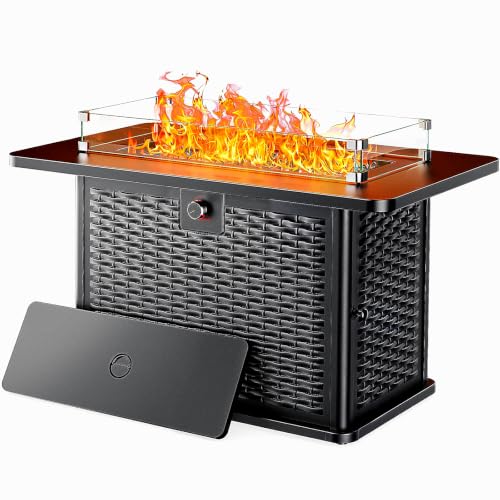

As an Amazon Associate we earn from qualifying purchases at no extra cost to you. Ratings are shown as listed on Amazon.
For example, a 48-inch round table has a 4-foot diameter. If chairs sit roughly 24 inches away from its edge, the seating circle becomes about 8 feet across before adding a walking route. A 30-inch table may fit a 7-foot patio more comfortably, but it will provide less usable tabletop and a smaller burner area.
- 30–36 inches: best for two to four seats, narrow patios, and occasional use.
- 42–48 inches: the most versatile range for four to six seats.
- 48–60 inches: better for six or more people, but check weight and clearance carefully.
- Rectangular tables: use space efficiently on long patios and work well with benches or sofas.
- Round tables: encourage conversation and avoid sharp corners, but need a circular seating area.
Propane versus natural gas
Propane: the flexible choice
Propane tables are usually the easiest option when a patio has no existing gas line. A standard 20-pound cylinder can often be concealed inside the base or connected through an external hose. The trade-off is ongoing cylinder replacement or refilling, plus the need to store cylinders upright in a ventilated location away from excessive heat.
Propane also makes a table easier to relocate, but do not assume a heavy model is portable simply because it uses a tank. A 150-pound table may require two or more adults, a furniture dolly, or a permanent position.
Natural gas: convenient but permanent
Natural-gas tables are sensible for frequent use when a properly installed connection is already nearby. They avoid cylinder handling and can cost less to operate over many seasons, but installation may require a licensed professional, a shutoff valve, approved piping, and inspection under local requirements. A natural-gas table is not a substitute for a portable propane model unless the manufacturer specifically offers a certified conversion kit.
Wood-burning: maximum atmosphere, maximum maintenance
Wood-burning fire tables can deliver strong radiant heat and do not need a gas line, but they produce smoke, sparks, ash, and embers. They also require fuel storage and more generous clearances. Many communities restrict wood fires on decks, balconies, or during dry-weather conditions. Choose this style only when local rules, the surface, and nearby structures all permit it.
How much heat do you need?
BTU is a measure of fuel input, not a guaranteed measure of warmth reaching every guest. Wind, humidity, burner design, flame height, and the open sides of the table affect comfort. A 40,000-BTU table in a sheltered courtyard can feel more useful than a 60,000-BTU model exposed to steady wind.
- 25,000–35,000 BTU: adequate for a compact table and mild evenings.
- 40,000–50,000 BTU: the practical range for most four- to six-seat patios.
- 55,000–65,000 BTU: helpful for larger tables or cooler, open areas, though fuel use and clearance demands increase.
Use a wind guard when it is approved for the model. It can improve flame stability and reduce heat loss, but glass becomes hot and can limit access to the burner controls. Never use a wind guard, lid, glass media, or decorative stones that are not specified for that burner system.
Tabletop materials: appearance versus ownership
| Material | Advantages | Typical concerns | Best for |
|---|---|---|---|
| Porcelain tile | Resists moisture, stains, and ultraviolet exposure; easy to wipe | Grout can discolor; individual tiles may chip from impact | Busy patios and varied weather |
| Concrete or glass-fiber concrete | Heavy, stable, modern appearance | Can stain, hairline-crack, or fade without suitable sealing | Permanent installations in windy locations |
| Aluminum | Lightweight, rust-resistant, and relatively easy to move | Can dent or become hot in direct sun; finish may scratch | Renters and flexible layouts |
| Natural stone | Distinctive appearance and substantial weight | Porous varieties need sealing; acidic spills can etch some stones | Design-led patios with routine maintenance |
| Steel | Strong and often less expensive | Coating damage can lead to rust, especially near coastal air | Covered patios or owners willing to maintain the finish |
The burner insert is usually more important than the decorative top. Look for corrosion-resistant burner components, a clearly labeled control, a flame-failure safety device, and a removable lid that keeps rain and debris away from the burner. Decorative glass or lava rock should be rated for fire features; ordinary glass can crack or release unsafe particles when heated.
Clearance and placement decisions
Follow the exact manual first, because minimum distances vary by model. As a planning baseline, many gas fire tables require roughly 36 inches of clearance from combustible walls, railings, umbrellas, and overhead structures, but the required distance may be greater above the flame. Do not place a fire table beneath a roof, low tree branches, an awning, or a fabric canopy unless the manufacturer and local code explicitly allow it.
Keep the table on a level, stable, noncombustible surface. Composite decking, wood decking, artificial turf, and outdoor rugs can be combustible or heat-sensitive. Check whether the table needs a protective pad, and leave access to the tank valve and control compartment. Avoid positioning the control beside the main walking route where it could be bumped.
A realistic propane-use calculation
A useful estimate is that one pound of propane contains about 21,500 BTU. At 50,000 BTU per hour, a full 20-pound cylinder theoretically supplies:
20 × 21,500 ÷ 50,000 = about 8.6 hours at maximum output.
In actual use, a tank may provide less time because of cold conditions, regulator behavior, and the difference between rated and usable capacity. If you operate the burner at an average of 35,000 BTU for two hours each weekend, the theoretical seasonal use is 70,000 BTU per weekend, or about 3.3 pounds of propane. That is approximately six weekends per 20-pound cylinder before allowing a safety margin. Use this as a planning estimate, not a guarantee.
What wears out first
- Burner holes and rings: dust, insects, and corrosion can distort the flame. Inspect before each season and keep the burner covered when cool.
- Ignition systems: electronic igniters may need batteries, while push-button spark units can fail after moisture exposure. Keep replacement batteries available if applicable.
- Finish and sealant: concrete, stone, and painted steel often need periodic resealing or touch-up, especially in coastal or freeze-thaw climates.
- Fire media: soot-stained media can be cleaned or replaced, but never wash media and return it while damp; trapped moisture can cause cracking when heated.
- Cover: a breathable, correctly fitted cover protects the table while reducing condensation. Let the unit cool fully before covering it.
Final buying checklist
Before choosing among the best fire pit tables, measure the full seating footprint, confirm the required overhead and side clearances, and decide whether a 20-pound propane cylinder can be accessed safely. Then compare usable tabletop space rather than exterior dimensions alone, verify the burner’s BTU range, check the material’s maintenance needs, and confirm that every accessory is approved for that exact model.
For most patios, the safest all-around decision is a 42- to 48-inch propane table with adjustable output, a corrosion-resistant burner, a durable porcelain or properly sealed concrete top, and a certified lid or wind guard. Choose smaller when circulation is tight, larger only when the patio can accommodate the complete seating and clearance zone, and natural gas when frequent use justifies a permanent installation.


Write Your Review
No reviews yet. Be the first to share your experience!