

Key takeaways
- Length: Measure from the widest point at one end to the widest point at the other.
- Width: Measure front to back, including arms, raised edges, and protruding hardware.
- Height: Measure from the ground to the highest point, such as a chair back, table umbrella hole, or recliner headrest.
The best outdoor furniture covers are breathable, UV-resistant covers sized to your furniture’s actual dimensions, with waterproof fabric, reinforced seams, and a fastening system that keeps wind from turning them into sails.
Our top picks


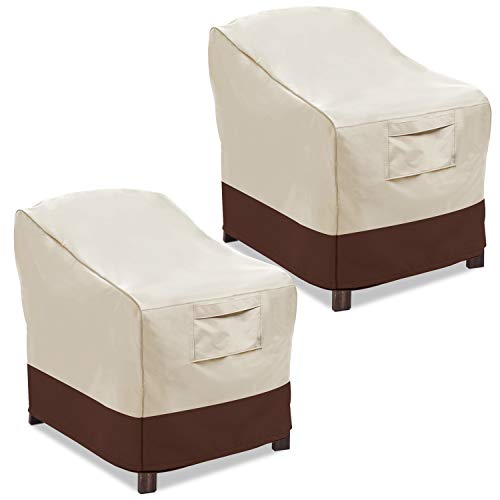
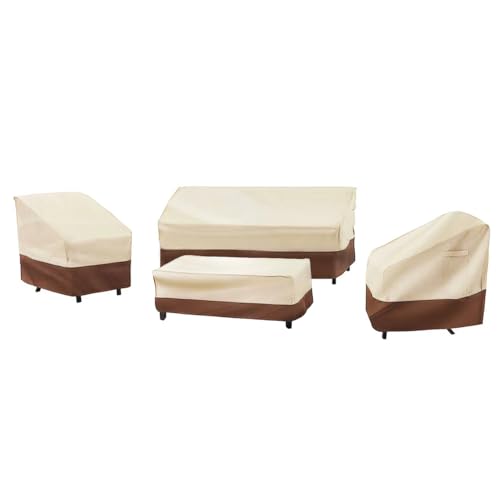
As an Amazon Associate we earn from qualifying purchases at no extra cost to you. Ratings are shown as listed on Amazon.
Best Outdoor Furniture Covers by Situation
| Situation | Best cover specification | Why it fits | Typical price range |
|---|---|---|---|
| Occasional rain and light sun | 300D polyester, PU coating, taped or bound seams, drawcord | Good everyday protection without paying for expedition-grade fabric | $25–$60 per cover |
| Year-round outdoor exposure | 500D solution-dyed polyester or heavy-duty polyester, UV treatment, air vents, buckles | Better resistance to fading, abrasion, wind, and repeated wet-dry cycles | $50–$140 per cover |
| High-wind location | Heavy fabric, four or more adjustable buckles, elastic hem, vent panels | Multiple attachment points distribute force instead of stressing one drawcord | $60–$160 per cover |
| Wood, wicker, or upholstered furniture | Water-resistant outer fabric, soft inner surface, generous ventilation | Reduces moisture trapping, scuffs, mildew risk, and condensation damage | $45–$130 per cover |
| Small balcony or frequent use | Lightweight 210D–300D fabric, handles, compact storage bag, easy-release buckles | Fast removal matters more than maximum fabric weight | $20–$55 per cover |
How to Measure Furniture Covers Correctly
Measure the furniture after assembling it in the position where it will normally remain. Do not measure only the cushion dimensions: the cover must clear the frame, arms, back, legs, and any attached table leaves or side shelves.
1. Measure length, width, and height
- Length: Measure from the widest point at one end to the widest point at the other.
- Width: Measure front to back, including arms, raised edges, and protruding hardware.
- Height: Measure from the ground to the highest point, such as a chair back, table umbrella hole, or recliner headrest.
Record each measurement in inches or centimetres and keep the units consistent. For an ordinary rectangular table, add about 2–4 inches (5–10 cm) to the length and width for clearance. Add roughly 1–2 inches (2.5–5 cm) to height if the hem is designed to sit above the ground. A cover that is much larger than this can collect rainwater, flap in wind, and create a damp pocket around the furniture.
2. Account for unusual shapes
For sectional sofas, measure the complete arrangement if it will stay connected. If the pieces are rearranged often, separate covers are usually easier to fit and remove. For round tables, measure the diameter and height. For fire-pit tables, measure the widest rim and confirm that the cover is rated for that furniture type; never cover a hot or warm appliance.
Use the manufacturer’s size chart as a final check, but compare its listed dimensions with your own measurements. “Fits up to” dimensions are not always interchangeable: one cover may be cut tightly for a table while another allows room for chairs pushed underneath.
Waterproof Fabric: What the Numbers Mean
Most outdoor furniture covers use polyester or Oxford-weave polyester coated with polyurethane (PU) or polyvinyl chloride (PVC). Fabric weight is often listed in denier, but a higher denier number alone does not prove better waterproofing or UV performance.
- 210D polyester: Light and easy to store. Suitable for sheltered balconies and seasonal use, but more vulnerable to abrasion and wind.
- 300D polyester: A practical middle ground for normal rain and sun exposure.
- 500D polyester: More resistant to rubbing, punctures, and repeated handling; useful for year-round coverage.
- 600D Oxford polyester: Common in heavy-duty covers, though coating quality and stitching still determine real performance.
Look for a stated water-resistance or hydrostatic-head rating when available. A rating around 1,500–3,000 mm is generally suitable for rain protection, while higher figures provide more margin during prolonged storms. This number describes resistance to water pressure, not guaranteed long-term waterproofing. Coatings age, needle holes remain in seams, and water can enter through unsealed stitching.
PU-coated fabric is usually lighter and more flexible. PVC-coated fabric can be highly water-resistant and abrasion-resistant, but may be heavier, less flexible in cold weather, and more prone to cracking if folded when cold or stored carelessly.
Ventilation Matters as Much as Waterproofing
A completely sealed cover can trap humid air against cushions and metal frames. Condensation may form even when no rain enters, especially when cool furniture warms in morning sunlight. Choose covers with mesh-lined vents, ideally on two opposing sides. This allows air movement while reducing the chance of wind lifting the cover.
Vents should be positioned high enough to remain clear of puddles and low enough to release humid air from inside. They should have mesh backing rather than open holes that allow insects and wind-driven rain to enter easily. For padded furniture, ventilation is particularly important: remove cushions and dry them separately whenever possible.
Fastening Systems: Drawcords Versus Buckles
An elastic hem gives a cover a neat fit, but it should not be the only wind-control feature in an exposed yard. Drawcords tighten the lower edge continuously and work well around irregular shapes. Adjustable buckles or clips attach the cover to the furniture and are easier to inspect and replace.
- Best for sheltered areas: Elastic hem plus one drawcord.
- Best for moderate wind: Elastic hem, drawcord, and two adjustable buckle straps.
- Best for exposed decks: Four or more buckles, reinforced strap attachment points, and vent panels.
Do not cinch straps around sharp metal corners, and do not allow buckles to hang where they can scratch a finished floor. If a cover repeatedly balloons, add a properly positioned strap rather than placing heavy objects on top of the fabric. Weights can create stress points and hold water against the furniture.
Seam Quality and UV Durability
Fabric usually fails first at seams, corners, and strap anchors—not in the middle of an undamaged panel. Prefer double-stitched or bound seams, bar-tacked strap attachments, and corner panels with extra reinforcement. Seam tape or a waterproof seam sealant helps, but tape that is poorly bonded can peel after heat and repeated folding.
For strong sun, choose solution-dyed polyester or a cover that specifically states UV treatment. In solution-dyed fabric, the color is incorporated through the fibers rather than applied only to the surface, generally improving fade resistance. Look for a stated UV-resistance period or warranty rather than relying on the color or thickness alone.
Dark covers can become hotter in direct sunlight, while very light covers show dirt quickly. A medium shade with a reflective or UV-treated outer surface is often a useful compromise. No cover should be expected to remain permanently outdoors without fading: ultraviolet light, heat, dust, and wind gradually weaken coatings and thread.
A Simple Fit Calculation
Suppose a patio table measures 72 inches long, 40 inches wide, and 30 inches high. Adding 3 inches of clearance to the length and width gives a target cover size of approximately 75 × 43 inches. For height, a cover listed at 30–32 inches is usually preferable to one listed at 36 inches, provided the hem can reach below the table frame without dragging on the ground.
If chairs remain under the table, measure the combined footprint and the highest chair back. Do not assume a table-only cover will reach over them. A cover that is 6 inches too short may expose chair backs; one that is 12 inches too long may pool water around the legs.
Ownership Costs and Maintenance
A $40 cover used for two seasons of weekly exposure may cost about $0.38 per use: $40 divided by approximately 104 weekly uses. A $100 heavy-duty cover lasting five seasons at the same frequency costs about $0.38 per use as well. The cheaper purchase is not automatically the cheaper ownership choice if its seams or coating fail after one summer.
Extend service life with a simple routine:
- Brush off leaves and grit before removing the cover, because trapped debris abrades the coating.
- Wash with lukewarm water and mild soap using a soft brush; avoid bleach, harsh solvents, and abrasive pads.
- Rinse thoroughly so detergent does not attract dirt or interfere with water repellency.
- Dry both the cover and furniture completely before covering again.
- Store the cover loosely folded in a dry, ventilated place when not in use.
- Inspect seams, buckles, elastic, and strap anchors at the start of each season.
Never put a damp cover into its storage bag. Do not place it over wet cushions for extended periods, and do not use a cover as a substitute for shade when furniture is exposed to intense daily sun. If water begins soaking through an otherwise sound fabric, apply only a reproofing product compatible with that fabric and test it on a hidden area first.
Bottom Line
Choose a cover with roughly 2–4 inches of dimensional clearance, 300D fabric for ordinary use or 500D-and-up for demanding exposure, waterproof seams, two-way ventilation, and fastening points matched to your wind conditions. The most durable cover is the one that fits closely enough to stay secure, breathes well enough to prevent trapped moisture, and is easy enough to remove that you will use it consistently.




Write Your Review
No reviews yet. Be the first to share your experience!