

Key takeaways
- Chain-and-tripod systems: Offer continuous adjustment and work well over irregular fire rings, but the chain and hooks become extremely hot.
- Notched support arms: Provide several repeatable heights, commonly 6, 10, 14, and 18 inches above the fire. They are easier to reposition with heat-resistant gloves.
- Telescoping posts: Give controlled adjustment but add moving parts that can clog with ash or seize from corrosion.
- Rim-supported grates: Are stable and simple, although they usually have only one cooking height.
The best fire pit cooking grates combine a diameter that fits your pit, stable legs or a secure rim mount, height adjustment, and uncoated steel or food-safe cast iron; for most backyard cooks, a 22- to 24-inch adjustable grate is the most versatile choice.
A cooking grate turns a fire pit into a practical grill, but the right model depends less on its advertised surface area than on how it sits over the fire. A grate that is too small wastes heat and tips when loaded, while one that is too large can overhang the bowl, restrict airflow, or become difficult to lift safely. Use the criteria below to match the grate to your fire pit and cooking habits.
Our top picks
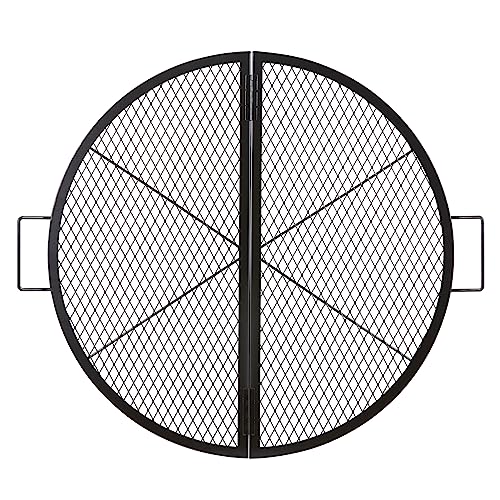
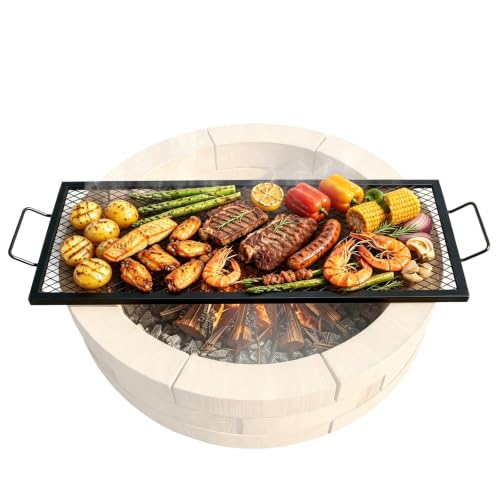


As an Amazon Associate we earn from qualifying purchases at no extra cost to you. Ratings are shown as listed on Amazon.
Best fire pit cooking grates by situation
| Situation | Recommended grate | Useful specifications | Why it fits |
|---|---|---|---|
| Occasional burgers and hot dogs | Chromed or stainless-steel folding grate | 18–22 in. diameter; 5–8 lb; fixed or two-position height | Affordable, easy to store, and quick to clean |
| Frequent family cooking | Heavy-duty adjustable steel grate | 22–26 in. diameter; 10–18 lb; 3–5 height positions | Offers usable space and better control over heat |
| High-heat searing | Cast-iron cooking grate | 18–24 in. diameter; 15–30 lb; thick bars or a solid cooking surface | Retains heat well for steaks and dense vegetables |
| Uneven ground or a custom fire ring | Three-leg tripod grate | 20–30 in. diameter; 24–36 in. total height; chain adjustment | Independent legs improve stability when there is no supporting rim |
| Large round fire pit | Rim-supported half or full grate | 26–32 in. diameter; 12–25 lb; at least 1 in. rim overlap | Uses the pit wall for support and leaves part of the fire accessible |
How to choose the correct grate diameter
Measure the fire pit’s inside diameter at the level where the grate will rest, not the outside diameter of the bowl. A grate intended to sit on a rim should be 1 to 3 inches larger than the opening, depending on the support design. A grate with support tabs may need only a small overlap; a flat grate needs enough contact to resist shifting.
For a free-standing grate inside the bowl, choose a cooking surface about 4 to 8 inches narrower than the pit’s inside diameter. This leaves space for firewood, keeps the legs away from the hottest sidewalls, and makes it easier to lift the grate without scraping the bowl.
For example, if a fire pit has a 30-inch inside diameter, a 22- to 24-inch cooking surface is usually more practical than a 30-inch grate. The smaller grate still provides about 380 to 450 square inches of nominal area, while leaving room around it for fuel and airflow. A 30-inch circular grate has about 707 square inches, but that entire area is rarely usable because food near the edge receives less even heat and becomes difficult to reach.
Steel versus cast iron
Steel grates
Steel is lighter, heats relatively quickly, and is generally the better choice when you need to remove the grate during cooking. A 22-inch steel grate may weigh roughly 8 to 15 pounds, compared with 18 to 28 pounds for a similarly sized cast-iron grate. Steel also works well for tripod designs and height-adjustable systems.
Look for thick welded bars, preferably around 3/8 inch or more for frequent use. Thin wire can warp over repeated high-heat cycles, especially when a heavy pan is placed in the center. Stainless steel resists rust better than ordinary carbon steel, but it can still discolor and develop heat marks.
Cast iron grates
Cast iron stores heat longer and produces strong searing performance. It is well suited to steaks, corn, thick vegetable slices, and cast-iron cookware. Its disadvantages are weight, slower temperature changes, and vulnerability to rust if it is left damp or repeatedly exposed to rain.
Uncoated cast iron needs a thin layer of cooking oil after cleaning and drying. Avoid assuming that a decorative painted grate is suitable for food contact: paint, powder coating, and unknown anti-rust treatments can release unpleasant fumes or deteriorate when heated. Choose a grate specifically labeled for cooking, with an uncoated cooking surface or a finish identified as food-safe and rated for high heat.
Height adjustment matters more than many buyers expect
A grate fixed just above the fire is convenient for quick grilling, but it gives you little protection from flare-ups. Adjustable height lets you use the same fire for searing, roasting, and holding food. Useful designs include:
- Chain-and-tripod systems: Offer continuous adjustment and work well over irregular fire rings, but the chain and hooks become extremely hot.
- Notched support arms: Provide several repeatable heights, commonly 6, 10, 14, and 18 inches above the fire. They are easier to reposition with heat-resistant gloves.
- Telescoping posts: Give controlled adjustment but add moving parts that can clog with ash or seize from corrosion.
- Rim-supported grates: Are stable and simple, although they usually have only one cooking height.
As a practical starting point, cook thin foods such as burgers or sausages 6 to 10 inches above a steady coal bed. Raise the grate to 12 to 18 inches for slower roasting or when flames are active. The exact distance depends on fuel, wind, grate material, and food thickness, so height adjustment is most valuable when it is easy to use while wearing gloves.
Stability and load capacity
Stability is determined by the support geometry, not just the grate’s weight. Three widely spaced legs or support arms are usually more stable than four short legs on uneven ground. Feet should be broad enough not to sink into soil, and a rim-mounted grate should have stops that prevent it from sliding sideways.
Check the manufacturer’s stated load capacity where available. For normal family cooking, a minimum of 20 pounds is useful: a 12-pound grate, a large pan, and several pounds of food can approach that figure. A 30-pound capacity gives more margin for a Dutch oven, but only if the legs and supporting fire pit rim are also rated for the load.
Test the fit before lighting a fire. Place the empty grate on the pit, push gently from several directions, and confirm that it does not rock or rotate. Then place your heaviest expected pan in the center. If the grate bends, shifts, or lifts off one support point, it is not a safe match.
Food-safe finishes and materials
The cooking surface should be made from stainless steel, uncoated carbon steel, seasoned cast iron, or another material explicitly intended for food contact. Be cautious with generic hardware-store grates that have a bright plated or painted appearance but no cooking designation.
- Remove labels, shipping oils, and manufacturing residue before the first use.
- Follow the product’s burn-in instructions; do not burn off an unknown coating over food.
- Do not use a grate if its coating blisters, flakes, or produces persistent chemical odors.
- Use stainless-steel or cast-iron utensils rather than scraping aggressively with tools that can damage a protective finish.
For direct-contact cooking, a simple uncoated grate is often easier to evaluate and maintain than a decorative finish. A separate cast-iron pan or griddle can provide a cleaner cooking surface for small foods that might fall through the bars.
Cleaning, rust, and the parts that wear first
Most grates fail from neglect at the joints, not from the cooking bars themselves. Hinges, height notches, chains, welds, and threaded feet collect grease and ash. After the grate cools completely, brush off food residue, remove loose ash, and dry any moisture before storage.
Do not pour cold water onto a hot grate. Thermal shock can warp steel and crack cast iron. For cast iron, use a small amount of hot water and a stiff brush when necessary, dry it over low heat, and apply a very thin oil film. For stainless steel, wash with mild detergent and dry thoroughly. Carbon steel should also be dried and lightly oiled.
Store the grate under cover rather than leaving it on the fire pit through rain and condensation. A breathable cover or dry shed is preferable to sealing a damp grate in plastic. Replace a grate when bars have thinned substantially, welds are separating, support legs are bent, or corrosion creates sharp flakes on the cooking surface.
A simple buying decision
Choose an 18- to 22-inch steel grate if you cook only a few times per season and need low weight. Choose a 22- to 26-inch adjustable grate for regular family meals, especially if your pit is 28 to 36 inches across. Choose cast iron when searing and heat retention matter more than portability. Choose a tripod model when the pit has no dependable rim or sits on uneven ground.
Before ordering, confirm five measurements: the pit’s inside diameter, rim width, grate diameter, lowest cooking height, and maximum supported weight. That short checklist prevents the most common mismatch—a grate that technically fits the pit but cannot hold a loaded pan safely or sit far enough above the fuel.
Frequently asked questions
Can a fire pit grate be larger than the fire pit?
Only when it is designed to rest securely on the rim. A loose grate that overhangs without stops can slide when food is moved. For an unsupported grate inside the bowl, keep it smaller than the pit’s inside diameter.
Is cast iron better for outdoor cooking?
It is better for heat retention and searing, but not automatically better overall. Steel is lighter, easier to reposition, and often more suitable for adjustable or tripod grates. The best material depends on whether portability or heat stability is your priority.
How high should the grate be above the fire?
Start around 6 to 10 inches above a coal bed for direct grilling, then raise it for slower cooking or active flames. An adjustable model is preferable because fire intensity changes as wood burns down.


Write Your Review
No reviews yet. Be the first to share your experience!