

Key takeaways
- Dining-height versatility: Ciays 43-inch with the cover that converts it into a regular table.
- Cleanest look, tank out of sight: Bali Outdoors 42-inch with a hidden tank compartment and ceramic-style top.
- Best value mid-size: Meilocar 45-inch, a 50,000 BTU 3-in-1 table.
- Premium linear design: Elementi Granville Fire Table, 60 x 27 inches, 45,000 BTU, electronic ignition.
- Small balcony or deck corner: OutVue 32 x 24 inch or Werph 28-inch, both rated at 50,000 BTU.
- Lowest output and fuel use: Nestl 28-inch at 40,000 BTU.
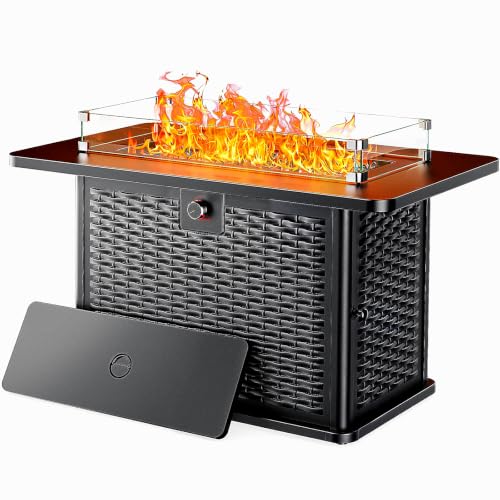
The best propane fire pit tables for most patios are the Ciays 43-inch (60,000 BTU stainless H-burner with a wind guard and dining-table cover), the Bali Outdoors 42-inch (60,000 BTU with a hidden tank compartment), the Meilocar 45-inch (50,000 BTU, 3-in-1 design), and the Elementi Granville for buyers who want a long, premium linear table at 45,000 BTU. For small decks, the OutVue 32 x 24 inch and Werph 28-inch tables deliver 50,000 BTU in a compact footprint, while the Nestl 28-inch (40,000 BTU) is the quiet, lower-output option.
A propane fire pit table is a tabletop-height frame with a gas burner, fire glass or lava rock, and usually a concealed spot for a 20 lb tank. It gives you instant flame with a knob or push-button ignition, no ash and no smoke. The trade-off is heat: gas flames look generous but radiate less warmth than a wood fire of the same size, so output and seating distance matter more than looks. This guide explains how to size the burner, how long a tank lasts, which table class fits your patio, and which models are worth comparing.
Our top picks



As an Amazon Associate we earn from qualifying purchases at no extra cost to you.
Quick answer: which propane fire pit table fits which patio
- Dining-height versatility: Ciays 43-inch with the cover that converts it into a regular table.
- Cleanest look, tank out of sight: Bali Outdoors 42-inch with a hidden tank compartment and ceramic-style top.
- Best value mid-size: Meilocar 45-inch, a 50,000 BTU 3-in-1 table.
- Premium linear design: Elementi Granville Fire Table, 60 x 27 inches, 45,000 BTU, electronic ignition.
- Small balcony or deck corner: OutVue 32 x 24 inch or Werph 28-inch, both rated at 50,000 BTU.
- Lowest output and fuel use: Nestl 28-inch at 40,000 BTU.
How we chose
This guide is based on desk research, not first-hand evaluation. We compared manufacturer specifications and published product listings, checked which models are currently sold, and weighed them against the criteria that actually change how a gas fire table performs on a patio: BTU rating, tabletop size, burner construction, ignition type, wind protection, tank access, and cover availability. Where a specification could not be confirmed from a published source, the product is described by spec class instead of a made-up figure. Always confirm current specs on the manufacturer page before buying, because rated BTU and dimensions can change between production runs.
Our selection filters were:
- A burner rated at 40,000 BTU or more, which is the practical floor for noticeable warmth at arm’s length.
- A table surface of at least 28 inches, so drinks and plates fit beside the flame.
- A CSA, UL or equivalent listing noted by the maker, plus a regulator and hose rated for propane.
- A way to hide or house a standard 20 lb tank.
How to size a propane fire pit table
Match three numbers: burner output (BTU per hour), tabletop footprint, and your seating distance. Burner output is the main driver of felt warmth, but only within about three feet of the flame, and even then wind strips heat away fast.
| Patio situation | Table size class | Burner target | Seating count |
|---|---|---|---|
| Balcony or small deck, under 100 sq ft | 28 to 33 inches | 40,000 to 50,000 BTU | 2 to 4 |
| Mid-size patio, 100 to 250 sq ft | 40 to 45 inches | 50,000 to 60,000 BTU | 4 to 6 |
| Large patio, over 250 sq ft | 50 to 60 inches, or a rectangular linear table | 45,000 to 60,000 BTU plus a separate heater | 6 to 8 |
Note that bigger tables do not always have bigger burners. A long linear table such as the Elementi Granville spreads 45,000 BTU across a 60-inch flame line, which looks dramatic but warms people near it more evenly rather than more intensely.
Worked example: tank runtime and fuel cost
A standard 20 lb propane tank holds about 4.7 gallons, and propane carries roughly 91,500 BTU per gallon. That gives a tank about 430,000 BTU of total energy. Divide by burner output to see how long a tank lasts on full flame.
| Burner rating | Calculation | Runtime on high |
|---|---|---|
| 40,000 BTU | 430,000 / 40,000 | About 10.7 hours |
| 45,000 BTU | 430,000 / 45,000 | About 9.6 hours |
| 50,000 BTU | 430,000 / 50,000 | About 8.6 hours |
| 60,000 BTU | 430,000 / 60,000 | About 7.2 hours |
Practical takeaway: running a 60,000 BTU table on high for a typical three-hour evening uses about 40 percent of a tank, so a single tank covers roughly two evenings. Turning the knob to medium cuts fuel use about in half. If you entertain on most weekends, a 20 lb tank refill or exchange is a recurring cost, so burner efficiency is a better value signal than a headline BTU number. Keep a second full tank on hand, because a burner starved of propane sputters and goes out without warning.
Burner and build criteria that matter
Burner type and material
Look for a 304-grade stainless steel burner. Stainless resists the corrosion that comes from moisture and propane combustion byproducts. An H-shaped or ring burner spreads flame evenly over the fire glass. Cheap burners in thin carbon steel can rust through within a couple of seasons if the table sits uncovered.
Ignition
Push-button electronic ignition (battery or piezo) is more convenient than a match-lit burner. Battery-powered ignition fails quietly when the cell dies, so check whether the table offers a manual backup route for lighting.
Wind guard
A clear tempered-glass wind guard keeps flames steady in light breezes and shields the burner. It makes the flame taller visually and protects it, but it also reflects some heat back upward, so it slightly reduces warmth at seated height. In exposed locations it is still worth having.
Tank access
Two layouts dominate: a hinged or sliding door to a tank compartment inside the table base, or a visible tank tucked behind a decorative panel. A hidden-tank design needs ventilation openings and enough interior room for the tank collar. If the compartment door is flimsy or the interior is cramped, swapping tanks becomes a chore.
Cover and table lid
A hard lid that turns the fire table into a plain coffee or dining table gives the piece year-round use. A fitted soft cover is still needed for winter to keep water out of the burner and glass.
Best propane fire pit tables to compare
1. Ciays 43-inch Propane Fire Pit Table
Spec line: 43 inches · 60,000 BTU · 304 stainless steel H-burner · transparent wind guard · cover converts to table top
Best for: Mid-size patios that need one piece to double as a dining or conversation table.
Skip if: You want a visibly low-profile coffee-table height or a premium finish.
- Pros: High 60,000 BTU rating for the size, stainless burner, wind guard included, lid gives a flat table surface.
- Cons: A heavy-output burner burns through a tank quickly on high, and lower-cost finishes may not match furniture-grade tables.
2. Bali Outdoors 42-inch Propane Fire Pit Table
Spec line: 42 inches · 60,000 BTU · ceramic-style top · hidden tank compartment
Best for: Buyers who dislike seeing the propane tank and want a tidy, furniture-like look.
Skip if: You plan to use larger-capacity tanks, since hidden compartments are typically sized for the standard 20 lb tank.
- Pros: Clean look, strong output, tank stays out of sight.
- Cons: A solid top can chip if hit, and the compartment limits tank options.
3. Meilocar 45-inch 3-in-1 Propane Fire Pit Table
Spec line: 45 inches · 50,000 BTU · 3-in-1 multi-use design
Best for: Budget-conscious shoppers who want the largest surface for the output.
Skip if: You want a premium-grade finish and long-term hardware.
- Pros: Large surface, 50,000 BTU is plenty for four people, versatile design.
- Cons: Entry-level finish and hardware, so a cover is essential for longevity.
4. Elementi Granville Fire Table
Spec line: 60 x 27 inches · 45,000 BTU/hr · electronic ignition · rectangular linear flame
Best for: Premium patios where a long rectangular table sits between sofas or a sectional.
Skip if: You want a small footprint or the strongest radiant heat per dollar.
- Pros: Furniture-grade presence, even flame along the table length, lower BTU than flashier competitors but a very well regarded design.
- Cons: Premium cost, large footprint, and the heat is spread out rather than concentrated.
5. OutVue 32 x 24 inch Propane Fire Pit Table
Spec line: 32 x 24 inches · 50,000 BTU · compact rectangular layout
Best for: Small decks and corners where a coffee-table scale works.
Skip if: You need to seat more than four people around it.
- Pros: High output in a small package, easy to place.
- Cons: Little tabletop room for plates and drinks.
6. Werph 28-inch Propane Fire Pit Table
Spec line: 28 inches · 50,000 BTU · round compact table
Best for: Balconies where permitted and tight patios with two to three chairs.
Skip if: Your building or landlord bans open-flame appliances. Check the rules before buying.
- Pros: Small footprint, strong output for the size, affordable class.
- Cons: A tank may be visible or tucked awkwardly in so small a base.
7. Nestl 28-inch Propane Fire Pit Table
Spec line: 28 inches · 40,000 BTU · round compact table
Best for: Ambiance-first use and lower fuel burn.
Skip if: You want to warm a cold evening for several people.
- Pros: The 40,000 BTU burner stretches a tank to over ten hours on high, which cuts running cost.
- Cons: The lowest heat output on this list.
Safety essentials for gas fire tables
- Clearance: Use the table only outdoors, away from overhangs, pergola slats, umbrellas, trees and siding. Follow the minimum distances in the manual; many makers specify several feet of open clearance, and a safe habit is ten feet from the house with nothing flammable overhead.
- Level, non-combustible base: Place the table on a flat surface such as pavers or concrete. Composite decking and wood decks can be damaged by radiant heat, so use a manufacturer-approved heat shield or pad where the manual calls for it.
- Leak check: After every tank change, brush soapy water on the connection. Bubbles mean a leak. Close the tank valve and do not light the burner until it is fixed.
- Tank handling: Keep the tank upright, never store spare tanks indoors or in a hot car, and never use a damaged hose or regulator.
- Never leave it unattended: Turn off the burner at the control, then close the tank valve, before leaving the area.
- Glass and glass media: Use only fire-rated tempered glass or lava rock made for fire pits. Ordinary stones can trap moisture and crack under heat.
- Carbon monoxide: Gas fire tables are for open-air use only. Never use one under a fully enclosed roof or in a screened enclosure without adequate ventilation.
Decision matrix: choose by your biggest constraint
| Your priority | Choose | Why |
|---|---|---|
| Warmth for 4 to 6 people | Ciays 43-inch or Bali Outdoors 42-inch | 60,000 BTU in a 42 to 43 inch footprint |
| Largest table surface for the output | Meilocar 45-inch | 45 inches at 50,000 BTU |
| Premium look in a long space | Elementi Granville | 60 x 27 inch linear flame, electronic ignition |
| Tight space | OutVue 32 x 24 or Werph 28-inch | 50,000 BTU in compact footprints |
| Lowest running cost | Nestl 28-inch | 40,000 BTU gives about 10.7 hours per tank |
| Hide the tank | Bali Outdoors 42-inch | Hidden tank compartment |
Mistakes to avoid
- Chasing BTU alone: A 45,000 BTU premium linear table can feel as comfortable as a 60,000 BTU round one because heat is spread differently.
- Ignoring the tank door: Check that a 20 lb tank with its collar fits and can be swapped without removing the burner pan.
- Skipping the cover: A soft cover is the cheapest way to extend burner and finish life.
- Placing it under a low roof: Heat and exhaust build up. Keep the area fully open overhead.
- Forgetting a leak test: Do it every time the tank is connected.
Care and maintenance
Wipe the tabletop and glass with mild soap and water once the table is fully cool. Brush debris off the burner ports with a soft brush so every port lights evenly. Cover the table when idle, and in winter remove and store fire glass or lava rock if the manual advises it. Inspect the hose for cracks each season. Replace any regulator or hose that shows wear.
Propane vs. natural gas vs. wood
Propane is portable and needs no plumbing, which is why most tables on this list run on a 20 lb tank. Natural gas models connect to a house line, never run out, and cost less per hour, but need a licensed installer and a fixed location. Wood gives the most radiant heat and crackle, but needs ash cleanup, sends smoke into neighboring yards, and may be restricted by local burn bans. If you want zero smoke and fast on-off use, propane is the practical choice.
Frequently asked questions
How many BTUs do I need in a propane fire pit table?
For most patios, 40,000 to 60,000 BTU is enough. Use 40,000 to 50,000 for small decks and 50,000 to 60,000 for mid-size patios seating four to six people.
Higher BTU gives a stronger flame and more warmth but also uses more fuel, so size to your seating count rather than the biggest number.
How long does a 20 lb propane tank last in a fire pit table?
On full flame, a 20 lb tank lasts roughly 7 to 11 hours depending on the burner: about 7.2 hours at 60,000 BTU and about 10.7 hours at 40,000 BTU.
These figures come from dividing about 430,000 BTU of tank energy by burner output. Running on medium roughly doubles the time.
Can a propane fire pit table sit on a wood or composite deck?
Often yes, but only if the manual permits it and you follow its clearance and heat-shield instructions. Radiant heat can damage composite and wood boards.
A non-combustible pad or heat shield under the table is a sensible precaution. When in doubt, move the table to pavers or concrete.
Do propane fire pit tables give off real heat?
Yes, but less than wood fires of equal visual size. Expect noticeable warmth within about three feet of the flame, especially on 50,000 to 60,000 BTU models.
Wind and a glass guard change this. For larger groups, pair a fire table with a patio heater if you need whole-area warmth.
Is it safe to use a fire pit table under a covered patio or pergola?
Only if the manual allows it and there is ample open ventilation and overhead clearance. Never use one in an enclosed or screened-in space.
Radiant heat can scorch low ceilings and pergola slats, and gas appliances can produce carbon monoxide in poorly ventilated areas.
Where should I hide the propane tank?
Use a model with a built-in tank compartment, or a fitted tank cover placed beside the table, as long as the hose is not strained and ventilation openings stay clear.
Never place the tank in a closed cabinet without ventilation, and keep it upright and away from direct heat.
How do I check for a propane leak?
Mix soapy water, brush it on every gas connection with the valve open, and watch for bubbles. Bubbles mean a leak.
If you see them, close the tank valve, tighten or reseat the connection, and retest before lighting the burner. Replace the part if bubbles persist.
Do I need a cover for my fire pit table?
Yes, a fitted cover is strongly advised. It keeps moisture and debris out of the burner and prevents corrosion and glass staining.
Some tables, such as the Ciays 43-inch, include a hard lid that also works as a tabletop, but a weatherproof cover still helps over winter.



Write Your Review
No reviews yet. Be the first to share your experience!