

Key takeaways
- Remove grit before folding. Sand trapped in the hinge, closures, or foam-facing fabric accelerates abrasion.
- Dry it fully. Air-dry the pad open after wet sessions. Do not store it compressed while damp, since moisture and pressure can encourage odors and fabric deterioration.
- Clean gently. Use a soft brush or damp cloth and mild soap. Avoid solvents, bleach, and high heat, which can damage the cover or foam.
- Inspect the harness. Check stitching, buckle attachment points, and strap adjustment hardware before each outdoor trip.
- Rotate the pad. Repeatedly landing on one corner can compress foam unevenly. Turn the pad and vary placement when possible.
- Do not use it as furniture. Sitting occasionally is harmless, but leaving heavy gear on a folded pad for long periods can create permanent compression.
The best bouldering crash pads for most climbers are a two- or three-layer pad around 10–11 cm thick, with a dense closed-cell foam landing zone, a softer open-cell foam layer, reliable backpack straps, and a folded length that fits your approach rather than simply the largest possible surface.
Our top picks


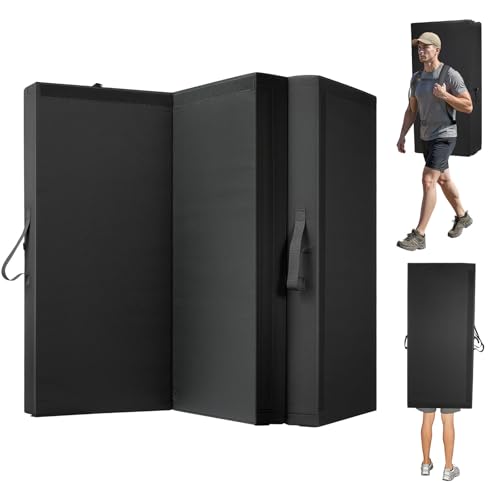
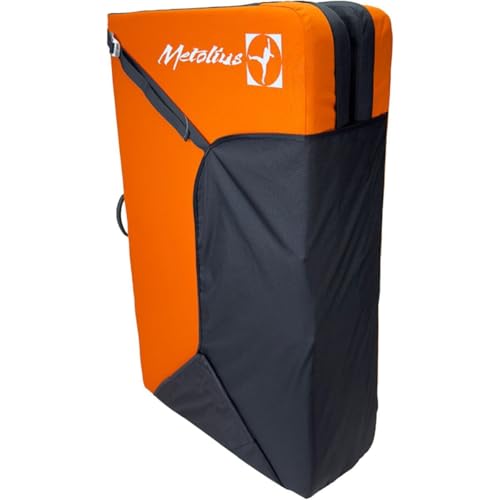
As an Amazon Associate we earn from qualifying purchases at no extra cost to you. Ratings are shown as listed on Amazon.
Quick picks by climbing situation
| Situation | Best pad type or example | Why it fits | Typical trade-off |
|---|---|---|---|
| First outdoor pad or tight budget | Standard taco-style pad, such as the Metolius Session II | Portable, relatively affordable, and adequate for low to moderate problems | Less coverage and less impact protection than a full-size pad |
| One-pad outdoor setup | Full-size hinge or taco pad, such as the Black Diamond Mondo | Broad landing area and substantial foam for varied terrain | Heavier and bulkier on long approaches |
| Frequent outdoor use | Durable full-size pad, such as the Organic Full Pad | Large landing zone, replaceable-looking heavy-duty construction, and comfortable carry system | Usually costs more than entry-level pads |
| Gym sessions and short approaches | Medium pad, such as the Black Diamond Circuit | Easy to carry, store, and position under training problems | Not as much coverage or margin for uneven outdoor landings |
These are categories rather than a substitute for checking the current manufacturer specification. Dimensions, foam formulations, and colors can change between production years.
What separates the best bouldering crash pads
Foam construction matters more than the headline thickness
A crash pad is commonly built from a combination of closed-cell and open-cell foam. Closed-cell foam resists bottoming out and gives the pad a firm first response. Open-cell foam compresses more progressively and helps absorb energy. A good pad balances both: too much firm foam can feel harsh, while a soft pad may compress through to the ground.
Two pads can both measure 10 cm thick yet feel very different because of foam density, layer order, and how the hinge or fold interrupts the landing surface. For outdoor bouldering, look for a multi-layer design with a continuous or well-protected hinge area. For gym use, where the floor is generally flat and the falls are more predictable, a simpler foam package can be sufficient.
Thickness is useful, but coverage is safety-critical
About 8–9 cm is common on compact pads, while larger models often approach 10–11 cm. More thickness can provide greater reserve on a hard landing, but a wide landing zone reduces the chance of missing the pad in the first place. If your problems involve sideways movement, traverses, or awkward top-outs, two medium pads may protect more ground than one very thick small pad.
No crash pad makes an uncontrolled fall safe. Pads should be placed on suitable ground, checked for gaps, and used with spotters when the landing zone or fall direction is uncertain.
Head-to-head: compact versus full-size pads
| Pad class | Typical open size | Typical folded size | Typical weight | Best use |
|---|---|---|---|---|
| Compact | 90–100 × 60–75 cm | 60–75 × 45–60 × 15–25 cm | 1.8–2.5 kg | Gym training, short approaches, supplementing another pad |
| Medium | 100–120 × 90–100 cm | 90–100 × 60 × 20–30 cm | 2.5–3.5 kg | Single-pad sessions and moderate outdoor problems |
| Full-size | 120–140 × 90–100 cm | 90–100 × 60–70 × 25–35 cm | 3.5–5 kg | Outdoor projects, high-traffic landings, and uneven ground |
A full-size pad can cover roughly 1.1–1.4 square metres when open. A compact pad may cover closer to 0.6–0.75 square metres. That difference is significant when a climber drifts several inches during a fall.
Important design choices
Hinge, taco, and hybrid folding
A hinge pad folds in half with a defined crease. It is usually easy to pack and can lie flat, but the fold may be a less forgiving landing point unless the construction protects it well. A taco pad bends continuously, avoiding a central hinge but often producing a bulkier, rounded carry shape. Hybrid designs combine a manageable folded package with a more continuous landing surface.
For gym use, a hinge is convenient because it opens and closes quickly. For rocky outdoor landings, prioritize how the folded area behaves when placed over gaps, roots, or sloping ground—not merely how compact it looks in a gear closet.
Straps and carrying comfort
Look for padded backpack straps with a sternum strap, a waist belt on heavier models, and enough adjustment range to carry the pad over a jacket. A load-lifter strap is helpful on longer approaches, but strap padding cannot compensate for a pad that is too heavy for your route.
Test the folded dimensions against your actual transport. A pad that fits in a car but blocks a narrow hallway or cannot be carried alongside a rope, water, and food may get used less often than a smaller model.
Materials and durability
420-denier nylon is common on lighter covers; heavier 600-denier or similarly rugged fabrics generally tolerate abrasion better. The cover, stitching at the shoulder straps, corner seams, and closure straps usually show wear before the foam does. A replaceable or repairable cover, robust hook-and-loop closures, and protected buckle attachment points can extend ownership.
Decision matrix: choose by frequency, experience, and space
| Your situation | Recommended specification | Reason |
|---|---|---|
| Beginner, mostly indoor, under 10 sessions per year outdoors | 8–10 cm thick, 1.8–3 kg, compact or medium size | Enough portability without paying for a large pad that may see little outdoor use |
| Intermediate climber, monthly outdoor trips | 10–11 cm, medium or full-size, two-layer or three-layer foam | Better landing coverage and durability justify the extra weight |
| Frequent outdoor climber with long approaches | 10 cm or more, efficient backpack harness, roughly 3–4 kg per pad | Balances impact protection with the ability to carry multiple pads |
| Limited storage or public transport | Folded length below about 90 cm and thickness below about 25 cm | More likely to fit closets, lockers, and transit spaces |
| Highball or complex landing | Several compatible medium/full-size pads, not one pad alone | Coverage and gap reduction matter more than maximum thickness |
How many pads do you need?
Start with the landing zone, not the product count. Measure the likely fall area and compare it with the open dimensions of the pad. For example, a 120 × 90 cm pad covers 10,800 square centimetres. Two overlapping pads do not provide 21,600 usable square centimetres because the overlap reduces total area, but they can protect a wider, irregular zone and eliminate a dangerous gap.
A practical first outdoor setup is one medium or full-size pad plus a spotter. Add a second pad when the fall can move sideways, the landing includes rocks or roots, or the problem has multiple top-out positions. A small pad can be useful as a supplemental pad or sit pad, but it should not be treated as the main landing surface for a serious fall.
Ownership: what wears first and how to maintain it
- Remove grit before folding. Sand trapped in the hinge, closures, or foam-facing fabric accelerates abrasion.
- Dry it fully. Air-dry the pad open after wet sessions. Do not store it compressed while damp, since moisture and pressure can encourage odors and fabric deterioration.
- Clean gently. Use a soft brush or damp cloth and mild soap. Avoid solvents, bleach, and high heat, which can damage the cover or foam.
- Inspect the harness. Check stitching, buckle attachment points, and strap adjustment hardware before each outdoor trip.
- Rotate the pad. Repeatedly landing on one corner can compress foam unevenly. Turn the pad and vary placement when possible.
- Do not use it as furniture. Sitting occasionally is harmless, but leaving heavy gear on a folded pad for long periods can create permanent compression.
Foam eventually loses resilience. If a pad feels noticeably thinner, stays compressed, exposes a hard spot, or bottoms out on landings that previously felt well supported, replacement is safer than relying on the original advertised thickness.
Bottom line
Choose a compact pad for indoor training and short approaches, a medium pad for a versatile first outdoor purchase, and a full-size pad—or multiple pads—for frequent outdoor bouldering and complicated landings. When comparing the best bouldering crash pads, rank landing coverage, foam behavior, folded portability, and strap durability together. The ideal pad is not the thickest model on paper; it is the one you can carry to the boulder, position correctly, and keep in dependable condition.



Write Your Review
No reviews yet. Be the first to share your experience!