

Key takeaways
- Compare the best bulb planters for fall planting, from stand-up plug tools to depth-marked hand planters, with specs, soil tips and a clear verdict.
Fall is when a bag of tulips, daffodils and crocus has to go into the ground on schedule, and when most gardeners discover how slow a trowel really is. A bulb planter cuts a clean, repeatable hole at a set depth, so a whole bed goes in at the same level and comes up evenly in spring. The tools below cover the full range of hand planting: two stand-up models for long rows and lawns, two compact hand planters for beds and borders, and a pointed dibble for small bulbs. Every pick is a hand tool, not a drill attachment, so depth control stays in your hands.
As an Amazon Associate, we earn from qualifying purchases.
Quick answer
For most fall planting, the ProPlugger 5-in-1 is the easiest recommendation: its depth rings set 2, 4 or 6 inch holes from a standing position, and the tube holds several soil plugs before it needs emptying. Gardeners who work at ground level in beds should look at the Edward Tools hand planter for its spring-loaded soil release, while the two Berry&Bird tools suit small bulbs and traditional depth-marked planting.
ProPlugger 5-in-1 Planting Tool
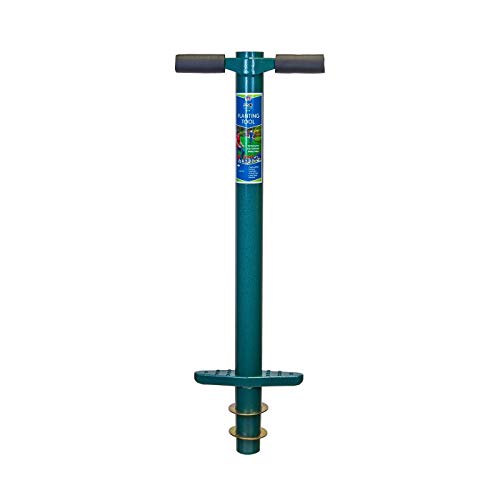
The ProPlugger takes a different approach from the classic cone-shaped planter. It is a long carbon steel tube with foot pegs near the base and padded handles at the top, and it works more like a coring tool than a scoop. You step on the pegs, push the tube to the depth set by one of its adapter rings, and lift out a neat plug of soil. Because the plugs stack inside the tube, you can cut a run of holes before stopping to empty it over the planted bulbs, which speeds up long drifts of tulips or daffodils considerably.
The depth rings are the real advantage for fall work. One ring sets a shallow 2 inch hole for crocus, the second sets 4 inches for most tulips, and planting with no ring reaches 6 inches for large daffodil bulbs. That matches the standard guidance of setting a bulb roughly three times as deep as the bulb is tall, without measuring each hole. The trade-off is hole width: at about 2 and 1/8 inches across, the tube suits small to mid-sized bulbs and feels tight around the largest daffodil or dahlia bulbs. It also performs best in loose or moist soil; in dry, compacted ground the narrow tube takes real foot pressure.
Specs
- Material: carbon steel
- Dimensions: 34 x 2.5 x 13 inches
- Weight: 4 pounds
- Depth settings: rings for 2 and 4 inch holes, 6 inches with no ring
- Hole diameter: about 2 and 1/8 inches
- Model: P246XL
- Made in: USA
Ymachray Long Handled Bulb Planter

The Ymachray is a stand-up transplanter built around a spring-loaded jaw rather than a fixed tube. Standing up, you press the stainless steel head into the soil, and the spring mechanism, rated by the maker for more than 50,000 uses, helps the tool dig the hole, hold the soil, and release it back over the bulb after planting. That semi-automatic action makes it as much a seedling transplanter as a bulb planter, and it handles vegetable starts and bedding plants in spring as readily as tulips in fall.
Sponge grips on the handles soften the repeated squeezing, which matters when a session runs to a hundred bulbs or more. The honest limitation is documentation: the listing confirms the stainless steel build, the sponge handles and the spring rating, but it does not publish an overall length or depth marks, so gardeners who plant strictly by printed depth lines will need to judge depth by eye or mark the shaft themselves. Gardeners who want one standing tool that moves between bulbs, seedlings and small transplants will find that flexibility more useful than a fixed depth scale.
Specs
- Material: stainless steel
- Handle: sponge grips
- Model: PD-20453
- Spring rating: 50,000 or more uses, per the listing
- Depth marks: not stated
- Overall length: not stated
- Weight: not stated
Edward Tools Bulb Planter

The Edward Tools planter is the classic hand tool shape: a reinforced steel cone with a depth marker running from 1 to 4 inches and a spring-loaded handle that squeezes to release the soil plug. That release is the feature that matters most at ground level. Plain hand planters hold onto sticky soil and force you to shake or pry the plug loose; here a squeeze drops the plug back over the bulb, so the rhythm of push, twist, lift, plant and release stays quick across a whole border.
The reinforced, chrome-plated steel body resists the bending that ruins thin hand planters in heavy ground, and the depth marker covers the range most fall bulbs need, from shallow crocus to tulips and daffodils near the 4 inch line. It is still a kneeling tool, and the spring in the handle is the part owners most often have trouble with, so it suits beds, borders and raised planters rather than a full lawn project. For close work where a long tube cannot fit between perennials, it is the most practical pick in this group.
Specs
- Material: reinforced steel, chrome plated
- Dimensions: 9.5 x 4.5 x 3 inches
- Depth marker: 1 to 4 inches
- Soil release: automatic, spring-loaded handle
- Model: RMG1000
- Weight: not stated
Berry&Bird Bulb Planter Tool, 12 Inch

This Berry&Bird tool is a dibble rather than a coring planter: a polished stainless steel point on an FSC-certified ash wood handle that you push and rotate into the soil to open a tapered hole. It cuts a hole about 1.5 inches across, the right scale for crocus, grape hyacinths, snowdrops, garlic cloves and other small bulbs that would rattle around in a wide tube. Working the handle in a circular motion widens the hole for slightly larger bulbs, so one simple tool covers most small-bulb planting with no moving parts to jam.
The build quality is the appeal. The metal part is heat-treated stainless steel with a sharpened edge, the ash handle sits naturally in the hand, and at just over 6 ounces the tool disappears into an apron pocket between beds. What it does not have is a printed depth scale on this listing, so depth is judged by feel rather than by marks. Gardeners planting drifts of small bulbs in soft, worked soil will not miss the scale; gardeners planting large daffodils should choose one of the coring tools instead.
Specs
- Material: stainless steel with FSC-certified ash wood handle
- Dimensions: 2 x 2 x 11.79 inches
- Weight: 6.3 ounces
- Hole diameter: about 1.5 inches, widened by rotating the handle
- Depth marks: not stated
Berry&Bird Garden Bulb Planter with 4 Inches Depth Mark

The second Berry&Bird entry is the traditional hand planter shape from the same maker: a stainless steel barrel with a short ash wood handle wide enough for two hands and a depth mark that reaches 4 inches. Where the dibble above pokes a tapered hole, this tool cuts and lifts a proper plug, which makes it the better Berry&Bird choice for standard tulip and daffodil work in beds and borders. The printed depth mark keeps a row of bulbs at one level, which is what makes a border flower evenly.
At 6.3 ounces it is light enough for long sessions, and the stainless steel body shrugs off the damp soil that fall planting usually means. The cautions are the usual ones for wooden-handled hand tools: it asks you to kneel or crouch, the handle rewards dry storage, and some owners report handle failures when the tool is forced in very hard ground, so it belongs in worked beds rather than unbroken turf. Gardeners who like the classic dig-and-lift motion, and who plant mostly at standard 4 inch depth, will find this the most straightforward tool here.
Specs
- Material: stainless steel with FSC-certified ash wood handle
- Dimensions: 8.86 x 7.09 x 2.36 inches
- Weight: 6.3 ounces
- Depth mark: 4 inches
- Handle style: short handle, wide enough for two hands
How to choose
Start with working height. If you are planting dozens of bulbs across a lawn or a long border, a stand-up tool like the ProPlugger or the Ymachray saves your knees and back, and body weight through a foot peg does the hard work in firm soil. If most of your planting happens in raised beds, containers or crowded borders, a short hand tool gives you the control to work between plants without disturbing roots.
Next, match the tool to bulb size and depth. Small bulbs such as crocus and snowdrops sit shallow and fit narrow holes, which is dibble and small-tube territory. Tulips and daffodils want deeper, wider holes, so look for a depth marker or rings reaching at least 4 inches, and 6 inches for the largest daffodil bulbs. A printed depth scale or depth rings are worth more than any other feature, because even depth is what makes a spring display come up together.
Finally, think about your soil. Spring-loaded releases earn their keep in sticky or clay-heavy beds where plugs refuse to drop out of a plain cone. Sharpened edges help in turf and root-filled ground. Whatever you choose, water the bed the day before planting if the soil is dry, and twist the tool rather than rocking it, so the sides of each hole stay straight.
Who should skip
Skip this whole category if you are planting only a handful of bulbs in soft soil; a trowel you already own will do that job, and a dedicated planter earns its space when the count reaches dozens. Skip the hand planters if bending and kneeling are difficult, and go straight to a stand-up model. Skip the narrow tools, including the dibble and the ProPlugger, if your fall list is mostly large dahlia tubers or the biggest daffodil bulbs, since their holes run small. Gardeners with very rocky or unbroken ground should temper expectations too: every tool here is a hand tool, and ground that defeats a spade will defeat a bulb planter. And if your real workload is hundreds of holes in open ground, a drill-driven auger is a different category of tool that this guide deliberately does not cover.
FAQ
How deep should fall bulbs be planted?
The standard rule is to set a bulb about three times as deep as the bulb is tall, measured to the base of the hole. That puts most tulips and daffodils around 4 to 6 inches deep and small crocus nearer 2 to 3 inches. A depth marker or depth rings keep every hole in a row consistent.
Can a bulb planter be used in a lawn?
Yes, stand-up models suit naturalizing bulbs in grass, because the foot pegs drive the tube through turf and the plug lifts out cleanly. Work when the soil is moist rather than bone dry, and drop the plug back over the bulb so the turf closes over the planting spot.
What is the difference between a dibble and a coring bulb planter?
A dibble pushes soil aside to open a tapered hole, which suits small bulbs and seedlings and never clogs. A coring planter cuts and lifts a plug of soil out, leaving a straight-sided hole at a marked depth, which suits larger bulbs. Dibbles are simpler and lighter; coring tools are more precise for depth.
How should bulb planters be cleaned and stored?
Brush soil off while it is still fresh, wash off anything sticky, and dry the metal before storage so chrome and stainless surfaces stay bright. Wooden handles last longer stored indoors out of damp air. A light wipe of oil on steel parts before winter storage helps keep edges keen.
Final verdict
For a single purchase that covers most fall planting, choose the ProPlugger 5-in-1: the depth rings take the measuring out of the job, and the stacking tube keeps a long row moving. Gardeners who plant at ground level should take the Edward Tools planter for its spring-loaded release, while the Ymachray suits anyone who wants one standing tool for bulbs and seedlings alike. The two Berry&Bird tools split the traditional vote: the depth-marked hand planter for standard tulip work, and the slim dibble for small bulbs.
Product and ASIN Reference
| Product | ASIN |
|---|---|
| ProPlugger 5-in-1 Planting Tool | B003MRTVUI |
| Ymachray Long Handled Bulb Planter | B078JKHDC6 |
| Edward Tools Bulb Planter | B01LXM0SXA |
| Berry&Bird Bulb Planter Tool, 12 Inch | B0BZPLY1V4 |
| Berry&Bird Garden Bulb Planter with 4 Inches Depth Mark | B08M978V1F |
More from Amazon
Programs that pair well with the guide above. Offers and eligibility are set by Amazon and may change.
Collect the home and kitchen items you want in one registry that guests can shop from.
Create a wedding registrySet up recurring deliveries of everyday items on eligible products. Terms and savings are set by Amazon.
Explore Subscribe & SaveFree shipping on eligible items, Prime Video and more. Eligible new members can start with a free trial.
Start a Prime free trialAudiobooks and podcasts to listen to on the go. Eligible new members can start with a free trial.
Try Audible freeAs an Amazon Associate we earn from qualifying purchases.

Write Your Review
No reviews yet. Be the first to share your experience!