

Key takeaways
- Best all-around: Weber Original Kettle 22-inch. Simple, repairable, and big enough for a family cookout.
- Best with upgrades: Weber Master-Touch 22-inch. Adds a hinged grate, ash-catching system and built-in lid thermometer to the same kettle shape.
- Best for entertaining on a work surface: Weber Performer Deluxe 22-inch. A kettle built into a cart with a side table and gas-assisted ignition.
- Best premium kamado: Kamado Joe Classic III. Ceramic body, multi-level grate system, strong fuel efficiency for long cooks.
- Best budget kamado-style: Char-Griller Akorn. Insulated steel body that mimics ceramic heat retention at a lower entry price.
- Best small-space: Kamado Joe Jr. for a ceramic option, or Weber Jumbo Joe 18-inch for a basic steel one.
- Best ultra-portable: Weber Smokey Joe 14-inch for balconies, tailgates and camping.
The best charcoal grill for most backyards is the Weber Original Kettle 22-inch, the Weber Master-Touch 22-inch is the pick if you want easier temperature control, and the Kamado Joe Classic III is the premium choice if you want to smoke as often as you sear. Everything else in this guide is a variation on those three designs: a steel kettle, a steel kettle with convenience features, or a ceramic kamado that holds heat like an oven.
Charcoal grilling rewards a little planning. The same fuel that gives you a hard sear at 600 degrees Fahrenheit can also hold 225 degrees for a pork shoulder, but only if the grill has the right airflow, enough cooking area to build two heat zones, and a lid that actually seals. This guide groups eight current grills by the way people really buy them: by cooking area, by build type, and by how much control you want over vents and fuel.
Our top picks

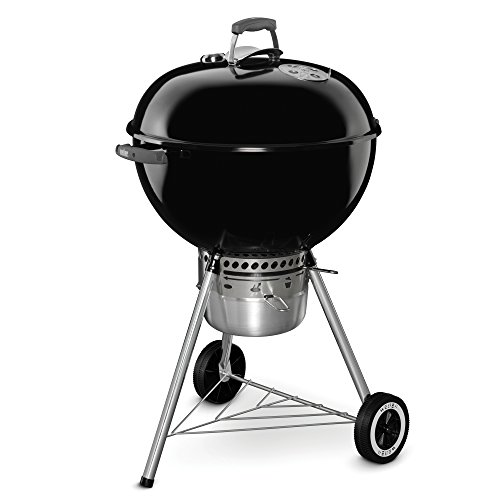
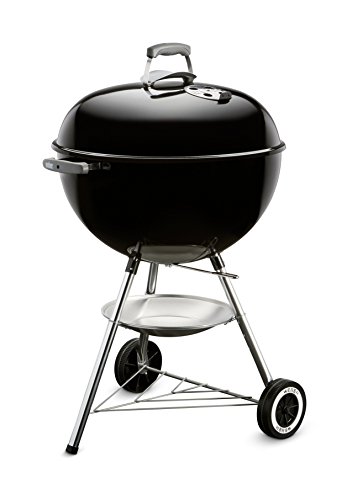

As an Amazon Associate we earn from qualifying purchases at no extra cost to you.
Quick answer: which charcoal grill fits you
- Best all-around: Weber Original Kettle 22-inch. Simple, repairable, and big enough for a family cookout.
- Best with upgrades: Weber Master-Touch 22-inch. Adds a hinged grate, ash-catching system and built-in lid thermometer to the same kettle shape.
- Best for entertaining on a work surface: Weber Performer Deluxe 22-inch. A kettle built into a cart with a side table and gas-assisted ignition.
- Best premium kamado: Kamado Joe Classic III. Ceramic body, multi-level grate system, strong fuel efficiency for long cooks.
- Best budget kamado-style: Char-Griller Akorn. Insulated steel body that mimics ceramic heat retention at a lower entry price.
- Best small-space: Kamado Joe Jr. for a ceramic option, or Weber Jumbo Joe 18-inch for a basic steel one.
- Best ultra-portable: Weber Smokey Joe 14-inch for balconies, tailgates and camping.
How we chose these grills
This guide is built from research, not from cooking sessions. We compared manufacturer specification pages, owner manuals, and the way multiple independent buying guides describe each grill. We kept only models that are widely sold in 2026, have a long record of replacement parts, and represent a distinct design. Where published sources disagreed on a number, such as the cooking area of a kamado with its upper rack, we describe the number as approximate or describe the feature by class instead of quoting a figure we could not confirm.
We weighed five criteria, in this order:
- Cooking area: Measured as grate diameter and square inches, because you need room to bank coals to one side.
- Airflow control: Bottom and top vents that open and close smoothly, and a lid that seals.
- Heat retention: Ceramic and insulated steel use less fuel on long cooks than a single-wall kettle.
- Ash and fuel handling: How easily you can empty ash and add charcoal mid-cook.
- Longevity and parts: Whether gaskets, grates and ash catchers can be replaced.
Comparison table
| Grill | Type | Grate / cooking area (approx.) | Best use | Tier |
|---|---|---|---|---|
| Weber Original Kettle 22-inch | Steel kettle | 22-inch grate, about 363 sq in | All-purpose grilling | Entry-level |
| Weber Master-Touch 22-inch | Steel kettle with features | 22-inch grate, about 363 sq in main grate | Grilling and occasional smoking | Mid-range |
| Weber Performer Deluxe 22-inch | Kettle on a cart | 22-inch grate, about 363 sq in | Entertaining, prep space | Premium |
| Weber Jumbo Joe 18-inch | Compact steel kettle | 18-inch grate, roughly 240 sq in | Small patios, 3-4 people | Entry-level |
| Weber Smokey Joe 14-inch | Portable kettle | 14-inch grate, roughly 140-150 sq in | Travel, balconies | Entry-level |
| Kamado Joe Classic III | Ceramic kamado | 18-inch grate; multi-tier system raises total area | Smoking, searing, baking | Premium |
| Kamado Joe Jr. | Ceramic kamado, compact | 13.5-inch grate | Small groups, tabletop use | Mid-range |
| Char-Griller Akorn | Insulated steel kamado | Roughly 314 sq in main grate; more with upper rack | Value kamado cooking | Mid-range |
Figures are approximate and drawn from manufacturer-style listings; always confirm the exact dimension on the product page before buying a cover, grate or accessory.
Group 1: Steel kettles (best value and simplest)
A kettle grill is a round bowl with a domed lid, a bottom vent that feeds air to the coals, and a top vent that sets draft. The design has barely changed in decades because it works. If you grill for two to six people and want to learn fire control, start here.
1. Weber Original Kettle 22-inch
Spec line: 22-inch steel bowl · porcelain-enameled lid and bowl · about 363 sq in cooking area · one-touch cleaning system on most versions · plated steel grate
Best for: First-time charcoal buyers, family cookouts, anyone who wants a grill that can be repaired with off-the-shelf parts.
Skip if: You want a built-in thermometer, a hinged grate for adding coals, or a large side shelf. Some versions include a thermometer, but check the listing carefully.
- Pros: Roomy enough for a two-zone setup; huge ecosystem of accessories; parts are easy to find; light enough to move around a patio.
- Cons: Single-wall steel uses more charcoal on long cooks; limited side space; the basic grate does not lift out around the edge for mid-cook refueling.
2. Weber Master-Touch 22-inch
Spec line: 22-inch steel bowl · same kettle shape as the Original · built-in lid thermometer · hinged cooking grate · ash catcher · lid hook and fuel-grate that sits higher than the Original
Best for: Cooks who plan to smoke ribs, chicken or pork and who want to add charcoal without removing the whole grate.
Skip if: You grill occasionally and only need burgers and hot dogs. The extra features cost more and the cooking surface is largely the same as the Original.
- Pros: Hinged grate makes fuel top-ups easier; thermometer helps you read dome temperature; strong all-purpose design.
- Cons: Pricier than the Original with the same footprint; still a single-wall kettle for fuel efficiency.
3. Weber Performer Deluxe 22-inch
Spec line: 22-inch kettle bowl · cart base with fold-out work table · gas-assisted charcoal ignition · enclosed ash catcher · storage bin under the bowl
Best for: Hosts who want prep space next to the fire and a way to light charcoal without lighter fluid or chimney starters.
Skip if: You have a small patio. The cart is larger and heavier than a standard kettle, and the gas ignition requires a propane cylinder.
- Pros: Built-in work surface; fast ignition; neat ash management.
- Cons: More assembly; higher cost; the bowl itself offers the same cooking area as the cheaper Original.
4. Weber Jumbo Joe 18-inch
Spec line: 18-inch bowl · porcelain-enameled lid · roughly 240 sq in cooking area · vents on bowl and lid · compact tripod legs
Best for: Small patios and households of two to four people who want a lower-priced charcoal grill that still sets up a basic two-zone fire.
Skip if: You cook for large groups or want to smoke a full brisket. Banking coals to one side leaves little direct-heat space.
- Pros: Compact; low entry cost; fast to light and clean.
- Cons: Limited capacity; the lid can crowd thick roasts.
5. Weber Smokey Joe 14-inch
Spec line: 14-inch bowl · lid with vent · locking lid handle design · about 140-150 sq in cooking area · lightweight steel
Best for: Balconies where rules allow charcoal, camping and tailgating where you need a grill you can carry in one hand.
Skip if: You want to grill for more than two people at once. The surface fits only a handful of burgers or a couple of steaks.
- Pros: Truly portable; low cost; very quick to heat.
- Cons: Small surface; thin steel loses heat in wind; not designed for long smoking sessions.
Group 2: Kamado and insulated cookers (best fuel efficiency and smoking)
Kamados use thick walls to trap heat. A ceramic body, or an insulated steel body that imitates it, lets a single load of lump charcoal run for many hours at low temperature. That is the main reason to pay more: you use less fuel, you hold steadier temperatures in wind and cold, and you can sear, roast, bake and smoke in one cooker.
6. Kamado Joe Classic III
Spec line: 18-inch ceramic body · multi-tier Divide and Conquer grate system · air-lift hinge · slide-out ash drawer
Best for: Cooks who want a single premium cooker for smoking, high-heat searing, pizza and roasting, and who are comfortable with a heavy grill that is not easy to relocate.
Skip if: You grill only on weeknights for quick meals and do not want to learn vent control; a kettle will be quicker and cheaper.
- Pros: Excellent heat retention; flexible grate layout for multiple cooking zones; ceramic holds temperature in cold weather; air-lift hinge reduces lid effort.
- Cons: Heavy and fragile if dropped; high upfront cost; ceramic needs careful handling and a stable stand.
7. Kamado Joe Jr.
Spec line: 13.5-inch ceramic body · compact tabletop or cart format · cast-iron top vent · gasket-sealed lid · portable for a ceramic cooker
Best for: Small households, patio dwellers, and anyone who wants ceramic cooking in a smaller package or as a second grill for sides and side projects.
Skip if: You often cook for more than four people; the grate is small for a full rack of ribs in a typical layout.
- Pros: Real ceramic performance in a compact size; strong fuel efficiency; easier to move than a full-size kamado.
- Cons: Small cooking area; still fairly heavy for its size; fewer accessory options than full-size models.
8. Char-Griller Akorn
Spec line: double-wall insulated steel body · cast-iron top vent · roughly 314 sq in main grate with an upper rack adding more · cart with side shelf · ash pan
Best for: Buyers who want kamado-style fuel efficiency and low-and-slow performance without ceramic cost or weight.
Skip if: You expect ceramic-level thermal mass in extreme cold; thin spots in the paint or seals may need maintenance over the years.
- Pros: Good value; large main grate for the price class; lighter than ceramic.
- Cons: Insulated steel does not hold heat as long as ceramic; gasket and hardware may need upkeep; build quality can be less consistent than premium makers.
Worked example: how many square inches do you really need?
Cooking area on the box is the total grate surface. You will not use all of it if you cook with indirect heat. Here is a simple method to size a grill to your cooking style.
- Count your typical meal. Say you cook for six people and plan one burger each, plus a few extras for seconds: 8 burgers.
- Estimate space per item. A burger patty plus spacing for airflow and flipping takes roughly 25 to 30 square inches. Use 28.
- Multiply. 8 burgers times 28 equals 224 square inches of direct-heat area.
- Add the safe zone. In a two-zone fire, about half the grate sits over coals and half sits over the empty side. Double the direct-heat area: 224 times 2 equals 448 square inches total.
- Compare to your options. A 22-inch kettle with about 363 square inches fits six burgers in the hot zone with space to spare on the cool side. An 18-inch grate near 240 square inches handles about four burgers with a hot side and a cool side.
That same logic works for smoking. A pork shoulder or two racks of ribs needs the indirect side, not the direct side. If you want to smoke a large cut and still grill vegetables at the same time, plan for at least 363 square inches or use a kamado with a multi-tier grate system.
Decision matrix: match the grill to the cook
| If you mostly… | Choose | Why |
|---|---|---|
| Grill burgers, hot dogs and chicken for 4 to 6 people | Weber Original Kettle 22-inch | Enough room for a two-zone setup at a low cost |
| Smoke ribs and shoulders on weekends | Kamado Joe Classic III or Char-Griller Akorn | Better heat retention and lower fuel use on long cooks |
| Host often and need prep space | Weber Performer Deluxe 22-inch | Table and storage built in, gas ignition |
| Have a tiny patio or balcony | Weber Jumbo Joe 18-inch or Kamado Joe Jr. | Smaller footprint with real two-zone potential |
| Travel or tailgate | Weber Smokey Joe 14-inch | Light enough to carry, quick to light |
| Want to add coals mid-cook | Weber Master-Touch 22-inch | Hinged grate for refueling |
Buying criteria with concrete thresholds
Cooking area
For two to three people, 150 to 240 square inches is workable. For four to six people, aim for 360 or more. For regular entertaining or smoking large cuts, look for 450 or more total cooking area, counting upper racks only if you will really use them.
Vents and lid fit
You need a bottom vent that you can close almost fully and a top vent that adjusts in small steps. A lid that rocks or leaves visible gaps will let air in and make low-temperature cooking unpredictable. On kamados, the gasket seals the lid; plan to replace it when it hardens or frays.
Material and build
Porcelain-enameled steel resists rust and is easy to clean. Ceramic resists heat loss but chips if dropped. Insulated steel offers a middle path with more weight than a kettle and less than ceramic. Check the grate material as well: plated steel is fine for general use; cast iron holds heat better for searing.
Ash handling
Ash blocks airflow and can hold moisture against the bowl. A sliding ash catcher or an ash drawer makes cleanup easier and prevents rust in the long term. If a grill lacks one, plan to empty the ash after every cook.
Ignition and fuel
A chimney starter is the safest, most economical way to light charcoal without fluid. Lump charcoal burns hotter and cleaner and works well in kamados. Briquettes burn evenly and last longer in kettles. Avoid mixing lighter-fluid-soaked fuel with food-contact surfaces.
Safety essentials for charcoal grilling
- Never grill indoors or in an enclosed space. Charcoal produces carbon monoxide, an odorless gas that can build up quickly in garages, tents, porches with limited ventilation, and covered patios with no airflow.
- Place the grill on a stable, non-flammable surface at least 10 feet from siding, railings, overhanging branches and fences. Check local rules for balconies and multi-family housing.
- Use a chimney starter. Avoid adding lighter fluid to hot or lit coals because flare-ups can burn you.
- Keep a bucket of sand, a fire extinguisher rated for grease and cooking fires, or a garden hose nearby.
- Dispose of ash only when completely cold. Place cold ash in a metal container with a lid. Coals can stay hot for many hours, and some stay hot for days if the vents are open.
- Keep kids and pets away. Create a clear zone around the grill and use long-handled tools and heat-resistant gloves.
Maintenance that extends grill life
- Clean the grate while hot. A stiff brush or a ball of crumpled foil held with tongs removes debris. Check bristle brushes for loose bristles before use.
- Empty ash after the grill is fully cold. Wet ash is corrosive and traps moisture against the bowl.
- Season cast-iron grates with a thin layer of high-heat cooking oil to prevent rust.
- Inspect gaskets and hinges on kamados twice a year. A worn gasket lets air leak and makes temperature control harder.
- Protect the exterior. Use a fitted cover in rain and snow, and touch up any chipped paint on steel bodies.
Common mistakes to avoid
- Using too much charcoal for a quick cook. Start with a half chimney for burgers and steaks and add more only if you need it.
- Leaving the lid off. Charcoal burns fastest with the lid off and the vents wide open. Close the lid to control temperature and cook evenly.
- Opening the bottom vent fully for smoking. A few small adjustments make bigger differences than fully open or fully closed vents.
- Chasing temperature. Make small vent changes and wait ten to fifteen minutes before adjusting again.
- Skipping the two-zone setup. Always build a hot side and a cool side so you can rescue food from flare-ups.
Frequently asked questions
What is the best charcoal grill for beginners?
The Weber Original Kettle 22-inch is the best starting point because it is simple, widely supported, and large enough for a two-zone fire. Add a chimney starter and you have everything needed for a first season.
Beginners benefit from a design that gives clear feedback: open the bottom vent and the fire grows, close it and it calms. A kettle makes that relationship easy to see, and the grill is inexpensive to repair if you make a mistake.
Is a kamado worth the extra money?
A kamado is worth it if you smoke often or cook in cold or windy weather. If you mostly grill burgers and chicken, a kettle gives the same sear for much less.
The advantages are fuel efficiency and stable low temperatures. A ceramic body can run for hours on a single load of lump charcoal. The tradeoffs are weight, a steeper learning curve for vent control, and a higher price.
What size charcoal grill do I need?
For two to three people, 150 to 240 square inches is enough. For four to six people, choose roughly 360 square inches or more, such as a 22-inch kettle.
Remember that a two-zone setup uses only about half the grate for direct heat. If you regularly smoke large cuts, size up so you have a full indirect side.
Lump charcoal or briquettes?
Lump charcoal burns hotter and produces less ash, which suits kamados and searing. Briquettes burn more evenly and last longer, which suits kettles and long cooks.
Pick one brand and one type for a few cooks so you learn how it behaves. Avoid briquettes with added lighter fluid, and store all charcoal dry because moisture makes it hard to light.
Can I smoke meat on a kettle grill?
Yes. Bank lit coals to one side, put the meat on the other side, add wood chunks, and keep the lid vent over the meat to pull smoke across it.
Plan for more frequent charcoal top-ups than on a kamado because a single-wall kettle loses heat faster. A hinged grate, like the one on the Master-Touch, makes refueling easier during long cooks.
How long does a charcoal grill last?
With regular cleaning and a cover, a porcelain-enameled steel kettle can last many years. Ceramic kamados can last longer, but gaskets and hardware need replacing.
The parts that wear out first are grates, ash catchers and gaskets. Choose a brand that sells replacements, and store the grill dry between cooks to avoid rust.
How do I control temperature on a charcoal grill?
Adjust the bottom vent to control how much air feeds the coals and use the top vent to fine-tune. More air means a hotter fire; less air means a cooler one.
Make small changes and wait ten to fifteen minutes. For low-and-slow cooking, set the bottom vent nearly closed and the top vent about one-quarter open, then adjust from there.
Is it safe to use a charcoal grill on a balcony?
Many apartment buildings and local fire codes restrict or ban charcoal grills on balconies. Check your lease and local regulations before buying.
If charcoal is allowed, keep the grill well away from walls and railings, never leave it unattended, and keep an extinguisher or bucket of sand nearby. A small unit like the Weber Smokey Joe 14-inch is the usual choice where allowed.
Bottom line
If you want the simplest path to great grilled food, buy the Weber Original Kettle 22-inch and a chimney starter. If you want refueling convenience, step up to the Weber Master-Touch 22-inch. If you want a hosting setup, the Weber Performer Deluxe 22-inch adds a work table. For smoking and fuel economy, the Kamado Joe Classic III is the premium option and the Char-Griller Akorn is the value option. If space is tight, the Kamado Joe Jr., Weber Jumbo Joe 18-inch and Weber Smokey Joe 14-inch cover small patios, balconies and travel.




Write Your Review
No reviews yet. Be the first to share your experience!