

Key takeaways
- Keep steel-tip boards dry. Moisture and direct heat can affect fiber boards. Avoid cleaning sisal with liquids; follow the maker’s care instructions.
- Replace small parts before they become a nuisance. Flights, shafts, and tips wear or break. Keep spares compatible with your darts, especially soft tips for electronic boards.
- Don’t judge a board only by its cabinet. A heavy, attractive cabinet cannot compensate for a low-quality board, unreliable scoring electronics, or a poor mounting system.
- Expect consumables and upkeep. Steel-tip boards eventually show wear, and electronic boards may need batteries, tips, or occasional troubleshooting. Check whether replacement parts are readily available before choosing a less familiar board format.
Best Dart Board Cabinets for Home Game Rooms
For most home game rooms, the best dart board cabinets are a well-built cabinet with a regulation-size bristle board, steel-tip darts, and a backing area that protects the wall. Choose a sisal or bristle-board setup for regular play; choose an electronic cabinet if soft-tip games and automatic scoring matter more than the feel and upkeep of steel-tip darts. Before buying, check the open cabinet’s width and height, the space needed to throw, and how it attaches to your wall.
Cabinet styles compared
Dimensions below are useful planning ranges, not guaranteed measurements for every model. “Closed” means the cabinet doors are shut; open dimensions include the doors. Dartboards and cabinets vary, so verify the manufacturer’s drawing before drilling.
Our top picks
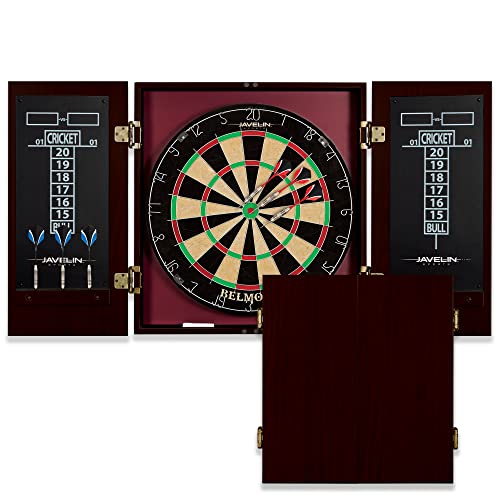
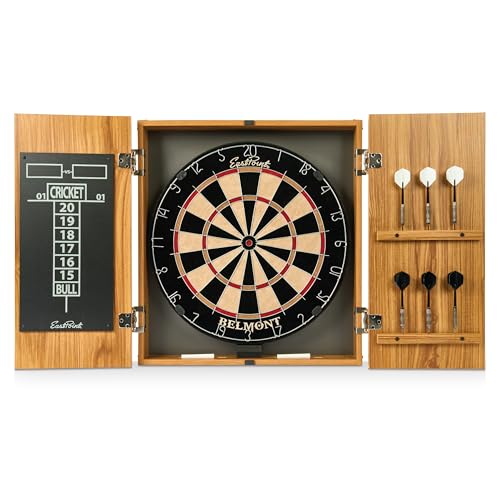
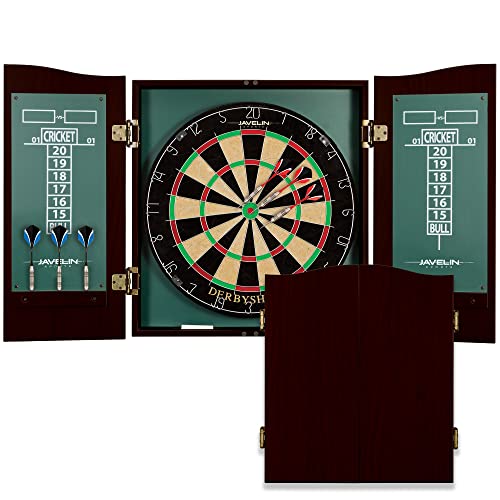

As an Amazon Associate we earn from qualifying purchases at no extra cost to you. Ratings are shown as listed on Amazon.
| Setup | Board and scoring surface | Typical cabinet dimensions | Storage and upkeep | Best fit |
|---|---|---|---|---|
| Steel-tip bristle cabinet | Regulation board face: 17.75 in diameter; sisal or other compressed plant fiber; manual chalkboard or dry-erase scoring panels | About 20–24 in wide × 24–30 in high closed; often 42–50 in wide open | Usually holds two to six darts and may include a chalkboard, marker panel, or shelf. Rotate the board periodically; replace worn flights and tips. | Frequent play, traditional rules, and players who want replaceable components |
| Soft-tip electronic cabinet | Typically a 15.5 in target face; plastic segment bed, electronic sensors, and LCD scoring | About 22–27 in wide × 30–36 in high closed; commonly 44–54 in wide open | Often includes dart holders and compartments for soft-tip darts; may need batteries or an outlet. Replace broken soft tips as needed. | Casual groups, automatic scoring, and players who prefer soft-tip darts |
| Cabinet-only setup | Board sold separately; verify that its mounting bracket and cabinet opening are compatible | Commonly 20–26 in wide × 24–32 in high closed; door width determines open footprint | Storage varies from simple door clips to several molded holders. Scoring may be a panel, a separate scoreboard, or none. | Replacing an existing cabinet or choosing a board and scoring system separately |
Regulation board diameter is not the same as cabinet width. A cabinet must also clear the board’s mounting hardware and allow its doors to open without hitting nearby furniture. Electronic boards are generally smaller at the target face than regulation steel-tip boards, so don’t assume the two are interchangeable.
Choose by room, play style, and budget
| Your situation | Good starting choice | Why |
|---|---|---|
| Occasional family games; easier scoring is a priority | Soft-tip electronic cabinet | Built-in scoring reduces scorekeeping, and soft tips are designed for a plastic segment bed. |
| Regular steel-tip practice | Sisal/bristle board in a sturdy cabinet | The board face is replaceable and can be rotated to spread wear across scoring segments. |
| Tight wall space or a narrow room | Measure first; consider a compact cabinet or cabinet-only setup | Door swing, throwing distance, and a clear path matter as much as closed dimensions. |
| Lowest initial spend | Basic cabinet with a suitable board and simple scoring panel | Decorative doors and extra storage raise cost without improving the board’s playability. |
| Shared room where darts must be put away | Cabinet with secure dart holders and doors that latch | Storage keeps darts together and lets the doors cover the board when it is not in use. |
As a broad market guide, basic cabinet-and-board combinations often fall around $50–$150, while better-finished cabinets or electronic bundles can run roughly $100–$300 or more. Price depends on board construction, scoring electronics, included darts, and cabinet finish; confirm what is actually included rather than paying extra for accessories you do not need.
What matters more than the cabinet’s finish
Board material and wear
For steel-tip play, look for a bristle board made from compressed sisal or another stated plant-fiber material. Sisal fibers close back around many dart holes, but the board is not wear-proof: the bull area and frequently hit segments take the most punishment. Rotate the board according to its instructions, and avoid twisting darts out, which can enlarge holes. A board with removable number ring and replaceable components is easier to maintain.
For soft-tip play, use plastic soft-tip darts on an electronic board designed for them. These boards can simplify group games, but small segment holes may be damaged by hard or incorrectly sized tips. Do not use steel-tip darts on an electronic soft-tip board.
Scoring surface and storage
Cabinet scoring panels are useful only if they suit how you play. Chalkboards are inexpensive but need chalk and occasional cleaning; dry-erase panels are quicker to wipe but can stain if marks are left for a long time. Electronic scoring saves manual arithmetic, but check power requirements, supported games, and whether scoring is built into the cabinet or mounted separately.
Count the actual dart holders and check their size. Some cabinets have room for only a few assembled darts; others provide space for extra flights, shafts, and tips. Loose accessories stored in an open shelf can fall when the doors move, so a compartment or covered pocket is preferable.
Measure and mount before the first throw
- Check the room footprint. Measure the cabinet closed and open, including door swing. Keep furniture and fragile items out of the throwing lane. Regulation steel-tip play uses a 7 ft 9¼ in horizontal throwing distance, measured from the board face to the throwing line; the board face sits 5 ft 8 in above the floor to the center of the bull. Follow the applicable rules for your board type and game.
- Locate a suitable fixing point. A loaded cabinet and board need secure support. Fasten into wall studs where possible, using hardware appropriate to the wall and the cabinet’s mounting holes. For masonry or other wall types, use suitable anchors; if unsure, consult a qualified installer. Do not rely on light-duty picture hooks.
- Set the board position, not just the cabinet position. Mount the board so its center reaches the required height, then check the throwing distance from the face of the board—not the wall or cabinet back.
- Protect the surrounding wall and floor. A cabinet helps protect the wall directly behind the board, but its doors may not catch stray darts. Add a purpose-made backboard or a durable protective panel wide and tall enough to cover likely misses. On hard floors, a dart mat can mark the throwing line and reduce damage from dropped darts.
Before drilling, use the cabinet’s mounting template or measure its actual hole spacing. A level cabinet keeps doors from swinging awkwardly, while secure mounting prevents movement when the board is removed for rotation or service.
Ownership details that prevent early replacement
- Keep steel-tip boards dry. Moisture and direct heat can affect fiber boards. Avoid cleaning sisal with liquids; follow the maker’s care instructions.
- Replace small parts before they become a nuisance. Flights, shafts, and tips wear or break. Keep spares compatible with your darts, especially soft tips for electronic boards.
- Don’t judge a board only by its cabinet. A heavy, attractive cabinet cannot compensate for a low-quality board, unreliable scoring electronics, or a poor mounting system.
- Expect consumables and upkeep. Steel-tip boards eventually show wear, and electronic boards may need batteries, tips, or occasional troubleshooting. Check whether replacement parts are readily available before choosing a less familiar board format.
The best dart board cabinets combine a board suited to your darts, enough open-door clearance, practical scoring, secure storage, and a mounting plan that protects the wall. Measure the playing area first; then choose the cabinet and board combination that fits how often—and how—you expect to play.



Write Your Review
No reviews yet. Be the first to share your experience!