

Key takeaways
- Compare five corded electric tillers and cultivators for backyard beds, with tilling widths, depths, motor ratings and setup checks for every pick.
Buying a corded electric tiller comes down to one honest question: is the soil already garden soil, or are you making a garden where none existed? Established beds ask for light, frequent cultivating, while new ground asks for motor strength and depth, and a machine chosen for one job feels wrong at the other. Width matters too: a tiller that cannot fit between your rows or turn inside your raised beds will sit in the shed while the weeds win.
This guide serves three kinds of gardeners: first-timers opening a small plot, raised-bed growers working tight rows, and experienced gardeners who want a lighter tool for in-season cultivating. The five machines below were chosen from the names and specifications on their Amazon pages, comparing motor ratings, tilling width and depth, tine layouts, and weight, so the differences that decide the purchase come from the listings themselves.
Quick Picks
As an Amazon Associate we earn from qualifying purchases.
| Product | Best for | Key spec from title |
|---|---|---|
| Sun Joe TJ604E Electric Garden Tiller/Cultivator | Breaking new ground in medium beds | 13.5-amp motor, 16-inch tilling width |
| Earthwise TC70016 Corded Electric Tiller/Cultivator | Switching between wide beds and narrow rows | 13.5-amp motor, 16-inch tilling width |
| Greenworks 27072 Corded Electric Tiller/Cultivator | Small raised beds and tight rows | 8-amp motor, 10-inch tilling width |
| Sun Joe TJ603E Electric Garden Tiller/Cultivator | Seasonal loosening of established beds | 12-amp motor, 16-inch tilling width |
| Westinghouse W14TCAC Corded Electric Tiller/Cultivator | Gardeners who carry the tiller to the bed | 10-amp motor, 14-inch tilling width, 4 steel blades |
How to Choose
Match Motor Strength to Your Soil
Motor rating is the clearest dividing line in this group. The 13.5-amp models are the ones to consider when the job includes ground never gardened before, heavy clay soil, or beds left untouched for several seasons. An 8-amp or 10-amp motor handles soil that is already loose and friable, in a lighter frame. Be honest about which soil you actually have: an underpowered tiller on raw ground stalls, kicks, and leaves the bed half worked, while an oversized one is heavier to steer through beds that were already soft.
Pick a Tilling Width That Fits Your Beds
Width decides how a tiller moves through your layout. A 16-inch machine covers open ground quickly, but it cannot slip between rows planted a foot apart or turn inside a short raised bed. A 10-inch cultivator threads those gaps and works close to bed frames without striking the boards. Adjustable-width models split the difference by shedding outer tines for in-season work. Measure your narrowest gap before choosing: spring row spacing, the inside width of your raised beds, and the path the machine travels to reach them.
Check Tilling Depth Against the Job
Depth ratings describe the deepest the tines can reach in workable soil, not a promise for every pass. Mixing compost into the top few inches, uprooting shallow weeds, and refreshing a bed between crops all happen in the upper layer, where the shallowest model here is enough. Setting out transplants, breaking a compacted layer, or building a new bed argues for the deeper machines. On hard ground, work in stages: a shallow pass first, then a second at full depth loads the motor less and leaves a finer finish.
Plan for the Cord Before You Buy
Every model here is corded, which buys unlimited running time and a lighter machine at the cost of managing a cable. Before ordering, walk from your outdoor outlet to the garden’s farthest corner and note what the cord must cross: paths, bed frames, and planted rows all snag a trailing cable. The tiller’s manual lists the extension cord gauges approved for different lengths, and that table, not habit, should pick your cord. If your plots sit far from any outlet, or beds wrap around obstacles, the cord shapes the whole job.
The 5 Best Options
Sun Joe TJ604E Electric Garden Tiller/Cultivator

The TJ604E is the strongest motor in this group, and that strength is what compacted, unworked soil demands. Its six steel tines span the full 16-inch width in a single pass, so a medium plot takes fewer overlapping runs than a narrow cultivator needs. The 370 RPM tine speed keeps the machine moving forward instead of bouncing on hard patches. Gardeners opening a new bed or working compost into clay-leaning soil will get the most from it. The trade-off is heft and cord discipline on longer plots.
Specs
- Model: TJ604E
- Motor: 13.5 amp
- Tilling width: 16 inches
- Tilling depth: up to 8 inches
- Tines: 6 steel tines
- Tine speed: 370 RPM
- Weight: not stated
Best for: Opening new beds and working compost into stubborn, compacted soil.
Watch out for: Availability signals on this listing have been inconsistent, so confirm the exact TJ604E model number on the listing before ordering.
ASIN: B01DTIC79Q
Earthwise TC70016 Corded Electric Tiller/Cultivator
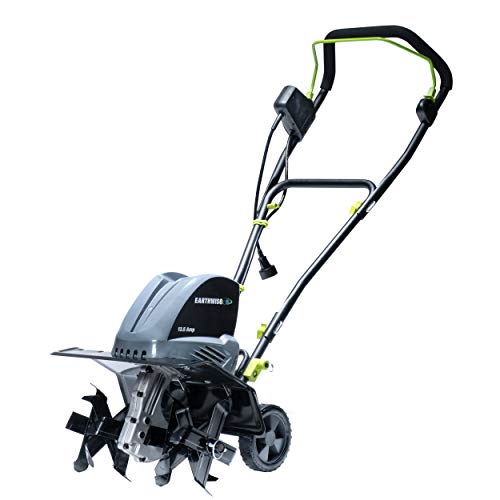
The TC70016 solves a layout problem the fixed-width machines cannot: its tine set adjusts, so the same tiller covers a full bed at its widest setting and then narrows to work between planted rows. The 13.5-amp motor matches the strongest models here, so narrowing down never forces a weaker machine on in-season jobs. At 29 pounds it is not the lightest pick, but the adjustable width removes the need for a second cultivator. Gardeners whose beds change shape across the season benefit most.
Specs
- Model: TC70016
- Motor: 13.5 amp
- Tilling width: adjustable, 11 to 16 inches
- Tilling depth: up to 8 inches
- Tines: 6 adjustable steel tines
- Weight: 29 pounds
Best for: Gardeners who till wide beds in spring and narrow rows in summer.
Watch out for: Confirm the removable outer tines are in the box, since the narrowing feature depends on them.
ASIN: B06Y2DMBF4
Greenworks 27072 Corded Electric Tiller/Cultivator
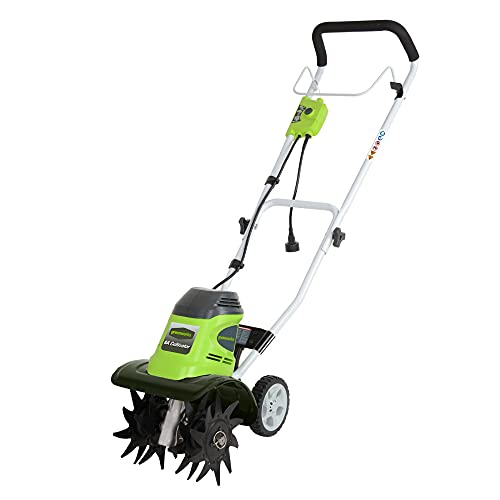
The 27072 is built for beds that are already garden soil rather than ground being opened for the first time. Its 10-inch width slips between rows and inside raised-bed frames where a 16-inch machine would clip boards or plants, and the 8-amp motor keeps the whole unit easy to steer with one guiding hand. Its shallower depth suits mixing compost, weeding passes, and refreshing beds between plantings. Small-plot and raised-bed gardeners who cultivate often, rather than break ground once, are its natural audience.
Specs
- Model: 27072
- Motor: 8 amp
- Tilling width: 10 inches
- Tilling depth: up to 5 inches
- Tines: 4 forward-rotating tines
- Weight: not stated
Best for: Raised beds, narrow rows, and frequent light cultivating between plantings.
Watch out for: The 5-inch depth ceiling is real; measure your beds if you planned to work amendments deeper.
ASIN: B00D3KJN3O
Sun Joe TJ603E Electric Garden Tiller/Cultivator

The TJ603E sits one step below its bigger sibling in motor strength, and for beds that have been worked in previous seasons that step rarely matters. It keeps the same 16-inch width and six-tine layout, so coverage per pass is identical, and at 27.1 pounds it is a little easier to haul from the shed and to hang up afterward. Gardeners who replant the same plots every year get full-width coverage without ground-breaking muscle they seldom need.
Specs
- Model: TJ603E
- Motor: 12 amp
- Tilling width: 16 inches
- Tilling depth: up to 8 inches
- Tines: 6 steel tines
- Weight: 27.1 pounds
Best for: Re-working established beds each season at full 16-inch coverage.
Watch out for: It shares its shape with the stronger TJ604E, so double-check the model printed on the listing before ordering.
ASIN: B00V6IEVXM
Westinghouse W14TCAC Corded Electric Tiller/Cultivator
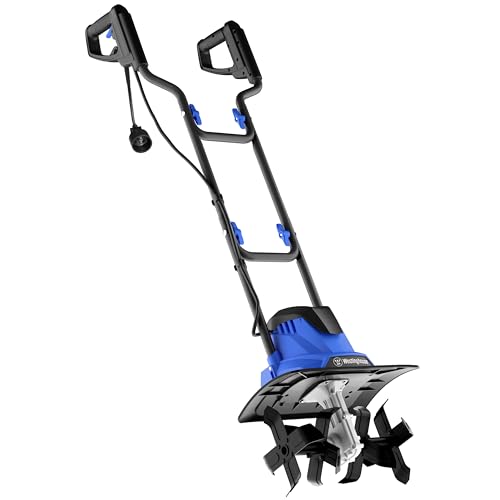
At 16 pounds, the W14TCAC is the machine in this group that nobody dreads carrying across the yard. The 14-inch width splits the difference between the narrow cultivators and the full 16-inch models, and the four steel blades still reach 8.7 inches down, deeper on paper than several heavier picks. The H-type handle gives two grip positions for pushing through beds or pulling back along a row. It suits smaller plots, raised beds, and tight storage, without giving up real tilling depth.
Specs
- Model: W14TCAC
- Motor: 10 amp
- Tilling width: 14 inches
- Tilling depth: up to 8.7 inches
- Blades: 4 steel blades, 8-inch diameter
- No-load speed: 380 RPM
- Weight: 16 pounds
Best for: Smaller plots and gardeners who carry the tiller to the bed each time.
Watch out for: Listing copy rounds the depth up; the manual figure is 8.7 inches, so plan around the manual number.
ASIN: B0DY2FLNZC
Which One Fits Your Situation
You Are Opening a New Plot This Spring
Start with the strongest motors. The Sun Joe TJ604E and the Earthwise TC70016 both run 13.5-amp motors across a 16-inch width, the combination that chews through unworked ground without constant stalling. The Earthwise adds width adjustment for later in the season; the Sun Joe leans on tine speed. Work the plot in two passes, shallow then deep, whichever you choose.
You Grow in Raised Beds and Narrow Rows
The Greenworks 27072 is the natural fit, since its 10-inch width turns inside bed frames and passes between rows without disturbing plants. The Westinghouse W14TCAC also works for wider beds, and its 16-pound frame lifts in and out of raised beds without a struggle. Skip the fixed 16-inch models for this layout; their width becomes a liability once crops are in.
You Only Cultivate Between Plantings
If your beds are already established, ground-breaking strength is wasted weight. The Sun Joe TJ603E keeps full-width coverage for fast seasonal loosening, and the Greenworks 27072 handles the lighter passes between crops, mixing in compost and cutting down young weeds. Either leaves soil ready for the next planting without a bigger machine’s strain.
You Want the Easiest Machine to Carry and Store
The Westinghouse W14TCAC wins on weight alone: at 16 pounds it carries one-handed from shed to bed and hangs on a wall hook without drama. The Greenworks 27072 is the other low-effort option, with a compact frame that tucks into a corner. Both still till to a useful depth, so easy storage does not mean giving up real bed preparation.
Common Mistakes
- Tilling soil that is too wet, which smears the bed into clods that dry like bricks instead of a workable seedbed.
- Forcing the tiller down to full depth in one pass on hard ground, instead of making a shallow pass first and deepening gradually.
- Letting the cord trail in front of the machine, where tines can reach it, instead of keeping it behind you.
- Choosing width by plot size alone and forgetting row spacing, so the machine cannot work between crops once the garden is planted.
- Storing the tiller with soil caked on the tines, which invites rust; a stiff brush and a dry wipe after use prevent it.
Frequently Asked Questions
Can a corded electric tiller break new ground?
Yes, within limits. The stronger 13.5-amp models here can open ground that has not been gardened before, especially after rain softens it, and the work goes faster in two passes at increasing depth. Ground baked hard, full of large roots, or mostly rock still belongs to heavier equipment, and forcing a small electric tiller through it only stalls the motor.
What size extension cord does a corded tiller need?
Use an outdoor-rated cord and follow the gauge table printed in the tiller’s manual, because the right gauge depends on the motor’s amp draw and the cord’s length. A cord that is too light for the run starves the motor and heats up under load. Keep the cord behind you as you work, and never use an indoor cord outside.
How deep should a vegetable bed be tilled?
Most vegetable beds do well with the top six to eight inches loosened, which puts compost in the root zone without churning up deeper, poorer soil. Deeper passes help when a bed is new or compacted. Between plantings, a shallow pass of a few inches is enough to cut down weeds and refresh the surface for the next crop.
Do corded electric tillers need much maintenance?
Far less than fuel-powered machines, since there is no oil, fuel, or spark plug to service. The routine is mechanical: brush soil off the tines after use, check that tine bolts and handle knobs stay tight, clear wrapped roots and string from the tine shaft, and store the machine dry. A light wipe of oil on the tines before winter storage slows rust.
More from Amazon
Programs that pair well with the guide above. Offers and eligibility are set by Amazon and may change.
Collect the home and kitchen items you want in one registry that guests can shop from.
Create a wedding registrySet up recurring deliveries of everyday items on eligible products. Terms and savings are set by Amazon.
Explore Subscribe & SaveFree shipping on eligible items, Prime Video and more. Eligible new members can start with a free trial.
Start a Prime free trialAudiobooks and podcasts to listen to on the go. Eligible new members can start with a free trial.
Try Audible freeAs an Amazon Associate we earn from qualifying purchases.





Write Your Review
No reviews yet. Be the first to share your experience!