
Our Short List of 3

- Best for: Family meals and group lounging where a full anchoring kit matters.
- Dimensions: 117.6 x 117.6 x 90 inches
- Floor area: 96 square feet
- Item weight: 23.4 pounds
- Frame material: fiberglass and carbon steel
- Best for: Campers and patio owners who carry their shelter by hand.
- Dimensions: 120 x 120 x 84 inches
- Floor area: 100 square feet
- Item weight: 12 pounds
- Frame material: fiberglass

- Best for: Tailgates, festivals, and campsites where setup speed matters most.
- Size: 10 x 10 ft
- Floor area: 100 square feet
- Occupancy: 6 person
- Item weight: 16.01 pounds
All 5 Picks at a Glance
| Product | Specs | Action |
|---|---|---|
| EAST OAK Screen House Tent 10 x 10 FT |
| Check price on Amazon |
| Alvantor Screen House Room 10’x10′ |
| Check price on Amazon |
| Coleman Skylodge Portable Screenhouse |
| Check price on Amazon |
 EVER ADVANCED Screen House 11.5 x 9.8 ft |
| Check price on Amazon |
 CLAM Pavilion Screen Tent 12.5 ft |
| Check price on Amazon |
Key takeaways
- Compare five outdoor screen rooms for patios, from a light 10x10 pop-up to a roomy 12.5 ft pavilion, with mesh, frames, setup and wind limits checked.
An outdoor screen room trades open air for real shelter: mesh walls keep mosquitoes and flies out while letting breezes through, but every model gives something up in return — weight, weather resistance, headroom, or setup time. A light fiberglass pop-up rises in under a minute, while a big framed pavilion holds a full dining set yet needs a vehicle to move. The real decision is which footprint and frame match the way your patio is actually used.
This guide serves patio owners setting up a bug-free dining spot, campers who want a screened lounge beside the tent, and families hosting backyard meals without the swatting. The five rooms below were chosen from the sizes, mesh, frame materials, and included anchoring gear stated on their Amazon pages, spanning compact 10 ft squares to a 12.5 ft pavilion.
Quick Picks
As an Amazon Associate we earn from qualifying purchases.
| Product | Best for | Key spec from title |
|---|---|---|
| EAST OAK Screen House Tent 10 x 10 FT | Family meals under fine mesh | 10 x 10 FT |
| Alvantor Screen House Room 10’x10′ | Lightest carry to the patio | 10’x10′ |
| Coleman Skylodge Portable Screenhouse | Fastest one-minute setup | 1-Minute Setup |
| EVER ADVANCED Screen House 11.5 x 9.8 ft | Room for a picnic table | 11.5 x 9.8 ft |
| CLAM Pavilion Screen Tent 12.5 ft | Big groups and wind panels | 12.5 Ft |
How to Choose
Footprint and headroom
Start by measuring the furniture, not the patio. A 10 ft square fits four to six chairs around a small table, while a dining set for six with pull-out room needs 11 ft or more on the long side. Headroom matters just as much: a 7 ft peak suits most adults standing, but a 71 inch ceiling feels low once a hanging light or a tall guest enters the picture. Check the listed dimensions in inches, since some brands measure corner to corner on hexagonal models and others measure side to side. Leave a clear strip around the walls so chairs do not press against the mesh.
Mesh fineness and door design
Mesh is what separates a screen room from a plain canopy, so read how the listing describes it. Fine mesh blocks smaller insects and still lets air move, while coarse netting admits gnats on still evenings. Count the doors and how they close: a zippered door seals tightly but needs a free hand, while magnetic doors swing shut behind children and pets carrying plates. Look for a double-sided zipper if you plan to open the room from inside and outside. Check whether the walls reach the ground, because gaps at the base invite crawling insects.
Frame material and packed weight
Frames decide both durability and how far you will carry the room. Fiberglass ribs flex in gusts and keep the packed weight near 12 to 23 pounds, which suits car camping and frequent moves. Steel and alloy frames add rigidity for patio use but push the weight past 30 pounds, so they belong near the car or on a deck. Read the packed size as well as the weight: a circular 39 inch carry bag needs wide trunk space, while a long slim bag slides behind a seat. Telescoping poles and hub designs cut setup time but add joints to inspect.
Weather limits and anchoring
No pop-up screen room is a storm shelter, and every listing states a wind limit — usually around 24 miles per hour — above which the room must come down. Treat water resistance honestly: most tops shed light drizzle, yet several models state plainly that they are not waterproof, so plan for rain to pass through. Anchoring is part of the product, not an accessory: count the stakes, guylines, and sandbags in the included components and use all of them. Set up on flat, well-drained ground and take the room down before severe weather arrives.
The 5 Best Options
EAST OAK Screen House Tent 10 x 10 FT
- Best for: Family meals and group lounging where a full anchoring kit matters.
- Dimensions: 117.6 x 117.6 x 90 inches
- Floor area: 96 square feet
- Item weight: 23.4 pounds
- Frame material: fiberglass and carbon steel
Family meals and group lounging where a full anchoring kit matters.
Confirm the listing’s current buying options before ordering, since the buy box has shown mixed availability signals.
The EAST OAK suits families who want a roomy screened space without wrestling a heavy frame. Its 10 ft square floor holds four to six people with chairs, and the four-sided fine mesh keeps the air moving while insects stay outside. Setup is a one-person pop-up that takes under a minute, and the included stakes, guylines, and sandbags give the shelter a complete anchoring kit. A three-year warranty is listed, which is generous for this class. The zipper closure seals the room properly, though the top is not water resistant, so this is a fair-weather shelter.
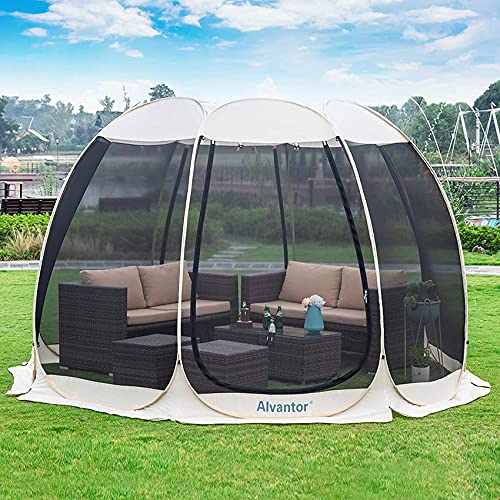
Alvantor Screen House Room 10’x10′
- Best for: Campers and patio owners who carry their shelter by hand.
- Dimensions: 120 x 120 x 84 inches
- Floor area: 100 square feet
- Item weight: 12 pounds
- Frame material: fiberglass
Campers and patio owners who carry their shelter by hand.
Confirm the listing’s current buying options before ordering, since the buy box has shown mixed availability signals.
The Alvantor is the lightest room here, and that changes how it gets used. At 12 pounds with an automatic fiberglass pop-up frame, it springs open in seconds and folds into a circular carry bag, so one person can move it from car to patio without help. Six mesh wall panels give 360-degree ventilation and views, while the fabric top supplies UPF 50+ sun protection. The trade-off is weather: the top is not waterproof, and the maker advises taking the room down in winds above 24 to 30.8 miles per hour. A floor is sold separately.
Coleman Skylodge Portable Screenhouse
- Best for: Tailgates, festivals, and campsites where setup speed matters most.
- Size: 10 x 10 ft
- Floor area: 100 square feet
- Occupancy: 6 person
- Item weight: 16.01 pounds
Tailgates, festivals, and campsites where setup speed matters most.
Confirm the listing’s current buying options before ordering, since the buy box has shown mixed availability signals.
The Coleman is built around speed: a lightweight hub with attached telescoping poles and pinch-free buttons brings the shelter up in about one minute. Two entryways through enclosed mesh walls make it easy to move people and gear in and out, which matters at busy gatherings. The 10 ft square floor covers 100 square feet for up to six people, with UPF 50+ protection and water-resistant fabric plus an included rainfly for light drizzle. At 16 pounds it is heavier than the lightest pop-ups, and the metal frame flexes in strong gusts, so stake it well.
EVER ADVANCED Screen House 11.5 x 9.8 ft
- Best for: Car campers and RV users who need room for a picnic table.
- Dimensions: 138 x 117.6 x 71 inches
- Floor area: 112.2 square feet
- Occupancy: up to 6 people
- Item weight: 21.5 pounds
Car campers and RV users who need room for a picnic table.
The 71 inch height is low for tall users, so measure headroom against your tallest guest before buying.
The EVER ADVANCED fits the middle ground between compact squares and full pavilions. Its 11.5 by 9.8 ft floor gives 112.2 square feet for up to six people, enough for a picnic table with chairs, while the 71 inch height keeps the profile low and steady in a breeze. One-person pop-up setup takes about a minute with no assembly, and the shelter folds to a 54 by 7.8 inch packed size for the car trunk. Bug-proof mesh and water-repellent polyester with UPF 50 protection cover the essentials, though fiberglass poles mean it should not sit out in a storm.
CLAM Pavilion Screen Tent 12.5 ft
- Best for: Large groups and base-camp gatherings where space beats portability.
- Dimensions: 150 x 150 x 94 inches
- Floor area: 12.5 x 12.5 ft
- Occupancy: up to 8 people
- Item weight: 39 pounds
Large groups and base-camp gatherings where space beats portability.
At 39 pounds it is heavy to carry far, so plan for vehicle access to the site.
The CLAM is the largest room in this guide and the one built most like a base camp. Its 12.5 ft square footprint holds up to eight people, and built-in wind panels add privacy and shelter on breezy sites. No-See-Um mesh screening pairs with 210 denier poly-oxford fabric, and setup takes under a minute with no tools. The cost of that space is weight: at 39 pounds with a fiberglass frame, this is a vehicle-accessible shelter rather than a long carry. Stakes, tie-down ropes, and an oversized carry bag are included.
Which One Fits Your Situation
Small patios and solo setup
When one person sets up alone on a compact patio, the Alvantor is the natural fit. Its 12 pound fiberglass frame opens automatically in seconds and folds into a circular bag one person can manage. The EAST OAK is the backup when a fuller anchoring kit and a three-year warranty matter more than minimum weight, since it still sets up solo in under a minute.
Family dining under mesh
For regular family meals outside, the EAST OAK earns the spot. Its 10 ft square floor seats four to six people, the four-sided fine mesh keeps insects out while air circulates, and the 12 stakes, 6 guylines, and 6 sandbags hold the room steady through dinner. The Coleman is the alternative when two entryways matter, since serving dishes pass through more easily.
Picnic-table gatherings
A picnic table needs a long side, which is where the EVER ADVANCED fits. Its 11.5 by 9.8 ft floor leaves room for the table plus chairs, and the 112.2 square feet keep elbows off the mesh. The CLAM is the step up when the table grows to eight seats, since its 12.5 ft square floor and wind panels suit bigger groups.
Large groups and windy sites
For eight people or breezy ground, the CLAM Pavilion is the pick. Built-in wind panels cut drafts, No-See-Um mesh screens small insects, and the 150 inch square footprint holds a full group with furniture. The EVER ADVANCED is the fallback when a lighter 21.5 pound carry matters more than maximum floor space.
Common Mistakes
- Buying by footprint alone without checking whether the brand measures corner to corner or side to side.
- Skipping the stakes, guylines, and sandbags on a calm day, then losing the room to a sudden gust.
- Expecting a screen room to stay dry in rain when the listing states the top is not waterproof.
- Choosing a 71 inch ceiling for a space where tall guests and hanging lights need headroom.
- Leaving the room up through a storm instead of taking it down when winds approach the listed limit.
Frequently Asked Questions
What size screen room fits a patio dining set for six?
A 10 ft square room fits six chairs, but a dining set with pull-out room is more comfortable at 11 ft or longer on one side. Measure the table plus about three feet of chair clearance on every side, then compare that rectangle with the listed dimensions. Remember that some hexagonal models are measured corner to corner, so the usable width is smaller than the headline number.
Are pop-up screen rooms waterproof?
Most are not. Several listings in this guide state plainly that the top is not water resistant, while others describe water-resistant fabric that sheds light drizzle. A screen room is designed for bugs and sun, not rain. If showers are likely, choose a model with a rainfly or a water-repellent top, and take the room down before heavy rain rather than trusting the mesh walls.
How long does setup take for a pop-up screen room?
One-person pop-up models generally take under a minute once the technique is learned, with hub-and-pole designs like the Coleman taking about a minute including staking. Larger pavilions still pitch in under a minute but need a second person to position the frame. Practice the fold at home first, since the take-down twist on fiberglass pop-ups takes a few tries to learn.
Do screen rooms need to be staked down?
Yes, always. Every model here includes stakes, guylines, or sandbags, and the listings advise using all of them. A screen room catches wind like a sail, so even a calm afternoon can turn with one gust. Anchor every corner on flat ground, tighten the guylines at right angles, and remove the room entirely when winds approach the limit stated on the listing.
More from Amazon
Programs that pair well with the guide above. Offers and eligibility are set by Amazon and may change.
Collect the home and kitchen items you want in one registry that guests can shop from.
Create a wedding registrySet up recurring deliveries of everyday items on eligible products. Terms and savings are set by Amazon.
Explore Subscribe & SaveFree shipping on eligible items, Prime Video and more. Eligible new members can start with a free trial.
Start a Prime free trialAudiobooks and podcasts to listen to on the go. Eligible new members can start with a free trial.
Try Audible freeAs an Amazon Associate we earn from qualifying purchases.



Write Your Review
No reviews yet. Be the first to share your experience!