

Key takeaways
- Best all-around choice: Weber Spirit II E-310 for dependable three-burner cooking, a manageable footprint, and simple maintenance.
- Best for frequent family cooking: Weber Genesis E-325s for a larger cooking surface, stronger heat recovery, and a more substantial cart.
- Best for flexible two-zone cooking: Napoleon Rogue 425 for three burners, cast-iron cooking grates, and useful side-shelf features.
- Best budget-oriented choice: A three-burner stainless-steel or porcelain-coated grill with at least 400 square inches of primary cooking area and independent burner controls.
- Best for small patios: A compact two-burner propane grill, provided you can accept less room for indirect cooking and large batches.
The best propane grills for outdoor cooking depend on four practical questions: how much food you cook at once, how precisely you need to control heat, how much patio space you have, and whether you want a grill that can remain outdoors for many years.
Our top picks


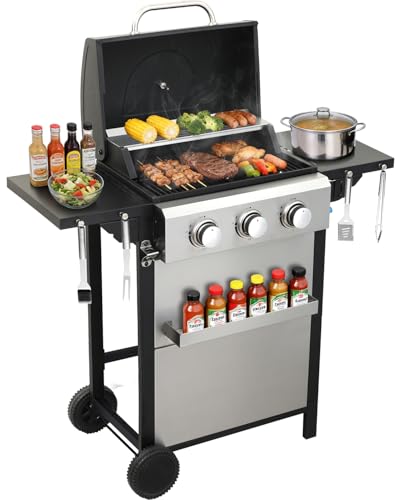

As an Amazon Associate we earn from qualifying purchases at no extra cost to you. Ratings are shown as listed on Amazon.
Quick picks by cooking situation
- Best all-around choice: Weber Spirit II E-310 for dependable three-burner cooking, a manageable footprint, and simple maintenance.
- Best for frequent family cooking: Weber Genesis E-325s for a larger cooking surface, stronger heat recovery, and a more substantial cart.
- Best for flexible two-zone cooking: Napoleon Rogue 425 for three burners, cast-iron cooking grates, and useful side-shelf features.
- Best budget-oriented choice: A three-burner stainless-steel or porcelain-coated grill with at least 400 square inches of primary cooking area and independent burner controls.
- Best for small patios: A compact two-burner propane grill, provided you can accept less room for indirect cooking and large batches.
Best propane grills compared
| Grill | Primary cooking area | Burners | Cooking grates | Approximate weight | Typical market range |
|---|---|---|---|---|---|
| Weber Spirit II E-310 | About 424 sq. in. | 3, 30,000 BTU total | Porcelain-enameled cast iron | About 114 lb | $500–$700 |
| Weber Genesis E-325s | About 513 sq. in. | 3, 39,000 BTU total | Porcelain-enameled cast iron | About 170 lb | $900–$1,200 |
| Napoleon Rogue 425 | About 425 sq. in. | 3, roughly 42,000 BTU total | Porcelain-coated cast iron | About 100–115 lb | $600–$900 |
| Compact two-burner propane grill | About 300–360 sq. in. | 2, 20,000–26,000 BTU total | Cast iron or porcelain-coated steel | About 70–100 lb | $250–$500 |
Cooking-area figures generally refer to the main grate, not the warming rack. That distinction matters: a grill advertised with 600 total square inches may provide only 400 to 450 square inches where food receives direct heat.
Weber Spirit II E-310: the sensible all-around pick
The Spirit II E-310 is a strong choice for couples, small families, and first-time grill owners who want three independently controlled burners without paying for a large cabinet-style grill. Its roughly 424-square-inch primary grate can handle about 12 burgers or a family-sized meal, while the three-burner layout makes two-zone cooking possible.
The porcelain-enameled cast-iron grates retain heat well and are less demanding than uncoated cast iron. The open cart leaves the propane cylinder visible, which makes tank changes easy but provides less weather protection and storage. Assembly is moderate rather than difficult: expect to attach the cart, firebox, side tables, burners, and gas controls, then perform a leak check before cooking.
Choose it when you grill one or two times per week and value predictable operation over premium storage or maximum capacity. Its main limitation is space. A large brisket, several racks of ribs, or a party-sized batch can quickly fill the grate.
Weber Genesis E-325s: best for frequent, larger meals
The Genesis E-325s is better suited to regular cooks who want room to separate foods by temperature. Its approximately 513-square-inch primary cooking area offers noticeably more working space than the Spirit II, and the three-burner arrangement supports direct heat on one side and indirect heat on the other.
The heavier cart, enclosed storage, larger side tables, and higher total burner output make it feel more like a permanent outdoor appliance. Enclosed propane storage also gives the patio a tidier appearance, although it makes tank access slightly less immediate. The larger body and heavier components increase assembly time; two people are helpful when positioning the firebox and attaching the cabinet or side sections.
This is the better purchase if you grill several times per week, cook for five or more people, or routinely prepare foods that need different heat zones. It is less attractive for a narrow balcony or a patio where every extra foot of depth matters.
Napoleon Rogue 425: a flexible alternative
The Napoleon Rogue 425 competes directly with mid-range three-burner grills. Its roughly 425-square-inch main surface is large enough for everyday family cooking, while the three burners allow a hot searing zone and a cooler finishing zone. Depending on the specific version, features may include folding side shelves, an infrared side burner, or a more protective cabinet configuration, so check the exact model before comparing prices.
Cast-iron grates provide good heat retention and distinct searing marks, but they need more attention than stainless-steel grates. After cooking, brush away residue, run the burners briefly to dry the surface, and apply a thin layer of high-smoke-point cooking oil if the manufacturer permits it. A cover is particularly valuable in wet or coastal climates.
The Rogue 425 makes sense for shoppers who want a sturdy three-burner platform and may value a side burner for sauces, vegetables, or a pan of beans. It can be more feature-rich than a basic three-burner grill, but added burners and shelves also mean more parts to clean and assemble.
How to choose the right cooking area
Use the primary grate, rather than the total advertised area, for sizing. A practical estimate is:
- 300–360 square inches: one to three people, compact patios, and smaller weeknight meals.
- 400–500 square inches: three to five people, normal family grilling, and occasional indirect cooking.
- 500–650 square inches: five or more people, batch cooking, or simultaneous main dishes and vegetables.
- 650 square inches or more: frequent entertaining, but only if the patio can accommodate the larger cart and safe clearance.
For a useful fit calculation, measure the available patio width and depth, then add at least 24 inches of working clearance on the sides where you will stand and open the lid. If a grill is 54 inches wide, a practical operating span can approach 102 inches once side access is included. Always follow the clearance requirements in the owner’s manual, especially near vinyl siding, railings, overhead roofs, and combustible furniture.
Burner layouts and heat control
Three burners are usually the best balance for propane cooking. With all burners on, they preheat the grate evenly. With one burner off, they create an indirect zone for chicken, thick pork chops, or foods that need to finish without scorching. Two burners can also create direct and indirect zones, but the smaller grate leaves less room between them.
Look for controls that turn smoothly and allow small adjustments. BTU output alone does not prove that a grill cooks better: a well-sealed lid, efficient burner spacing, and a heavy grate can matter as much as the headline number. Heat should recover quickly after the lid is opened, but a grill that runs excessively hot with no low setting is difficult to use for delicate foods.
For searing, preheat with the lid closed for 10 to 15 minutes, then use the hottest zone. For indirect cooking, light the outside burner or burners and leave the food over the unlit area. A separate instant-read thermometer is more useful than relying on the lid thermometer alone, because lid gauges measure air temperature in one location rather than the food’s internal temperature.
Materials, propane storage, and ownership costs
Stainless-steel lids and control panels resist surface rust, but not all stainless steel has the same corrosion resistance. Porcelain-enameled steel can hold up well when its coating remains intact, while exposed mild steel can rust quickly after scratches or chipped paint. Cast-iron grates retain heat but are heavier and require drying; stainless-steel grates are easier to maintain and generally tolerate neglect better.
Expect the cooking grates, burner shields, and grease-management components to wear first. Burner tubes can eventually corrode or clog, particularly near saltwater. Keep replacement parts available for the exact model, and avoid lining the entire grease tray with foil if the manual prohibits it: pooled grease and restricted airflow can create a flare-up hazard.
A standard 20-pound propane cylinder contains roughly 4.7 gallons of liquid propane. Actual runtime varies with weather, burner setting, and grill efficiency, but a practical planning estimate for a three-burner grill is about 18 to 25 hours on medium heat. At a refill or exchange cost of roughly $20–$30, fuel may cost around $0.80–$1.70 per hour of medium cooking. A short high-heat preheat adds fuel use, so turning all burners to maximum for every meal is unnecessary.
Assembly and first-use checklist
- Inventory the hardware before starting; missing fasteners are easier to identify before the grill is partly assembled.
- Build the cart on a level surface and do not overtighten bolts into painted or thin metal panels.
- Install the burners, heat shields, grease tray, and grates in the order shown in the manual.
- Connect the propane cylinder with the valve closed, then apply a manufacturer-approved leak-check solution to the connections.
- Open the tank valve slowly and check for bubbles; close the valve and correct the connection if bubbles appear.
- Run the grill on high for the recommended burn-in period, then let it cool before oiling or cooking.
For most households, a three-burner grill in the 400-to-500-square-inch range is the safest buying target: large enough for family meals and two-zone cooking, but not so large that it wastes propane or dominates the patio. Choose the Spirit II E-310 for value and simplicity, the Genesis E-325s for capacity and frequent use, and the Rogue 425 when flexible features and a robust mid-range design are priorities.



Write Your Review
No reviews yet. Be the first to share your experience!