

Key takeaways
- Compare the best stepping stones for garden paths, from natural river rock and slate-look pavers to recycled rubber and resin, with bedding tips.
A worn line through the lawn tells you where a path wants to be. Stepping stones turn that muddy shortcut into a deliberate feature: they keep shoes out of wet soil, protect roots and bulbs from foot traffic, and give a garden a rhythm that gravel or a full paved walkway rarely matches. Because each stone sits on its own, you can build a path in an afternoon, adjust it next season, and lift every piece again if the beds change shape.
The five options below cover the main material families, from real river rock and slate-look molded pavers to recycled rubber, lightweight resin, and decorative polished stone. They differ less in appearance than in weight, thickness, and how much ground preparation they reward. A thick, heavy stone on a shallow sand bed will outlast a thin decorative piece laid straight on turf, so the buying advice after the reviews matters as much as the stones themselves.
As an Amazon Associate, we earn from qualifying purchases.
Quick answer
For most gardens, natural river rock mats such as the Qualdout hexagon set give the most convincing look with the least digging, while recycled rubber suits muddy or rented ground and lightweight resin suits quick, movable paths. Whichever material you choose, bed each stone on sand or fine gravel, keep spacing to a natural stride, and pick a textured surface for wet weather.
Qualdout River Rocks Stepping Stones, Set of 6, Hexagon

These mats are built from real, lightly polished river rocks fixed to a flexible backing, so each hexagon carries the color variation and cool feel of natural stone without the weight of a solid slab. The hexagonal outline is the practical detail here: the edges nest closely, which lets you run a near-continuous path with narrow joints, or space the pieces apart for a lighter, scattered look through a border. Because the rocks sit slightly proud of the backing, the surface drains well and gives shoes something to grip.
The trade-off is height. The mats are thin compared with cast pavers, so they belong on level, compacted ground or a shallow gravel bed rather than soft, freshly dug soil, where the edges can curl or sink. Polished stone also deserves respect in wet weather: smooth river rock gets slippery when it is wet or mossy, so place these where leaves can be swept off and avoid shaded, damp corners that stay green. For a path across a lawn or through a gravel garden, though, the set delivers a genuinely natural finish that molded pieces rarely match, and the flexible backing makes repositioning simple.
Emsco Group FlatRock Natural Paver, 16 by 16 Inch, Slate

The FlatRock is a molded paver with a slate finish, formed from high-density resin rather than quarried stone or cast concrete. That construction explains both its appeal and its limits. At 16 inches square and about an inch thick, each piece covers ground quickly, and the ribbed underside with gripping teeth helps it bite into soil and stay put. It is light enough to carry in one hand, it will not crack in freeze and thaw cycles the way a thin concrete slab can, and its low profile lets a mower pass over the edge without scalping the turf.
Be honest with yourself about the material, though. Resin does not have the cool, mineral feel of real slate, and on a prestige front-garden path the uniform color can read as molded rather than natural. Where this paver earns its place is utility ground: side yards, runs to a shed or compost bin, and muddy shortcuts where a full stone path would be hard to justify. Bed it on leveled soil or a thin layer of sand so the wide, flat base bears evenly, and it will shrug off seasons that would split lesser pieces.
Gardener’s Supply Company Flagstone Recycled Rubber Stepping Stone

Cut from recycled rubber and molded with a flagstone face, this single large stone, about 17 inches across and half an inch thick, is the soft option in the group. Rubber gives a little underfoot, which makes it kind to knees on a path you walk many times a day, and the material grips well in rain compared with smooth stone. The flexible body also conforms to slightly uneven ground instead of rocking on a high spot, and it can be trimmed with a utility knife to fit around a curve or a post.
That thin, flexible build sets the boundaries. Half an inch of rubber is a surface, not a structure: on soft soil it should sit over mulch, gravel, or compacted earth, and it is not the choice for a route that carries wheelbarrows or delivery traffic. The dark flagstone coloring suits informal and woodland planting, and because each piece is sold singly, you can buy exactly the count your stride needs and add more later without worrying about matching a discontinued set. For renters, it lifts cleanly at the end of a tenancy and leaves the lawn unmarked, which no bedded stone can promise.
MARCHROSE Round Beige Resin Stepping Stones, Set of 4
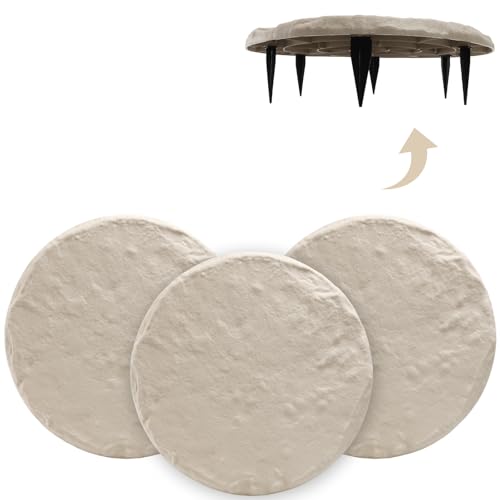
Each stone in this set of four is a 15.5-inch round of weather-resistant resin in a beige limestone tone, weighing a little over a pound, with four ground stakes that push into the soil beneath it. The stake system is the whole idea: there is no digging, no bedding layer, and no leveling beyond flattening the spot by eye. You press the stone down, tap the stakes home, and the path exists. If the route proves wrong, you pull the stakes and move it in minutes.
Resin at this weight cannot match the planted feel of stone or concrete, and the makers are candid in effect if not in words: the system depends on soft, reasonably level ground, because stakes driven into hard, stony soil bend or refuse to seat, and a stone that is not fully staked can shift under a turning foot. The textured face helps grip in wet weather, and the round shape suits informal layouts, stepping across a lawn, a vegetable plot, or a play area. Choose this set when speed, low effort, and the freedom to rearrange matter more than permanence, and check the stakes after the first heavy rain softens the ground.
Bits and Pieces Square Marble Riverstone Stepping Stones, Set of 3

This set of three 12-inch square mats tops a polyresin base with smooth, polished marble riverstones in variegated grey tones, and it is the decorative entry in this roundup. The stones are beautiful in the literal sense that water improves them: after rain the colors deepen and the path looks freshly washed. The square format lines up neatly along a straight border or a patio edge, and the raised pebble surface gives more texture underfoot than a flat polished slab would.
Two cautions belong with the good looks. First, 12 inches is a modest landing area, fine for a garden stroll but tight for anyone carrying a crate or walking with a cane, so treat these as a light-traffic accent rather than the main route to a door. Second, polished stone is the most slippery surface in this guide when wet or mossy, so keep the set out of permanently shaded, damp runs, or commit to brushing it clean through the wet season. Used along a sunny flower bed, beside a pond, or as a decorative crossing through gravel, the set adds a crafted, mosaic quality that plain pavers cannot offer.
How to choose
Begin with thickness, because thickness decides whether a stone rocks or cracks underfoot. A stone bears weight across its whole base only when it is thick enough to stay rigid and bedded flat; thin pieces flex, find a high spot, and rock, and brittle thin pieces eventually split along that flex line. For cast concrete and natural stone, look for roughly two inches of depth on a main path. Flexible rubber and resin mats are the exception: they are thin by design and rely on full ground contact instead of rigidity, which is why they demand level, compacted soil.
Next, plan the bed, not just the stone. Frost heave shifts stones because water in the soil freezes, expands, and lifts each piece unevenly, then leaves it tilted when the thaw comes. A shallow bed of sand or fine gravel under each stone drains that water away, spreads the load, and makes releveling a five-minute job with a trowel and a handful of sand. Stones laid directly on turf or clay will move; stones on a drained bed mostly stay where you put them.
Then set spacing by walking, not by measuring the catalog. Most adults settle into a stride that puts stepping stone centers roughly two feet apart, a little less for children and shorter adults. Lay the stones loose, walk the route at your normal pace carrying something, and adjust until you stop thinking about your feet. Surface finish is the last filter: choose textured, matte faces for shaded or wet routes, and save polished decorative stone for sunny, light-traffic spots you can keep swept, because smooth stones get slippery when wet or mossy.
Who should skip
Skip stepping stones altogether if the route must serve wheels every day. Wheelbarrows, rollators, strollers, and wheeled bins all need a continuous surface; a spaced path will frustrate every trip and can catch a small wheel between stones. A gravel path with edging, or a full paved walkway, serves that ground better. Also skip thin decorative and resin pieces if your path climbs a slope: individual stones on a gradient creep downhill over a season and become a trip hazard on the way down.
Renters who cannot dig should skip bedded stone and concrete entirely and look at the rubber and stake-down resin options above, which leave no trace. Gardeners on heavy clay in a cold climate should think twice about any stone they are not willing to bed on gravel, because frost heave on clay is relentless and a path that needs releveling every spring stops being a pleasure. Finally, if the route is the main entrance used in the dark, choose wide, pale, textured stones or a lit continuous path instead; small dark stones disappear at night exactly where a guest expects firm ground.
Frequently Asked Questions
How far apart should stepping stones be placed?
Place them so the center of one stone sits about one natural stride from the center of the next, which for most adults is roughly two feet. The reliable method is to lay the stones loose, walk the route at your normal pace, and nudge each piece until your feet land without stretching or shuffling. Shorten the gaps on slopes and for children.
Do stepping stones need a base underneath?
For stone and cast concrete, yes: a shallow bed of sand or fine gravel under each piece keeps it level, drains water that would otherwise drive frost heave, and makes future adjustments easy. Thin rubber and stake-down resin pieces are designed to sit on level, compacted soil or mulch instead, but even they sit better on a flattened, cleared spot.
How do I stop stepping stones from rocking?
Rocking means the base is uneven or the stone is too thin for the ground. Lift the stone, remove high spots, add or rake the sand or gravel bed level, and set the stone back with a twist so it beds in fully. On soft soil, widen the bed beyond the stone edges. A stone that still rocks after leveling is usually flexing, and a thicker piece is the real fix.
Are stepping stones slippery in wet weather?
They can be. Smooth and polished surfaces, including river rock and marble pebble mats, get slippery when wet or mossy, while textured concrete, slate-look, and rubber faces keep more grip. Reduce the risk by choosing textured stones for shaded routes, brushing off algae and leaf film through the wet season, and keeping the path clear of standing water.
Final verdict
Match the material to the job and every set here does it well. The Qualdout river rock mats are the pick for a natural-looking main path, the Emsco Group FlatRock covers utility ground that would crack lesser pavers, and the Gardener’s Supply rubber stone is the kind, grippy choice for muddy or rented gardens. The MARCHROSE set wins on sheer ease for anyone who wants a path today and the freedom to move it, while the Bits and Pieces marble squares earn their place as a decorative accent in sunny, light-traffic spots. Whichever you choose, spend your effort on the bed and the spacing: a well-bedded stone at the right stride feels permanent, and a careless one never will.
Product and ASIN Reference
| Product | ASIN |
|---|---|
| Qualdout River Rocks Stepping Stones, Set of 6, Hexagon | B0BPRWPG3M |
| Emsco Group FlatRock Natural Paver, 16 by 16 Inch, Slate | B00295R1Z6 |
| Gardener’s Supply Company Flagstone Recycled Rubber Stepping Stone | B06XD1GGD4 |
| MARCHROSE Round Beige Resin Stepping Stones, Set of 4 | B0FQ2BR23N |
| Bits and Pieces Square Marble Riverstone Stepping Stones, Set of 3 | B07VHPVFRV |
More from Amazon
Programs that pair well with the guide above. Offers and eligibility are set by Amazon and may change.
Collect the home and kitchen items you want in one registry that guests can shop from.
Create a wedding registrySet up recurring deliveries of everyday items on eligible products. Terms and savings are set by Amazon.
Explore Subscribe & SaveFree shipping on eligible items, Prime Video and more. Eligible new members can start with a free trial.
Start a Prime free trialAudiobooks and podcasts to listen to on the go. Eligible new members can start with a free trial.
Try Audible freeAs an Amazon Associate we earn from qualifying purchases.




Write Your Review
No reviews yet. Be the first to share your experience!