

Key takeaways
- Profiles: Use separate profiles for gaming, streaming, editing, and office work. Automatic application switching is convenient, but check that the relevant application is detected reliably.
- Folders: Reserve the first page for frequent actions. Deep folder structures save keys but slow down occasional commands.
- Multi-actions: These can open software, wait briefly, type text, and activate a shortcut in sequence. Add small delays when programs need time to load.
- Icons and labels: Use short labels and consistent colors. Similar-looking icons are a common source of mistakes during meetings or live broadcasts.
- Compatibility: Windows and macOS support is strongest for mainstream tools. Linux users should check current software availability before purchase, because desktop control software and plugins may be limited.
- Privacy: Some integrations use cloud services or account connections. Review permissions before connecting chat, smart-home, calendar, or communication accounts.
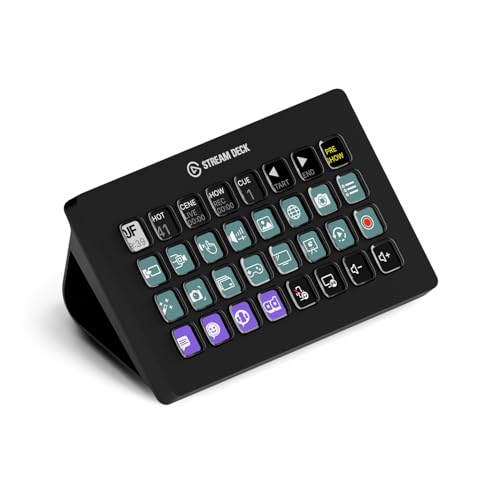
The best stream decks for most people are the Elgato Stream Deck MK.2 for balanced everyday use, the Stream Deck XL for serious streaming and complex workflows, and the Stream Deck Mini for a compact, lower-cost shortcut panel.
A stream deck is a programmable control surface with physical or touchscreen buttons. It can launch applications, run multi-step actions, control microphones and lights, insert text, switch scenes, or trigger shortcuts in creative software. The right choice depends less on maximum button count than on how many commands you need visible at once, how much desk space you have, and whether your software is supported directly or through general keyboard shortcuts.
Our top picks



As an Amazon Associate we earn from qualifying purchases at no extra cost to you. Ratings are shown as listed on Amazon.
Best stream decks at a glance
| Model | Keys or controls | Approx. footprint | Approx. weight | Best for | Typical 2026 market range |
|---|---|---|---|---|---|
| Elgato Stream Deck Mini | 6 LCD keys | 8.4 × 6.0 cm | About 160 g | Everyday shortcuts and small desks | $50–$70 |
| Elgato Stream Deck Neo | 8 LCD keys plus capacitive touch controls | About 10.7 × 11.8 cm | About 210 g | New users and office workflows | $80–$100 |
| Elgato Stream Deck MK.2 | 15 LCD keys | 11.8 × 8.4 cm | About 145 g | Best all-rounder for gaming and work | $120–$150 |
| Elgato Stream Deck + | 8 LCD keys, 4 dials, touch strip | 14.0 × 13.8 cm | About 465 g | Audio, video, photo, and timeline control | $170–$220 |
| Elgato Stream Deck XL | 32 LCD keys | 18.2 × 11.2 cm | About 410 g | Full streaming scenes and large shortcut libraries | $200–$250 |
| Razer Stream Controller X | 15 LCD keys | About 11.1 × 15.0 cm | About 146 g | Streamers who prefer Razer’s ecosystem | $120–$170 |
Dimensions and prices vary slightly by revision, bundle, and region. The table is intended for planning desk space rather than exact furniture measurements.
Our picks by situation
Best overall: Elgato Stream Deck MK.2
The MK.2’s 15 individually labeled LCD keys provide the most useful balance of capacity and footprint. Fifteen visible buttons are enough for common OBS Studio scenes, microphone controls, music playback, video calls, frequently used applications, and a few nested folders for less frequent actions.
Its strongest advantage is the mature Stream Deck software. It supports profiles that change according to the active application, folders, multi-actions, timers, hotkeys, website launches, and a broad plugin ecosystem. It connects by USB and works especially well with OBS Studio, Discord, Zoom, Microsoft Teams, Philips Hue, Spotify, and many Adobe workflows, although individual plugin support can change over time.
Choose the MK.2 if you use shortcuts several times a day but do not want a large control panel occupying the middle of your desk. It is also the safest starting point for a first purchase because 15 keys are more flexible than six without the footprint of the XL.
Best for serious streaming: Elgato Stream Deck XL
The XL is the better choice when you need many controls available without opening folders. Its 32 keys can accommodate several OBS Studio scene layouts, audio sources, camera controls, chat actions, sponsor links, recording functions, and game-specific commands at the same time.
The trade-off is physical size. At roughly 18 cm wide and 11 cm deep before allowing extra room for its cable and your hand, it can compete with a keyboard or mouse. Its price is also easier to justify for frequent streamers than for someone who mainly launches apps and pastes repetitive text.
For a large setup, organize the first page around actions used during every broadcast. Put rare functions in folders rather than filling all 32 keys with visually similar icons. This reduces accidental presses during a live session.
Best compact option: Elgato Stream Deck Mini
The Mini has six LCD keys, but each key can open a folder or run a multi-action. That makes it more capable than the raw number suggests. A key labeled “Work” might open a folder containing email, calendar, meeting, screenshot, and focus-mode commands; another could hold streaming controls.
Six keys become restrictive when you need several controls visible simultaneously. The Mini is therefore best for a small, stable set of shortcuts rather than a large streaming rig. It is a good fit beside a laptop, on a shallow desk, or next to a drawing tablet where every centimeter matters.
Best for dials and creative work: Elgato Stream Deck +
The Stream Deck + replaces some of the MK.2’s buttons with four rotary dials and a touch strip. Dials are useful for volume, brush size, zoom, exposure, timeline movement, and other continuously adjustable settings. This makes it more natural for audio editing, video production, photography, and design than a button-only panel.
It is not automatically better for streaming. A streamer who needs 15 or 32 instantly visible scene and source commands may prefer a button-heavy model. The Stream Deck + earns its higher price when you will adjust values repeatedly, not merely trigger on/off actions.
Best alternative for Razer users: Razer Stream Controller X
The Razer Stream Controller X offers 15 customizable LCD keys in a layout aimed at streaming and shortcut control. It makes the most sense if your desk already revolves around Razer software and peripherals, or if its current price is meaningfully below the comparable Elgato model.
Before buying, compare the exact plugin or integration you need. Stream-deck compatibility is not just about the buttons: software support, profile handling, multi-actions, and application-specific integrations determine how much setup is required.
Head-to-head: what matters more than key count?
| Decision factor | Mini or Neo | MK.2 or Stream Controller X | Stream Deck + | XL |
|---|---|---|---|---|
| Visible actions | 6–8 | 15 | 8 buttons plus continuous controls | 32 |
| Desk demand | Lowest | Low to moderate | Moderate to high | Highest |
| Best control type | Simple triggers and folders | General-purpose shortcuts | Triggers plus adjustment dials | Many simultaneous triggers |
| Learning curve | Low | Low to moderate | Moderate | Moderate because organization matters |
Software compatibility is broadly similar within the Elgato range because the Stream Deck application provides the common foundation. The difference is how comfortably each device exposes those functions. Generic keyboard shortcuts work with almost any application, while deeper controls may require a plugin, an API connection, or a program that supports hotkeys.
A practical sizing calculation
Estimate your needs before choosing by counting actions you use in one session. Suppose your setup needs eight streaming controls, four audio controls, three work shortcuts, and two emergency actions. That is 17 frequently used actions. A 15-key device can handle the first 15 directly, but two actions must go into a folder or onto a second page. An XL can display all 17 and still leave 15 keys for additional scenes or application-specific pages.
For a typical office user, the calculation may be six actions: mute microphone, start meeting, end meeting, screenshot, paste standard text, and open a project folder. A Mini can display all six, so paying for an XL would mainly buy unused capacity and a larger footprint.
Customization and software considerations
- Profiles: Use separate profiles for gaming, streaming, editing, and office work. Automatic application switching is convenient, but check that the relevant application is detected reliably.
- Folders: Reserve the first page for frequent actions. Deep folder structures save keys but slow down occasional commands.
- Multi-actions: These can open software, wait briefly, type text, and activate a shortcut in sequence. Add small delays when programs need time to load.
- Icons and labels: Use short labels and consistent colors. Similar-looking icons are a common source of mistakes during meetings or live broadcasts.
- Compatibility: Windows and macOS support is strongest for mainstream tools. Linux users should check current software availability before purchase, because desktop control software and plugins may be limited.
- Privacy: Some integrations use cloud services or account connections. Review permissions before connecting chat, smart-home, calendar, or communication accounts.
Ownership realities and common mistakes
The keys themselves are generally low-maintenance, but the printed or displayed labels can become less useful as workflows change. Reorganizing profiles every few months is normal. Start with a small set of actions and add commands only after you know they are used often.
Dust and skin oils collect around key gaps, especially on a desk near food or pets. Disconnect the device, use a soft dry cloth, and remove debris with gentle air. Avoid spraying liquid directly onto the panel or forcing liquid under the keys. Keep the USB cable from bending sharply at the connector, since cable strain is more likely to cause intermittent operation than ordinary button wear.
A common mistake is assigning a complicated multi-action to a key without a backup method. Keep important commands—such as stopping a recording or muting a microphone—available through the keyboard or application interface too. Also test actions after software updates, because changed window names, permissions, or plugins can interrupt automation.
Final buying advice
Choose the Elgato Stream Deck MK.2 if you want the best balance for gaming, streaming, and everyday work. Choose the Stream Deck XL when you regularly need more than 15 visible controls. Choose the Stream Deck Mini when desk space and budget matter most. Choose the Stream Deck + when dials are valuable for audio, video, photography, or design. The Stream Deck Neo suits beginners who want a compact, approachable control panel, while the Razer Stream Controller X is worth comparing when its ecosystem and pricing fit your setup.

Write Your Review
No reviews yet. Be the first to share your experience!