

Key takeaways
- Compare the best worm composting bins for patios and gardens, from stacking tray systems to a continuous-flow farm, with full specs and harvest advice.
A worm composting bin turns kitchen scraps into two of the best soil amendments a patio gardener can get: dark, crumbly worm castings and the liquid feed known as worm tea. Unlike a tumbler or a static compost bin, a vermicompost system never needs turning, builds no heat, and works quietly in a shaded corner of a patio, balcony or garage. The worms do the processing, eating roughly half their body weight in scraps each day once the colony is established.
The five systems below cover the two main designs. Stacking tray bins let worms migrate upward toward fresh food, so the finished bottom tray lifts out ready to empty. Continuous-flow bins take scraps at the top and release finished castings from the bottom without disturbing the colony at all. All five are sized for homes, and each runs without power or plumbing.
As an Amazon Associate, we earn from qualifying purchases.
Quick answer
For most patio gardeners, the Worm Factory 360 is the safest first worm bin: a proven four-tray stack that expands as your colony grows. The VermiHut Plus adds a fifth tray and better odor control. Choose the Hungry Bin if you want continuous flow with no tray lifting, the FCMP Essential Living for a compact recycled-plastic build, and the Maze Worm Farm for the smallest footprint.
Worm Factory 360

The Worm Factory 360 is the reference design for home vermicomposting, made in the United States and built around a simple migration loop. It starts with four stacking trays, each with a grid bottom. You fill the bottom tray with bedding and scraps; as it fills, you add the next tray on top and the worms climb through the grid toward the fresh food. When the bottom tray holds only finished castings, you empty it and return it to the top, so harvesting never means sorting worms by hand.
The stack is expandable to six trays when you follow the maker’s directions, which gives a mature colony room to process several pounds of scraps a week. The footprint stays under eighteen inches square, small enough for a shaded patio corner, a balcony or a utility room, and the maker rates it for odor-free operation indoors as well as out. A five-year limited warranty backs the housing. If you want the design with the longest track record and the clearest expansion path, this is the one to start with.
Specs
- System type: Stacking tray vermicomposter
- Trays: 4 included, expandable to 6
- Material: Plastic
- Dimensions: 17.95 x 17.95 x 14.95 inches
- Weight: 11 pounds
- Color: Black
- Warranty: 5-year limited warranty
- Origin: Made in the USA
VermiHut Plus 5-Tray Worm Compost Bin

The VermiHut Plus takes the stacking-tray idea and adds hardware aimed at the two problems beginners report most: stale air and smells. Five trays come in the box, and more can be added. Inside the stack, an M-board divider improves air movement between trays, while the vented lid carries a V-board and a piece of coconut fiber that help manage moisture and trap odor before it escapes. A liquid tray forms a single piece with the base, which removes one assembly step and one leak path.
Small details show the design has been revised with use. A set of raised shoes lifts the bin and discourages ants and other crawling pests from climbing in, a real consideration on warm patios. The starter kit and manual are included, so the box arrives with the bedding basics covered. The listed footprint matches the Worm Factory class at seventeen inches square, but the five-tray stack stands taller, so measure your sheltered spot first.
Specs
- System type: Stacking tray vermicomposter
- Trays: 5 included, expandable
- Manufacturer: VermiTek
- Dimensions: 17 x 17 x 33 inches
- Weight: not stated
- Material: not stated
- Features: M-board airflow divider, V-board and coconut fiber mat in the lid, ant-proof shoe stands, starter kit and manual included
Hungry Bin

The Hungry Bin abandons trays entirely. Designed in New Zealand, it is a tall, wheeled bin with a hinged lid and a patented flow-through floor. You add scraps at the top; the worms work in the upper layer, and finished castings settle downward, where you clip off the base tray and harvest compressed castings without lifting trays or disturbing the colony. Liquid drains to a separate tray beneath, ready to dilute as worm tea.
Capacity is the headline: the bin holds twenty gallons and, per the listing, a mature colony can process up to 4.4 pounds (2 kg) of food waste a day, far beyond a tray stack. The body is molded from polypropylene with organic colorants and a share of recycled content from the maker’s own production offcuts, and it carries a lifetime guarantee. Caster wheels matter more than they sound: a full bin is heavy, and rolling it into shade or under cover ahead of a heat wave or freeze protects the colony. Choose it if your household produces scraps faster than a tray system can take them.
Specs
- System type: Continuous flow-through bin
- Capacity: 20 gallons
- Dimensions: 24 x 26 x 37 inches
- Material: Polypropylene with organic colorants, partly recycled content
- Color: Green
- Mobility: Caster wheels
- Daily throughput: Up to 4.4 pounds (2 kg) of food waste per day, per the listing
- Warranty: Lifetime guarantee, per the listing
FCMP Outdoor Essential Living Composter
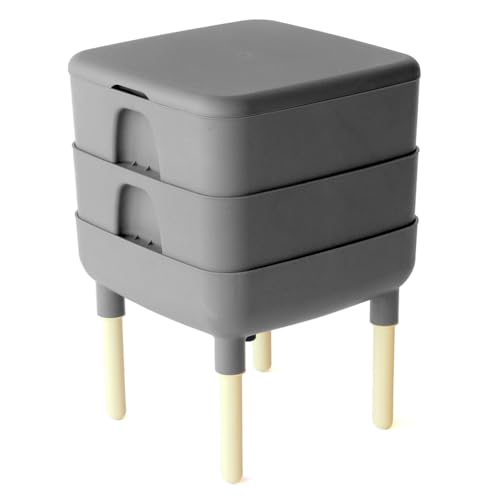
FCMP Outdoor already makes some of the most popular tumblers on this site, and its Essential Living Composter applies the same recycled-plastic construction to worms. The body is BPA-free, UV-inhibited recycled polypropylene, so it shrugs off direct sun on an exposed patio better than bins meant only for shade or indoor use. Two working trays keep the unit compact at fifteen inches square and twenty-two inches tall.
Two design touches help the worms work evenly. A moisture-control channel runs around the outside of each tray and collects water, keeping bedding at the edges from drying out, and fifty-two angled migration tunnels extend down from the tray above, giving worms far more routes upward than a plain grid. Liquid collects in the reservoir base as worm tea; the maker suggests mixing one part tea with one part water for feeding plants. FCMP rates the composter for year-round indoor use as well, since a healthy worm bin produces little odor. Pick it if you want the smallest full-featured tray system and prefer recycled material.
Specs
- System type: Stacking tray vermicomposter
- Trays: 2 working trays
- Material: BPA-free, UV-inhibited recycled polypropylene
- Dimensions: 15 x 15 x 22 inches
- Weight: 10 pounds
- Color: Gray
- Features: 52 migration tunnels, moisture-control water retention channel, worm tea reservoir base
Maze Worm Farm

The Maze Worm Farm is the compact option, a two-tray system just fifteen inches square and eleven inches tall before the optional legs. It suits a balcony, a small greenhouse bench or the floor of a garden shed where a taller stack will not fit. Two working trays rotate: fill one, start the second on top, and empty the first when the worms have moved up. A sliding worm-saver tray catches any worms that drop through, and a liquid collection tray gathers the drainage for use as a diluted feed.
The box includes a block of coconut peat, so the first bedding layer is ready once soaked and fluffed. The lid lifts off and hangs on the side of the bin while you feed, keeping both hands free. Legs are available separately if you prefer the bin raised for easier access and drainage. Capacity is modest, so this is a bin for a one- or two-person household’s vegetable scraps rather than a big family’s full waste stream, but within that role it is tidy, light and easy to move at nine pounds.
Specs
- System type: Stacking tray vermicomposter
- Trays: 2 working trays, plus worm-saver tray
- Dimensions: 15 x 15 x 11 inches
- Weight: 9 pounds
- Material: not stated
- Capacity: not stated
- Includes: Lid, base, liquid collection tray, coconut peat bedding
- Legs: Optional, sold separately
How to choose
Pick a system type first. Stacking trays (Worm Factory 360, VermiHut Plus, FCMP, Maze) harvest in batches: you lift off a finished tray every few months. They are cheaper to start and easy to expand. A continuous-flow bin (Hungry Bin) harvests from the bottom in small amounts whenever you need castings, with no tray lifting, but it costs more and needs a bigger colony to work well.
Match capacity to your scraps. A healthy colony eats roughly half its body weight per day, and a starting pound of red wigglers handles a small household’s vegetable scraps. Two-tray bins suit one or two people; four- and five-tray stacks suit families; the twenty-gallon Hungry Bin suits heavy producers and gardeners who also add shredded leaves and garden trimmings.
Plan the location before you buy. Worms want shade, shelter from driving rain, and moderate temperatures: a hot patio in full summer sun or an unheated space in a hard freeze will kill a colony. A shaded patio corner, balcony, garage or basement all work. Check the bin’s height and footprint against that spot, and prefer a model with a liquid tray so excess moisture drains instead of souring the bedding.
Budget for worms and bedding separately. None of these systems includes live worms; order red wigglers (Eisenia fetida) from a worm supplier when the bin arrives, and keep damp shredded cardboard or coconut coir on hand for bedding.
Who should skip
Skip worm composting if most of your food waste is meat, dairy, cooking oil or heavily salted food: worms cannot process those, and a sealed tumbler or municipal collection is a better fit. Skip it if you need finished compost in a few weeks for a large garden, since a worm bin produces castings in small, steady amounts rather than bulk volume. Skip it if your only available spot sits in full afternoon sun or freezes hard all winter with no garage or basement to move the bin into. And skip it if nobody at home will feed the bin and check moisture every week or so; a colony is livestock, however small, and a neglected bin fails slowly and smells while doing it.
FAQ
How many worms do you need to start a worm composting bin?
Start with about one pound of red wigglers, roughly a thousand worms, for a tray system. That sounds like a lot, but the colony settles quickly and begins breeding toward the bin’s carrying capacity. Feed lightly for the first weeks, about a quarter pound of scraps a day, and increase as the population grows.
Can a worm bin stay on a patio or balcony all year?
Yes, in a shaded, sheltered spot in a mild climate. Worms work best in moderate temperatures, so in regions with hard freezes or heat waves, plan to roll or carry the bin into a garage, basement or covered porch during extremes. Bins with legs or wheels make that move much easier.
What should you never feed composting worms?
Keep out meat, fish, dairy, oils, and pet waste, all of which sour the bedding and attract pests. Go easy on citrus peel, onions and spicy food, which worms avoid and which can acidify the bin. Fruit and vegetable scraps, coffee grounds, crushed eggshells and shredded cardboard are the reliable staples.
How long before you can harvest the first worm castings?
Expect the first finished tray in about three to six months, once the colony is established and the bottom tray is full of dark castings with few visible food scraps. After that first harvest, a tray system produces a tray every couple of months, and a continuous-flow bin yields small amounts from the bottom whenever you need them.
Final verdict
Every bin here will turn scraps into castings; the choice is about harvest style and space. The Worm Factory 360 remains the default recommendation for its proven migration loop, compact footprint and expansion to six trays. The VermiHut Plus is the better pick if odor control is your worry, and the Hungry Bin is the step up for households that outgrow trays. The FCMP Essential Living and the Maze Worm Farm cover the small-space end, one in sun-resistant recycled plastic, the other in the shortest, lightest package of the five.
Product and ASIN Reference
| Product | ASIN |
|---|---|
| Worm Factory 360 | B002LH47PY |
| VermiHut Plus 5-Tray Worm Compost Bin | B07PRKLCZQ |
| Hungry Bin | B01CRJGUOG |
| FCMP Outdoor Essential Living Composter | B0913GP19G |
| Maze Worm Farm | B07ZD8M1HN |
More from Amazon
Programs that pair well with the guide above. Offers and eligibility are set by Amazon and may change.
Collect the home and kitchen items you want in one registry that guests can shop from.
Create a wedding registrySet up recurring deliveries of everyday items on eligible products. Terms and savings are set by Amazon.
Explore Subscribe & SaveFree shipping on eligible items, Prime Video and more. Eligible new members can start with a free trial.
Start a Prime free trialAudiobooks and podcasts to listen to on the go. Eligible new members can start with a free trial.
Try Audible freeAs an Amazon Associate we earn from qualifying purchases.


Write Your Review
No reviews yet. Be the first to share your experience!