

Key takeaways
- For a front-door pair: Choose matching 20–24-inch tapered planters, each roughly 35–70 pounds empty, with drainage holes and a frost-resistant concrete or fiber-cement blend.
- For a balcony or raised deck: Use smaller fiber-reinforced planters, preferably under 35 pounds empty and no more than 18 inches wide. Confirm the structure’s load limits before adding wet soil.
- For a large patio focal point: A 28–36-inch bowl or square planter creates impact, but its filled weight can exceed 200 pounds. Position it before planting.
- For herbs and seasonal flowers: Select a 12–18-inch pot with a drainage hole. A concrete-look planter made from fiberglass or resin may be more practical if you rearrange containers often.
- For cold climates: Look for frost-resistant, fiber-reinforced concrete with good drainage and avoid leaving water trapped in the planter through freeze-thaw cycles.
The best concrete outdoor planters are the ones whose size, drainage, weight, and concrete blend match your patio surface, plant, and willingness to move them; for most homes, a fiber-reinforced concrete planter 18–24 inches wide with a real drainage hole is the most versatile choice.
Our top picks
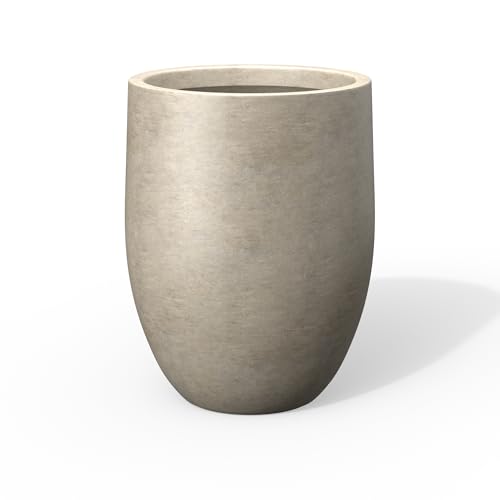


As an Amazon Associate we earn from qualifying purchases at no extra cost to you. Ratings are shown as listed on Amazon.
Quick picks by patio situation
- For a front-door pair: Choose matching 20–24-inch tapered planters, each roughly 35–70 pounds empty, with drainage holes and a frost-resistant concrete or fiber-cement blend.
- For a balcony or raised deck: Use smaller fiber-reinforced planters, preferably under 35 pounds empty and no more than 18 inches wide. Confirm the structure’s load limits before adding wet soil.
- For a large patio focal point: A 28–36-inch bowl or square planter creates impact, but its filled weight can exceed 200 pounds. Position it before planting.
- For herbs and seasonal flowers: Select a 12–18-inch pot with a drainage hole. A concrete-look planter made from fiberglass or resin may be more practical if you rearrange containers often.
- For cold climates: Look for frost-resistant, fiber-reinforced concrete with good drainage and avoid leaving water trapped in the planter through freeze-thaw cycles.
Concrete outdoor planter comparison
The dimensions below are useful planning ranges rather than universal specifications. Actual weight varies with wall thickness, aggregate, shape, and whether the planter is solid concrete, fiber cement, or a lightweight composite.
| Planter size | Typical planting capacity | Empty weight | Approximate filled weight* | Best placement |
|---|---|---|---|---|
| 12–14 in. diameter | 4–8 gallons | 12–30 lb | 50–100 lb | Steps, small patios, herbs, annuals |
| 16–18 in. diameter | 10–18 gallons | 20–45 lb | 100–180 lb | Single shrubs, grasses, entryway accents |
| 20–24 in. diameter | 20–35 gallons | 35–75 lb | 180–350 lb | Front doors, patios, substantial perennials |
| 28–36 in. diameter | 45–90 gallons | 70–180 lb | 400–850 lb | Permanent focal points and large shrubs |
*Filled-weight estimates assume damp potting mix and do not include the plant. Dense garden soil can be substantially heavier.
Concrete blends: what you are actually buying
Traditional cast concrete
Traditional concrete is the heaviest and often the most stable option in windy entryways. It tolerates sun well and usually feels substantial, but its weight makes delivery, installation, and later repositioning difficult. Hairline cracks can develop if water freezes inside the wall or base. Choose it when the planter will remain in one location for years and the supporting surface is suitable.
Fiber-reinforced concrete
Concrete reinforced with glass, polymer, or other fibers can use thinner walls while retaining useful strength. These planters are commonly lighter than traditional cast concrete and are less prone to large structural cracks, although they are not unbreakable. This is usually the best compromise for a residential patio or entryway.
Fiber cement and concrete-look composites
Fiber cement and composite planters can deliver the appearance of concrete at a fraction of the weight. They are easier to move and may be a better choice for balconies, roof terraces, and renters. The trade-off is that finishes can scratch or fade, and some lightweight products are less stable in strong wind. Check whether the base is weighted and whether the material is rated for year-round outdoor use.
Drainage matters more than the finish
A beautiful planter without drainage can kill a plant and damage the container. Look for at least one opening in the bottom, ideally 1/2 to 1 inch wide on a medium pot. Large planters may have several holes or a central drain. A removable plug is useful only if you can reliably open it outdoors; a permanently sealed planter is better treated as a decorative cover rather than a planting container.
Do not fill the bottom with gravel to “improve drainage.” It reduces the depth available to roots and does not create a faster-draining layer above a blocked hole. Instead, place the planter on feet or thin spacers so water can escape, then use a quality container mix. Add a mesh screen over a large hole if you need to keep potting mix from washing out.
For a planter holding 20 gallons of mix, a drainage hole that is blocked by a flat patio surface can leave many gallons of water trapped after heavy rain. That extra weight also increases stress on the base and makes freeze damage more likely.
How to choose the right size
Match the planter to the plant’s mature root space, not the size of the nursery pot. As a practical starting point, a 12–14-inch planter suits herbs, compact annuals, and small ornamental grasses. Use a 16–20-inch container for a larger grass, a compact shrub, or a mixed seasonal display. A shrub intended to remain outdoors for several years often needs at least 20–24 inches of width and depth, depending on the species.
For a front entry, measure the clear walking path first. A pair of 24-inch planters can occupy more than 5 feet from outside edge to outside edge when placed on either side of a door. Leave enough room for the door swing, packages, snow removal, and accessibility. On a narrow landing, tall tapered planters may provide the visual height you want without the footprint of wide bowls.
Decision matrix for real-world use
| Your situation | Recommended construction | Useful size | Why |
|---|---|---|---|
| Limited budget and permanent placement | Standard cast concrete | 16–24 in. | Usually offers the lowest cost per year when protected from standing water |
| Frequent rearranging | Fiber-reinforced concrete or composite | 12–18 in. | Lower empty weight makes seasonal changes realistic |
| Windy entryway | Heavy concrete with a broad base | 20–28 in. | Resists tipping; avoid tall, narrow shapes unless anchored |
| Freeze-thaw climate | Frost-resistant fiber concrete with open drainage | 16–24 in. | Reduces trapped-water damage while preserving useful mass |
| Balcony or rooftop | Lightweight concrete-look composite | 12–18 in. | Reduces structural load; still requires building approval |
Placement and surface protection
Concrete can scratch painted decking, stain porous stone, and trap moisture against wood. Place rubber pads, non-staining risers, or purpose-made pot feet beneath the planter, leaving enough clearance for airflow and drainage. Do not place a heavy container over a deck board that already flexes or over a damaged paver.
On balconies and decks, estimate the total load rather than considering the planter alone. For example, a 24-inch planter weighing 55 pounds empty, holding 25 gallons of damp mix at approximately 9 pounds per gallon, and containing a 10-pound plant weighs about 290 pounds:
55 + (25 × 9) + 10 = 290 pounds
That load is concentrated in a small area. Consult the property manager, building engineer, or structural professional when the supporting surface or allowable load is uncertain.
Durability and maintenance realities
- Water damage is the common failure: Keep drainage open, raise the base, and do not let the planter sit in a saucer of standing water outdoors.
- Finish changes are normal: Mineral deposits, algae, and uneven weathering may appear on concrete. A soft brush, clean water, and mild soap are safer than aggressive acids or pressure washing.
- Sealer is not a cure-all: A breathable, exterior-rated sealer can reduce staining, but it will not make a cracked or poorly drained planter frost-proof. Reapply only according to the manufacturer’s instructions.
- Roots can exert pressure: Avoid trees or aggressive bamboo-like plants in containers that are too small. Repot or root-prune as appropriate for the species before roots circle densely.
- Moving is hazardous: Never drag a full concrete planter across a patio. Use a furniture dolly before planting, with a second person helping to stabilize tall containers.
Bottom line
For most patios and entryways, choose a 16–24-inch fiber-reinforced concrete planter with a broad base, an unobstructed drainage hole, and a frost-resistant rating suited to your climate. Select traditional concrete when maximum stability and permanent placement matter, and choose a lightweight concrete-look composite when the surface, budget, or seasonal rearranging makes heavy containers impractical. Size the planter for the plant’s mature roots, calculate the filled weight before delivery, and treat drainage and placement supports as essential features rather than optional extras.




Write Your Review
No reviews yet. Be the first to share your experience!