

Key takeaways
- Small yard, many obstacles: Choose a push sweeper. Its narrower frame is easier to steer around trees, garden beds, and play equipment.
- Large lawn and riding mower: Choose a tow-behind with a wide brush and a large hopper. A rope dump lets you empty it without climbing off the mower, though you still need to pull the load to a suitable disposal spot.
- Frequent leaf drops: Prioritize hopper capacity and a convenient emptying method. A large hopper is useful only if your route allows it to reach the compost or collection area without awkward maneuvering.
- Mostly grass clippings: Either style can collect dry, loose clippings. Mow when the grass is dry, avoid leaving thick windrows, and make a second pass where clippings remain.
- Limited storage space: Check the assembled dimensions and whether the hopper folds or detaches. A broad tow-behind may take more room than its product photo suggests.
Best Lawn Sweepers for Fast Yard Cleanup
The best lawn sweeper depends on how you’ll use it: choose a push model for a small yard, tight turns, and occasional cleanup; choose a tow-behind model for a large, open lawn where a wider brush and bigger hopper can cut trips. For a versatile push option, consider the Agri-Fab 26-inch Push Lawn Sweeper; for riding-mower owners who want more capacity, the Agri-Fab 44-inch Tow Lawn Sweeper is a practical place to start.
Push vs. tow-behind: which suits your yard?
A push sweeper is powered by its wheels as you walk. It is easy to maneuver around beds and trees, requires no tractor, and is simpler to store. Its narrower path and smaller hopper mean more passes and more frequent emptying on a large property.
Our top picks

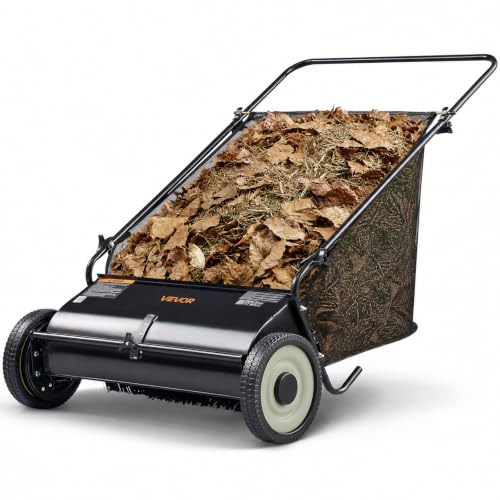


As an Amazon Associate we earn from qualifying purchases at no extra cost to you. Ratings are shown as listed on Amazon.
A tow-behind sweeper attaches to a lawn tractor or compatible riding mower. The larger working width and hopper suit broad, relatively level areas, but the equipment needs room to turn and a suitable towing vehicle. It is less convenient around narrow gates, steep slopes, and crowded landscaping.
Neither style is a lawn vacuum. Sweepers lift loose material with rotating brushes and deposit it in a hopper. They work best on dry leaves and clippings that have not been pressed into wet turf. A sweeper can also pick up pine needles and small twigs, but results depend on brush height, debris size, lawn condition, and how quickly the hopper fills.
Specifications at a glance
The figures below are manufacturer-listed specifications for representative Agri-Fab models. Confirm the current manual and product listing before buying: included hardware and specifications can vary by model year or configuration.
| Model | Type | Brush width | Hopper capacity | Emptying | Best fit |
|---|---|---|---|---|---|
| Agri-Fab 26-inch Push Lawn Sweeper | Push | 26 in. | 7 cu. ft. | Hopper lifts off for dumping | Small-to-medium yards and tight routes |
| Agri-Fab 44-inch Tow Lawn Sweeper | Tow-behind | 44 in. | 25 cu. ft. | Rope-operated dumping from the seat | Large, open lawns with a riding mower |
These models illustrate the main trade-off: the 44-inch sweeper covers about 69% more width per pass than the 26-inch model, while its listed hopper volume is over three times as large. Actual time saved depends on turning, overlap, debris volume, and dumping—not just brush width.
Best picks by situation
- Small yard, many obstacles: Choose a push sweeper. Its narrower frame is easier to steer around trees, garden beds, and play equipment.
- Large lawn and riding mower: Choose a tow-behind with a wide brush and a large hopper. A rope dump lets you empty it without climbing off the mower, though you still need to pull the load to a suitable disposal spot.
- Frequent leaf drops: Prioritize hopper capacity and a convenient emptying method. A large hopper is useful only if your route allows it to reach the compost or collection area without awkward maneuvering.
- Mostly grass clippings: Either style can collect dry, loose clippings. Mow when the grass is dry, avoid leaving thick windrows, and make a second pass where clippings remain.
- Limited storage space: Check the assembled dimensions and whether the hopper folds or detaches. A broad tow-behind may take more room than its product photo suggests.
What matters beyond brush width
Height adjustment
Brush height is one of the most important settings. The brushes should contact the lawn enough to lift debris, but not dig into soil or scrape the turf. Start with a higher setting, make a short test pass, and lower the brushes gradually until they collect well without dragging. Uneven ground may require a compromise: a setting that works on the smooth center of the lawn could be too low near bumps or roots.
Hopper capacity and emptying
Leaf volume varies enormously: a dry, lightly covered lawn fills a hopper differently from a thick layer of broad leaves. Bigger capacity reduces trips, but a full hopper gets heavier and can be harder to maneuver or dump. Push-sweeper hoppers that lift off are straightforward to empty near a compost pile; tow-behind rope dumps save steps when unloading from the seat. Check how the hopper attaches and whether it will fit through your gate when loaded or folded.
Leaves versus clippings
Dry leaves are generally the easiest material to sweep because they stay loose and ride over the grass. Wet leaves tend to mat, cling to the hopper, and overload the brushes. Fine or damp clippings can also pack into the mesh or fabric bag. If material is sticking, stop and clear the hopper rather than continuing to push or tow a clogged load. For heavy debris, several light passes usually work better than trying to collect everything at once.
Setup and maintenance that protect performance
- Assemble on level ground and check the wheel and brush drive. The brushes usually turn through wheel-driven gearing, so loose hardware or a poorly seated wheel can reduce pickup.
- Set the brush height with a short test pass. Adjust in small increments; excessive contact wears the brush and makes the sweeper harder to move.
- Work in manageable rows. Overlap passes slightly, but avoid repeatedly running over a full hopper’s trail of debris.
- Empty before the load becomes difficult to move. This is especially important on slopes and with push models.
- After use, remove packed leaves and clippings. Let the hopper dry before storage to limit mildew and corrosion. Inspect brush bristles, wheel-drive parts, hitch hardware, and the hopper fabric or mesh for wear.
Brushes are the main wear item: stiff bristles gradually shorten or bend, reducing their ability to lift debris. Hopper seams, fabric, and fasteners can also fail after repeated overloading or storage while wet. Replacement-part availability is worth checking before purchase, particularly if you expect to use the sweeper every fall. Avoid towing faster than the manual recommends; excess speed can cause bouncing and uneven pickup.
Is a lawn sweeper worth the cost?
Push lawn sweepers commonly fall in the roughly $100–$250 range, while tow-behind models are often about $250–$600, with larger or more specialized units costing more. Treat those as broad market ranges, not current quotes. The value comes from replacing repeated raking or blowing-and-piling with collection in one operation. For an occasional cleanup on a small lawn, a rake may be more economical; for recurring leaves across a large property, a tow-behind’s capacity can justify the extra equipment and storage space.
Before choosing, measure your narrowest gate, consider where the collected debris will go, and confirm your mower’s hitch compatibility and towing guidance. Those practical checks can matter more than buying the widest sweeper available.





Write Your Review
No reviews yet. Be the first to share your experience!