

Key takeaways
- Tines: Hollow steel tines can dull, bend, or clog. Replace damaged tines rather than forcing them through hard ground.
- Bearings and axles: Dirt and moisture shorten their life. Clean around moving parts and lubricate only where the manufacturer specifies.
- Fasteners: Vibration can loosen tine bolts, wheel nuts, and hitch hardware. Check them before each use.
- Weight trays and handles: Overloading a frame or dropping a heavy drum can cause bends that alter tine depth.
- Wheels: Pneumatic tires may lose pressure during storage, while small solid wheels can develop flat spots or wear unevenly.
The best lawn aerators for most home lawns are hollow-tine core aerators: they remove plugs of compacted soil rather than merely poking holes, improving air, water, and nutrient movement where grass roots need it.
The right choice depends less on the product label than on four practical questions: how large the lawn is, how severely the soil is compacted, how deeply the tines penetrate, and whether you have room to store or tow the equipment. Core, spike, tow-behind, and rolling aerators each suit a different situation.
Our top picks


As an Amazon Associate we earn from qualifying purchases at no extra cost to you. Ratings are shown as listed on Amazon.
Best lawn aerators by situation
| Lawn situation | Best aerator type | Typical working width | Typical depth | Why it fits |
|---|---|---|---|---|
| Small lawn under 2,000 sq. ft. | Manual core or rolling core | 10–18 inches | 2–3 inches | Low storage demand and precise control |
| Occasional light compaction | Spike aerator | 12–18 inches | 1–2 inches | Inexpensive and quick to use |
| Dense clay or repeatedly compacted soil | Core aerator | 12–24 inches | 2–4 inches | Removes soil plugs instead of compressing them |
| Lawn from 5,000–20,000 sq. ft. | Rolling or powered core aerator | 16–24 inches | 2–3 inches | Faster coverage with less repeated foot traffic |
| Large lawn or acreage | Tow-behind core aerator | 36–48 inches | 2–3 inches | Designed for repeated passes behind a lawn tractor |
Core aerators: the strongest choice for compacted soil
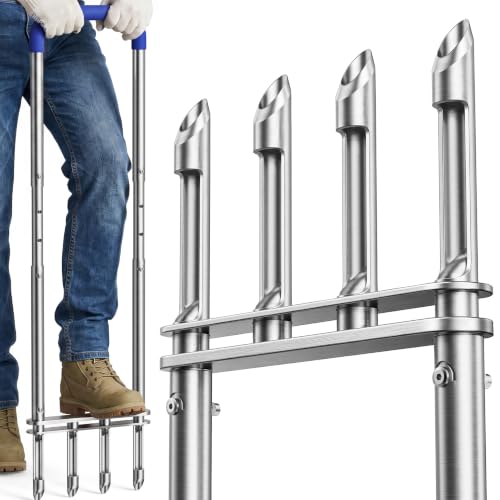
Core, hollow-tine, or plug aerators pull cylindrical samples of soil from the lawn. The open holes allow rainfall and irrigation to move below the surface, while the remaining soil plugs gradually break down on top of the turf.
Choose a core aerator when the lawn has hard clay, heavy foot traffic, standing water, thin growth, or a surface that feels difficult to penetrate with a garden fork. Look for hollow tines made from steel, a working depth of at least 2 inches, and a frame heavy enough to enter firm ground without excessive downward pressure.
Manual core aerators are economical for small areas but physically demanding. A two-tine or four-tine tool may weigh roughly 4–10 pounds and cover only a narrow strip per step. Rolling core aerators commonly weigh 15–35 pounds before added ballast. Their wider drum covers ground more quickly, but turning at lawn edges can be awkward.
The main ownership issue is tine blockage. Damp clay can fill hollow tubes and stop the tool from removing plugs. Aerate when the soil is moist enough to penetrate but not wet enough to smear; a practical test is that a footprint is visible, but water does not squeeze from the soil when pressed.
Spike aerators: affordable, simple, and limited
Spike aerators use solid points, blades, or star-shaped discs to puncture the soil. They are often the smallest and least expensive option, with general market prices of about $25–$100 for manual models and approximately $100–$300 for rolling versions.
They work well for light surface compaction, narrow side yards, and lawns that receive occasional rather than constant traffic. Spike shoes and small hand tools also make sense when storage space is extremely limited.
The limitation is soil displacement. A solid tine enters the ground and pushes soil sideways or downward. In heavy clay, repeated spiking can create compacted walls around the holes rather than opening a lasting channel. For that reason, spike aeration is better viewed as a maintenance treatment for mild problems, not a substitute for core aeration on severely compacted lawns.
If you choose a spike model, prefer sturdy steel tines, a frame that does not flex, and adjustable ballast. A lightweight tool may glide over hard ground; a model that accepts 20–40 pounds of added weight can penetrate more consistently, though it will require more effort to push.
Rolling aerators: the practical middle ground
Rolling aerators use a drum or wheel fitted with hollow or solid tines. You push them in straight lines, making them faster than a handheld tool while remaining easier to store than a tow-behind attachment.
A rolling core aerator is a strong fit for a level lawn between about 2,000 and 8,000 square feet, especially when the owner wants control over turns, garden beds, and tree roots. Typical working widths range from 12 to 18 inches, and one pass may cover roughly 2,000–4,000 square feet per hour depending on soil hardness, walking speed, and how often the drum needs clearing.
Weight matters more than advertised width. A broad but lightweight drum may not penetrate firm soil. A narrower model weighing 25–35 pounds can outperform a larger 15-pound unit if its tines are sharp and the frame maintains contact with the ground. Some drums can be filled with water or sand; check whether the added weight makes the tool difficult to lift into storage.
Tow-behind aerators: fastest for large lawns
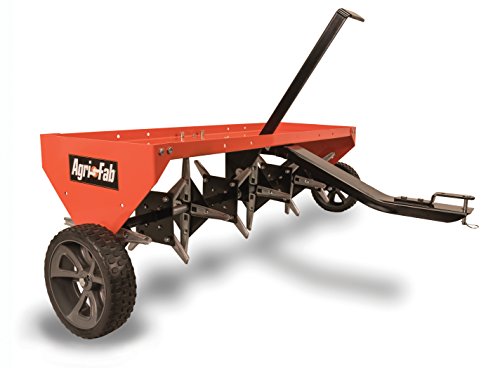
Tow-behind aerators attach to a lawn tractor, riding mower, or compatible utility vehicle. Their 36–48-inch working width can make them the most efficient option for lawns above roughly half an acre, particularly when aeration is needed more than once a year.
They usually rely on a weight tray, water-filled drum, or removable steel weights to force the tines into the soil. A useful target is around 70–150 pounds of operating ballast, depending on the model and the tractor’s towing capacity. More weight is not automatically better: excessive ballast can damage turf, overload the hitch, or make turns difficult.
Before buying, verify the hitch height, towing limit, storage footprint, and turning space. A 48-inch aerator can cover a large open lawn quickly but may be frustrating around fences, shrubs, drainage areas, and narrow gates. Tow-behind models also require seasonal maintenance on wheels, axles, tine shafts, and fasteners.
Decision matrix: which type matches your needs?
| Priority | Recommended choice | Trade-off |
|---|---|---|
| Lowest purchase cost | Manual spike or manual core | Slow coverage and greater physical effort |
| Best results in hard clay | Core aerator | More expensive and requires soil moisture timing |
| Least storage space | Handheld spike tool or narrow rolling model | Limited coverage per pass |
| First-time homeowner | Rolling core aerator for a small or medium lawn | Requires room to turn and clean |
| Frequent use on a large property | Tow-behind core aerator | Needs a towing vehicle and protected storage |
| Very occasional, mild compaction | Rolling spike aerator | Less effective in dense or wet clay |
How to size an aerator and estimate the work
Coverage is more useful than width alone. For example, an 18-inch rolling aerator has a nominal path of 1.5 feet. At a walking speed of 2 miles per hour, its theoretical coverage is:
1.5 feet × 176 feet per minute = 264 square feet per minute.
That equals about 15,800 square feet per hour before turning, clearing blocked tines, and overlapping passes. Allowing for real-world interruptions, 3,000–6,000 square feet per hour is a more practical planning range for a manual rolling unit. A 10,000-square-foot lawn could therefore take roughly two to three hours, rather than the theoretical 38 minutes.
For thorough coverage, make one pass in a north–south direction and a second pass east–west, especially where compaction is severe. Two crossing passes increase the number of holes but also increase labor and turf disturbance, so use them only when the soil and grass need that level of treatment.
What wears out first
- Tines: Hollow steel tines can dull, bend, or clog. Replace damaged tines rather than forcing them through hard ground.
- Bearings and axles: Dirt and moisture shorten their life. Clean around moving parts and lubricate only where the manufacturer specifies.
- Fasteners: Vibration can loosen tine bolts, wheel nuts, and hitch hardware. Check them before each use.
- Weight trays and handles: Overloading a frame or dropping a heavy drum can cause bends that alter tine depth.
- Wheels: Pneumatic tires may lose pressure during storage, while small solid wheels can develop flat spots or wear unevenly.
After use, remove soil from the tines, rinse away residue, and dry exposed steel before storing the tool under cover. Do not leave a filled water drum exposed to freezing temperatures. Empty it first, because expanding ice can split the drum or fittings.
How to aerate without damaging the lawn
- Confirm the problem. Push a screwdriver into the turf. If it stops within an inch or two in several locations, compaction may be significant.
- Mark hazards. Identify irrigation lines, shallow cables, drainage covers, tree roots, and edging.
- Water moderately. Aim for penetrable soil, not mud. Wait if the surface smears underfoot.
- Set the depth. Start at 2 inches. Increase toward 3–4 inches only if the soil, turf, and aerator can handle it.
- Make consistent passes. Walk or tow at a steady speed and avoid sharp turns that tear the grass.
- Leave the plugs. They usually break down naturally and return soil and organic matter to the surface.
- Clean and inspect. Clear every tine and check the frame before putting the aerator away.
Final recommendation
For the broadest range of lawn problems, choose a core aerator with steel hollow tines, at least 2 inches of penetration, and enough weight to stay engaged with the soil. Select a manual or rolling model when storage and maneuverability matter; choose tow-behind equipment when lawn size makes walking impractical. Use a spike aerator for light, occasional compaction—not as the primary solution for dense clay or chronically waterlogged ground.




Write Your Review
No reviews yet. Be the first to share your experience!