

Key takeaways
- Budget under $200: Choose a compact or 24-inch polyethylene roller. Spend the remaining budget on a replacement drain-plug washer, hitch hardware, and covered storage rather than on unnecessary accessories.
- First-time owner: Select a water-filled poly model with a visible fill opening and a broad, stable frame. Its adjustable weight makes mistakes less costly than using a permanently heavy steel drum.
- Small storage area: Favor the lowest empty weight and a roller that can stand vertically without resting on the drain fitting.
- Use once or twice a year: Poly is usually the better value because it will not rust and is easier to handle when empty.
- Frequent use on several acres: A wide steel roller saves travel time and generally offers stronger axle and bearing hardware, provided the tow vehicle is rated for it.
- Newly seeded lawn: Use a clean, partly filled poly roller. The aim is light seed-to-soil contact, not maximum compaction.
The best lawn rollers for most homeowners are tow-behind, water-filled polyethylene rollers: choose a 24-inch model for ordinary residential lawns, an 18-inch model for narrow gates and smaller tractors, or a 42- to 48-inch steel roller for frequent large-area work.
Our top picks



As an Amazon Associate we earn from qualifying purchases at no extra cost to you. Ratings are shown as listed on Amazon.
Quick picks by lawn and workload
| Best for | Recommended roller type | Why it fits | Typical market range |
|---|---|---|---|
| Occasional homeowner use | 24-inch poly, tow-behind, water-filled | Good balance of width, maneuverability, and storage | $150–$250 |
| Small yards or narrow access | 18-inch poly, approximately 36 inches wide | Fits tighter spaces and needs less water to fill | $130–$220 |
| Large lawns and repeated use | 42- to 48-inch steel, tow-behind | Covers ground quickly and tolerates frequent heavy work | $350–$800+ |
| Newly seeded lawn | Light poly roller, used partly filled | Provides gentle seed-to-soil contact without excessive compaction | $130–$250 |
Best lawn rollers compared
Best overall: 24-inch tow-behind polyethylene roller
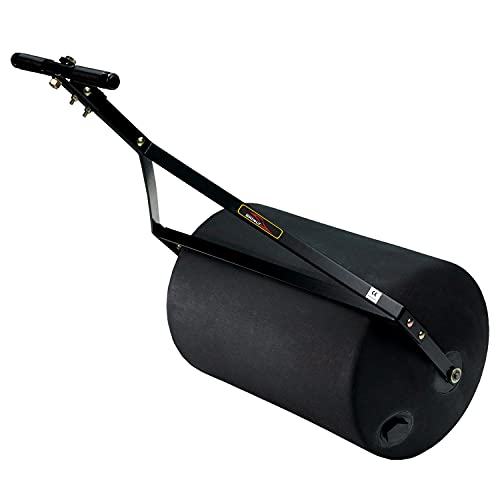
A 24-inch poly roller, such as the type sold by Brinly, is the most versatile choice for a typical suburban lawn. Its drum commonly holds about 270 pounds of water, giving a filled weight near 300 to 320 pounds once the frame and axle are included. Empty weight is usually around 45 to 55 pounds, so one person can move it into storage before filling.
The polyethylene drum will not rust, and a 24-inch width is narrow enough for many residential gates while still covering a useful strip on each pass. A rounded or rounded-edge drum is preferable to a sharply square-ended roller because it is less likely to leave ridges when turning.
This is the right pick for flattening minor frost heave, pressing down loose topsoil after light grading, and maintaining a lawn once or twice per year. It is less suitable for breaking down hard construction ruts; added water increases contact pressure, but it does not turn a residential roller into a grading machine.
Best for tight spaces: compact 18-inch roller
An 18-inch roller with a drum approximately 36 inches wide is easier to steer around landscaping and may pass through gates that exclude larger equipment. Compact rollers often hold roughly 250 to 400 pounds of water, depending on drum diameter and design.
The trade-off is coverage. If the drum is 36 inches wide, a 10,000-square-foot lawn requires approximately 2,778 linear feet of travel before allowing for overlap:
10,000 square feet ÷ 3 feet of drum width = 3,333 feet. Allowing for a modest overlap between passes, plan on about 3,500 feet. A 48-inch roller reduces the theoretical distance to about 2,500 feet, so the wider machine saves time on large open lawns.
A compact roller is also a sensible choice when storage space is limited. Its lower empty weight makes it easier to hang, stand upright, or move by hand, but the smaller drum may require more passes and can be less stable over pronounced uneven ground.
Best for large properties: heavy-duty steel roller
Steel rollers in the 42- to 48-inch class are designed for larger lawns, sports areas, estates, and frequent seasonal use. Depending on the drum diameter and construction, their filled weights can range from approximately 600 to more than 900 pounds. Empty weights commonly fall between 150 and 300 pounds.
Brands such as Ohio Steel and Agri-Fab offer recognizable tow-behind lawn equipment in this general category, although dimensions and capacities vary by model. Steel provides a rigid drum and strong axle support, but it costs more, requires rust prevention, and is much less forgiving if it is left full of water or stored outdoors.
Use a steel roller only with a tractor, riding mower, or utility vehicle whose hitch, braking ability, and operating manual support the load. A filled 48-inch roller can exceed the practical towing limit of many lightweight lawn tractors, particularly on slopes.
What the specifications really mean
| Feature | Compact poly roller | 24-inch poly roller | 42- to 48-inch steel roller |
|---|---|---|---|
| Typical drum width | 18–24 inches | 24 inches | 42–48 inches |
| Typical empty weight | 35–70 lb | 45–60 lb | 150–300 lb |
| Typical filled weight | 250–400 lb | 300–325 lb | 600–950+ lb |
| Approximate water capacity | 30–48 gallons | 32–35 gallons | 70–110 gallons |
| Best tow vehicle | Light lawn tractor | Lawn tractor or zero-turn with approved hitch | Heavy lawn tractor or compact utility tractor |
| Main advantage | Easy storage and access | Versatility | Coverage and durability |
Water weighs about 8.34 pounds per U.S. gallon. That means a 35-gallon drum contains about 292 pounds of water before adding the roller frame. This explains why a model that feels light when empty can become too heavy for a small mower when full.
Drain plugs, towing, and construction details
Drain plugs
A large, replaceable drain plug is more important than it first appears. Drain the roller after every use in freezing climates; trapped water can freeze, expand, and damage a poly drum or fittings. Look for a plug that can be reached while the roller is upright, uses a common gasket or washer, and does not sit directly against the ground where it can be scraped.
Some designs drain more completely than others. Tilting a roller to remove the final water is inconvenient and increases the chance of damaging the axle, so check the owner’s manual before buying. Never add antifreeze, salt, or other chemicals to a roller unless the manufacturer specifically permits it.
Towing options
Most lawn rollers use a pin-style tow hitch. Confirm that the hitch height aligns with your mower and that the supplied pin, retaining clip, and brackets are substantial enough for the filled load. A clevis-style connection can offer more articulation on uneven ground, while a rigid connection may transmit more shock into the mower.
Do not tow a full roller across steep slopes simply because the mower can pull it on level ground. Stopping and turning are often more demanding than starting. Follow the mower manufacturer’s towing limits, drive slowly, and avoid sharp turns that can cause the drum edges to dig into wet soil.
Which roller suits your situation?
- Budget under $200: Choose a compact or 24-inch polyethylene roller. Spend the remaining budget on a replacement drain-plug washer, hitch hardware, and covered storage rather than on unnecessary accessories.
- First-time owner: Select a water-filled poly model with a visible fill opening and a broad, stable frame. Its adjustable weight makes mistakes less costly than using a permanently heavy steel drum.
- Small storage area: Favor the lowest empty weight and a roller that can stand vertically without resting on the drain fitting.
- Use once or twice a year: Poly is usually the better value because it will not rust and is easier to handle when empty.
- Frequent use on several acres: A wide steel roller saves travel time and generally offers stronger axle and bearing hardware, provided the tow vehicle is rated for it.
- Newly seeded lawn: Use a clean, partly filled poly roller. The aim is light seed-to-soil contact, not maximum compaction.
How to roll uneven or newly seeded turf
- Inspect the surface first. Remove stones, sticks, and debris. Rolling over a hidden object can create a new bump or damage the drum.
- Fill the drum only partly for the first pass. Start at roughly one-third to one-half capacity. This gives useful contact without immediately compressing wet soil.
- Make straight, overlapping passes. Keep the tow vehicle at walking speed. Overlap each pass by a few inches so narrow strips are not left untreated.
- Check the result after one pass. If the surface is still loose, add water gradually. If tire tracks deepen or soil sticks to the drum, stop and wait for drier conditions.
- Use the lightest setting on newly seeded areas. One pass is normally preferable to repeated crossings, which can bury seed unevenly or create compacted lanes.
- Drain, rinse, and store. Empty the drum, rinse soil from the frame and bearings, and inspect the plug before the next use.
Ownership problems to expect
On poly rollers, the drain-plug gasket, hitch pin, axle bushings, and bearings usually need attention before the drum itself. Check for axle play at the beginning of each season and replace worn bushings rather than continuing until the drum runs crooked. Keep grit away from the fill opening; debris can prevent the plug from sealing.
On steel rollers, chipped paint is the first route to rust. Wash off fertilizer and soil, dry the drum, and touch up exposed metal with suitable outdoor paint. Store steel under cover and empty. For any roller, avoid leaving it full for months: the extra load stresses the axle, bearings, hitch, and storage surface.
Final verdict
For the broadest range of residential jobs, buy a 24-inch water-filled polyethylene roller with a dependable drain plug and tow hitch. Choose an 18-inch or similarly compact model when access and storage matter most. Move up to a 42- to 48-inch steel roller only when the lawn is large enough to justify its cost, maintenance, and towing demands. The best lawn rollers are not necessarily the heaviest; they are the ones that let you apply only as much pressure as the soil and grass actually need.





Write Your Review
No reviews yet. Be the first to share your experience!