

Key takeaways
- Length: Measure the farthest point you need to reach, then add only about 5 feet for comfortable movement. Excess length creates more loops, weight, and storage problems.
- Inner diameter: A 1/2-inch hose is light and compact; 5/8 inch is the versatile standard; 3/4 inch is appropriate for high-flow applications but is heavier.
- Flexibility: A hose should bend without flattening. Very soft materials can be easy to coil but may twist or collapse under flow.
- Kink resistance: Reinforcement and a generous bend radius help, but no hose can tolerate being sharply folded under pressure. A swivel connector at the spigot reduces twisting.
- Connectors: Solid brass or well-made polymer fittings with rubber washers usually outlast thin stamped fittings. The connector-to-hose joint is one of the first places leaks develop.
- Strain relief: A reinforced collar at each end prevents repeated bending from pulling the fitting out of the hose.
- Storage: A reel is useful for a 50-foot or longer hose. A wall hanger works for shorter, flexible hoses. Avoid tight coils, sharp hooks, and permanent sun exposure.
Best Garden Hoses for Every Yard
The best garden hose for most yards is a 50-foot, 5/8-inch-diameter hose with a flexible reinforced jacket, solid metal or high-quality polymer connectors, and a clearly stated drinking-water safety certification if you will fill bottles or pet bowls from it.
That recommendation changes with the job. A small patio may need only 25 feet and a lightweight 1/2-inch hose, while a large property may benefit from a 75- or 100-foot hose—or from two shorter hoses joined together to reduce weight and pressure loss. The right choice depends less on color or advertised “never kink” claims than on length, inner diameter, materials, fittings, storage, and how often you use it.
Our top picks
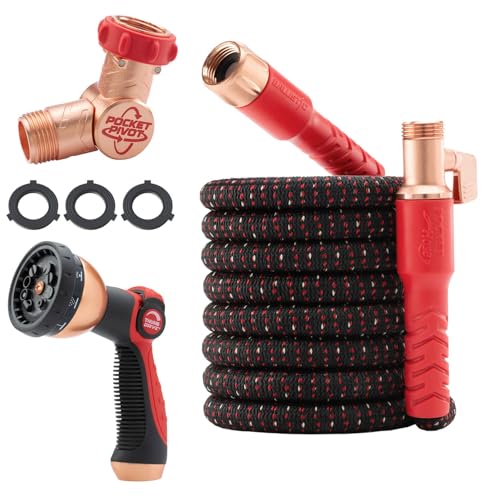
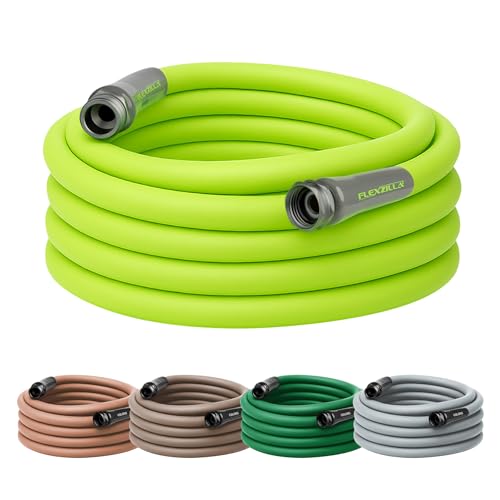


As an Amazon Associate we earn from qualifying purchases at no extra cost to you. Ratings are shown as listed on Amazon.
Quick comparison: which hose fits your yard?
| Hose type | Typical lengths | Inner diameter | Approximate weight at 50 ft | Best for | Main compromise |
|---|---|---|---|---|---|
| Lightweight expandable | 25–100 ft expanded | Usually under 1/2 in. | 2–5 lb dry | Small storage spaces and occasional watering | Shorter life if dragged, left pressurized, or stored in heat |
| Lightweight reinforced vinyl | 25–75 ft | 1/2 in. | 3–7 lb | Patios, balconies, container gardens | Lower flow than a 5/8-inch hose |
| Standard rubber or reinforced rubber | 25–100 ft | 5/8 in. | 8–18 lb | Frequent watering and general household use | Heavier and usually more expensive |
| Heavy-duty hybrid polymer | 25–100 ft | 5/8 or 3/4 in. | 6–14 lb | Regular use, rough ground, and hose reels | Can still kink if sharply folded or stored poorly |
| Drinking-water-safe hose | 25–50 ft most commonly | 1/2 or 5/8 in. | 4–12 lb | RV connections, filling tanks, pets, and occasional drinking use | Certification and materials narrow the selection |
Best garden hose choices by situation
Best all-purpose choice: 50-foot, 5/8-inch reinforced hose
For a typical suburban yard, this size offers the most useful balance. A 5/8-inch inner diameter carries noticeably more water than a 1/2-inch hose without becoming as bulky as a 3/4-inch model. Fifty feet usually reaches a spigot, lawn edge, and nearby planting beds without leaving a large coil across the patio.
Look for a reinforced vinyl, rubber, or hybrid-polymer construction with crush-resistant fittings. Flexible products such as Flexzilla are popular in this category, while conventional rubber hoses from brands such as Dramm and Gilmour are worth considering when durability matters more than minimum weight. Compare the actual inner diameter and connector construction rather than choosing by brand alone.
Best for a small patio or balcony: 25-foot, 1/2-inch hose
A shorter hose is easier to store, less likely to drag through furniture, and less prone to forming large loops that become trip hazards. A 25-foot length is often enough for container plants, washing a bicycle, or rinsing a small deck.
For this use, a lightweight polymer or reinforced vinyl hose is usually more practical than a heavy rubber model. The smaller diameter may reduce flow, but that is rarely important when using a watering wand or filling a few containers. Choose compact fittings and store the hose on a small reel or wall hanger instead of leaving it coiled in direct sun.
Best for long runs: 75- or 100-foot, 5/8-inch hose—or two 50-foot hoses
A 100-foot hose reaches farther, but its weight and drag can make it difficult to move. It also accumulates more pressure loss, especially when paired with a narrow nozzle, quick-connect system, or low-pressure spigot.
Two 50-foot hoses can be the better arrangement. You can use one section for nearby jobs and connect both only when needed. This also makes replacement cheaper: if one end fails, you do not have to discard the entire 100-foot length. For a large garden with sprinklers or high-flow nozzles, consider a 3/4-inch hose, but confirm that your spigot and fittings can support the larger connection.
Best for frequent heavy use: rubber or hybrid polymer
Rubber remains a strong choice for repeated watering, hot outdoor conditions, and jobs where the hose is dragged across concrete. It generally tolerates abrasion and temperature changes better than inexpensive vinyl. The disadvantages are weight, cost, and the possibility of black scuff marks on light surfaces.
Hybrid-polymer hoses aim to reduce that weight while retaining useful abrasion resistance. They are often easier to coil than rubber, but “hybrid” describes a material category rather than a guarantee of quality. Inspect the jacket, bend radius, strain relief, and fitting attachment before buying.
Best for drinking-water use: a hose with explicit potable-water certification
Do not assume that a hose is safe for drinking because it is white, blue, or labeled “lead-free.” If water will be consumed or used for a pet’s bowl, choose a product that explicitly identifies its intended potable-water use and states the relevant certification or compliance information, such as NSF/ANSI 61 where applicable. A drinking-water-safe hose should also avoid materials and coatings that can impart a plastic or rubber taste.
Even a certified hose should not sit full of warm water in direct sun. Flush the hose before use, drain it after use, and keep the open end off soil and standing water. For regular drinking-water connections, use clean, dedicated fittings rather than sharing the hose with fertilizers, pesticides, or dirty utility attachments.
What matters more than “kink-free” marketing?
- Length: Measure the farthest point you need to reach, then add only about 5 feet for comfortable movement. Excess length creates more loops, weight, and storage problems.
- Inner diameter: A 1/2-inch hose is light and compact; 5/8 inch is the versatile standard; 3/4 inch is appropriate for high-flow applications but is heavier.
- Flexibility: A hose should bend without flattening. Very soft materials can be easy to coil but may twist or collapse under flow.
- Kink resistance: Reinforcement and a generous bend radius help, but no hose can tolerate being sharply folded under pressure. A swivel connector at the spigot reduces twisting.
- Connectors: Solid brass or well-made polymer fittings with rubber washers usually outlast thin stamped fittings. The connector-to-hose joint is one of the first places leaks develop.
- Strain relief: A reinforced collar at each end prevents repeated bending from pulling the fitting out of the hose.
- Storage: A reel is useful for a 50-foot or longer hose. A wall hanger works for shorter, flexible hoses. Avoid tight coils, sharp hooks, and permanent sun exposure.
Decision matrix
| Your situation | Recommended specification | Why |
|---|---|---|
| Small space, occasional use | 25 ft, 1/2 in., lightweight polymer or vinyl | Easy to carry and store |
| One hose for most yard jobs | 50 ft, 5/8 in., reinforced construction | Good reach and balanced water flow |
| Frequent dragging over paving | 50–75 ft, rubber or abrasion-resistant hybrid polymer | Better resistance to wear and heat |
| Large property with distant beds | Two 50 ft hoses, or 75–100 ft, 5/8 in. | Modular storage and less unnecessary weight |
| High-flow sprinkler or low-pressure system | 5/8 or 3/4 in.; minimize connectors | Reduces restriction and pressure loss |
| Water for drinking or pets | Potable-water-rated, lead-conscious hose | Materials and certification are the priority |
A simple length calculation
Suppose your spigot is 18 feet from the nearest garden bed, the bed extends another 22 feet, and you want 5 feet of movement around the plants. The minimum practical length is:
18 + 22 + 5 = 45 feet.
A 50-foot hose is the sensible choice. A 25-foot hose would require an extension, while a 75-foot hose would add 25 feet of unnecessary weight and storage. If the route includes a sharp corner, measure the actual path rather than estimating in a straight line.
Ownership realities: what wears out first?
The hose itself is not always the first failure. Washers flatten, threaded fittings cross-thread, and end collars split after repeated bending. Keep spare rubber washers in the correct size, replace them when a connection begins to seep, and hand-tighten fittings before using pliers only for a very small final adjustment.
Before storage, shut off the water at the spigot, open the nozzle to release pressure, and drain the hose completely. Coil it in broad loops without twisting. In freezing climates, store it indoors or in a protected space after draining; trapped water can expand and damage fittings.
Do not drag a pressurized hose around sharp corners, leave it beneath a vehicle, or store it permanently on hot asphalt. These habits cause flattening, jacket cuts, and premature connector failure. For drinking-water hoses, rinse periodically, allow the interior to dry, and keep them separate from gardening chemicals.
Bottom line
Choose a 50-foot, 5/8-inch reinforced hose for the broadest range of yards. Downsize to 25 feet and 1/2 inch when storage and light weight matter most; choose rubber, hybrid polymer, or 3/4 inch construction when use is frequent, distances are long, or water flow is critical. If anyone will drink from the hose, treat potable-water certification and clean storage as essential specifications—not optional extras.




Write Your Review
No reviews yet. Be the first to share your experience!