

Key takeaways
- Flame-failure protection: shuts off gas if the flame goes out.
- Push-and-turn ignition: reduces accidental gas release compared with a control that turns freely.
- Recessed burner: lowers the flame profile and helps protect it from wind.
- Accessible emergency shutoff: especially important for natural-gas installations.
- Stable base and adjustable feet: reduce rocking on slightly uneven patios.
- Clearances in the manual: the table must be kept away from walls, overhead roofs, curtains, and combustible furniture by the stated distances.
The best rectangular fire pit tables are the ones that match your patio size, fuel preference, and entertaining habits: choose a compact 30–42-inch propane table for small spaces, a 48–60-inch propane model for regular hosting, or a plumbed natural-gas table when you use it frequently and want to avoid refilling tanks.
Our top picks
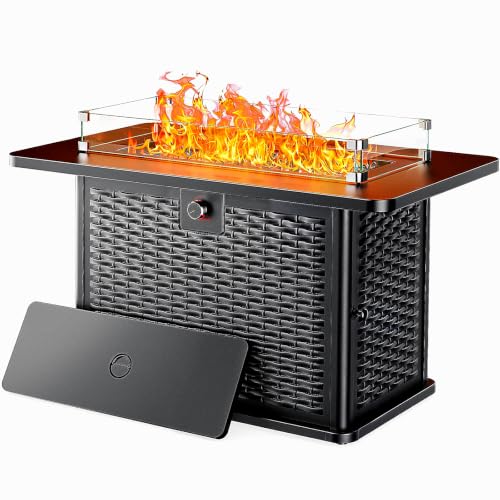


As an Amazon Associate we earn from qualifying purchases at no extra cost to you. Ratings are shown as listed on Amazon.
Quick picks by patio situation
| Best for | Recommended configuration | Why it makes sense |
|---|---|---|
| Small balcony or compact patio | 30–42 in. long, 40,000–50,000 BTU propane | Leaves walking space while providing enough heat for four people |
| Most homeowners | 48–60 in. long, 50,000–60,000 BTU propane | Balances tabletop room, heat, portability, and installation simplicity |
| Frequent entertaining | 60–72 in. long, 60,000–90,000 BTU natural gas or large propane | Provides more serving space and sustained heat for larger groups |
| Lowest purchase cost | 30–42 in. steel or aluminum propane table | Usually costs less, although finishes and covers may wear sooner |
| Best built-in appearance | Powder-coated aluminum or stone-look composite with concealed tank | Looks more like patio furniture and hides the cylinder completely |
| Windy location | Table with a recessed burner, glass wind guard, and adjustable flame | Protects the flame and reduces nuisance shutoffs |
Best rectangular fire pit tables compared
Best all-around: a 48–60-inch propane fire pit table
For most patios, this is the strongest choice. A rectangular table in this range usually offers 50,000 to 60,000 BTU, a burner area that is large enough to warm several people, and usable ledges for drinks or plates. Propane avoids the installation cost of a gas line and lets you reposition the table when rearranging the patio.
Look for a full-height compartment that accepts a standard 20-pound propane cylinder without forcing the tank against the regulator hose. Some models hide the tank behind a magnetic or hinged door; others require a separate matching tank-cover seat. The integrated design is tidier, but check whether the door can open while the table remains in its normal position.
Best for small patios: a compact 30–42-inch propane model
Shorter tables are easier to fit around a dining set, but their narrower burners produce a smaller heat zone. They are best for two to four people rather than for warming an entire sectional. A 40,000–50,000 BTU rating is adequate, provided the burner is not excessively narrow and the flame is protected from crosswinds.
Compact tables also tend to have less tabletop space. If you want to use the fire pit as a coffee table when the flame is off, prioritize a flush burner cover and at least 8–10 inches of clear ledge on each long side.
Best for frequent use: a natural-gas fire pit table
Natural gas eliminates cylinder changes and is convenient when the table stays in one location. It is the better long-term option for frequent users, but installation requires an appropriate outdoor gas line, shutoff valve, pressure regulation, and professional verification. A natural-gas table is not automatically hotter than a propane model: compare the stated BTU output for the exact fuel configuration.
Do not convert a propane table to natural gas unless the manufacturer provides an approved conversion kit and instructions. Burner orifice size, pressure, and ventilation requirements differ between fuels.
Best for a built-in look: aluminum or stone-look composite
Powder-coated aluminum resists rust and is relatively easy to move. Stone-look composite and concrete-style finishes can look more substantial, but they are heavier and may chip at corners. Real concrete can also absorb water, then crack during freeze-thaw cycles if it is not protected and drained correctly.
Steel tables can be durable when properly powder-coated, yet scratches that expose bare metal should be repaired promptly. In damp climates, steel is more likely than aluminum to develop bubbling paint or corrosion around doors, fasteners, and the burner opening.
Specifications that matter more than the marketing headline
| Specification | Useful target | What it tells you |
|---|---|---|
| Overall length | 30–42 in. compact; 48–60 in. general purpose; 60–72 in. large | Available seating and tabletop area |
| Overall width | 20–32 in. | Whether people can pass around it comfortably |
| Burner output | 40,000–60,000 BTU for most patios | Potential heat output, not guaranteed warmth in wind |
| Table weight | 50–90 lb. movable; 100 lb. or more semi-permanent | Portability and stability |
| Propane capacity | One standard 20-lb. cylinder | Usually about 18–22 hours at a moderate flame |
| Burner material | 304 stainless steel or coated stainless steel | Resistance to heat, moisture, and corrosion |
| Glass wind guard height | 4–8 in. above the burner area | Protection against side drafts without blocking the flame visually |
| Cover | Water-resistant, UV-resistant, fitted, with vents | Protection from rain, sun, and trapped condensation |
BTU is only one part of performance. A 60,000-BTU burner with a shallow exposed flame can perform worse in wind than a 45,000-BTU burner recessed below a burner lid and glass guard. A control knob with several flame positions is also preferable to a simple low/high arrangement because it lets you reduce heat without extinguishing the flame.
Fuel cost and runtime: a practical estimate
A 20-pound propane cylinder contains roughly 430,000 BTU of fuel. At a stated output of 50,000 BTU per hour, the theoretical runtime is:
430,000 ÷ 50,000 = 8.6 hours at maximum output.
Real use is often longer because the flame is turned down. If your average setting is approximately 25,000 BTU per hour, the same cylinder could provide about 17 hours of operation. At two three-hour gatherings per month, that is close to three months per cylinder. Actual runtime varies with temperature, regulator performance, and how consistently the burner is operated.
Natural gas is convenient for frequent use, but installation can outweigh fuel savings for occasional users. For a table used fewer than a few dozen hours annually, propane usually offers the simpler ownership equation.
Tabletop space and burner layout
Measure the usable ledge, not the advertised table length. A 56-inch table may devote much of its top to the burner, leaving only narrow strips for glasses. For dining use, aim for at least 8 inches of clear tabletop on the long sides and 6 inches on the ends. If food will be served around the fire, 10–12 inches is more comfortable.
A removable burner lid is valuable because it converts the fire area into additional table space. The lid should have a handle that stays cool enough to use with protection and should not sit directly on a hot burner immediately after shutdown. Store it only after the burner and media have cooled completely.
Safety features worth paying for
- Flame-failure protection: shuts off gas if the flame goes out.
- Push-and-turn ignition: reduces accidental gas release compared with a control that turns freely.
- Recessed burner: lowers the flame profile and helps protect it from wind.
- Accessible emergency shutoff: especially important for natural-gas installations.
- Stable base and adjustable feet: reduce rocking on slightly uneven patios.
- Clearances in the manual: the table must be kept away from walls, overhead roofs, curtains, and combustible furniture by the stated distances.
Never place cushions, covers, paper, or serving trays over an operating burner. Do not burn wood in a gas fire pit table unless it was specifically designed for that purpose. Lava rock and fire glass can become extremely hot, so keep children and pets away and use a noncombustible mat where required by the instructions.
Cover quality and weather resistance
The cover is not an accessory to ignore; it is one of the main factors determining how long the table remains attractive. A useful cover is fitted rather than loose, has vents to reduce condensation, includes tie-downs or buckles, and reaches below the tabletop without dragging on the ground.
Keep the cover off until the fire pit is fully cold. Covering residual heat can damage the fabric and trap moisture around the burner. After rain, remove the cover on a dry day and allow the table to air out. A cover can protect against weather, but it cannot make a non-winter-rated fire pit suitable for freezing conditions.
Ownership realities: what wears first
- Ignition batteries: replace them at the beginning of the season rather than repeatedly clicking a weak igniter.
- Fire glass or lava rock: dust, soot, and leaves collect between pieces; remove and wash compatible media periodically, then dry it completely.
- Burner ports: insects and debris can block openings. Inspect them only when the gas is off and the components are cool.
- Finish and corners: moving a heavy table by dragging it can crack composite surfaces or scrape powder coating.
- Cover seams: sun and wind usually damage seams and fasteners before the fabric panel itself.
- Regulator and hose: inspect for cracking, abrasion, or pest damage before each season.
The commonest mistake is treating the table like ordinary patio furniture: leaving it uncovered, allowing water to pool in the burner area, or placing a hot lid on a finished surface. A few minutes of seasonal inspection and careful cooling will usually matter more than a small difference in advertised BTU.
Final buying recommendation
For the broadest combination of heat, usable surface, and manageable ownership, choose a 48–60-inch rectangular propane fire pit table with a 50,000–60,000 BTU stainless-steel burner, concealed 20-pound tank storage, a recessed burner, flame-failure protection, and a vented fitted cover. Choose a compact model when preserving walkway space is the priority, and choose natural gas only when the table will stay in one place and be used often enough to justify professional installation.



Write Your Review
No reviews yet. Be the first to share your experience!