

Key takeaways
- Airflow precision: a stable top vent and lower vent allow small oxygen changes rather than abrupt swings.
- Thermal mass: heavier ceramic resists short-term temperature changes but takes longer to cool after an overshoot.
- Fire management: use a small, clean charcoal fire for low temperatures and avoid repeatedly opening the lid.
The best ceramic kamado grills for most backyards are the Kamado Joe Classic Joe II for convenience, the Large Big Green Egg for a proven modular ecosystem, and the Primo Oval XL when two-zone cooking and a long oval grate matter more than compactness.
A ceramic kamado is a charcoal grill, smoker, and high-heat oven in one insulated body. The useful differences are not just cooking area: ceramic mass affects heat stability, the vent design determines how easily temperature changes, and the cart can matter as much as the cooker when a 180- to 500-pound appliance is sitting on a patio.
Our top picks


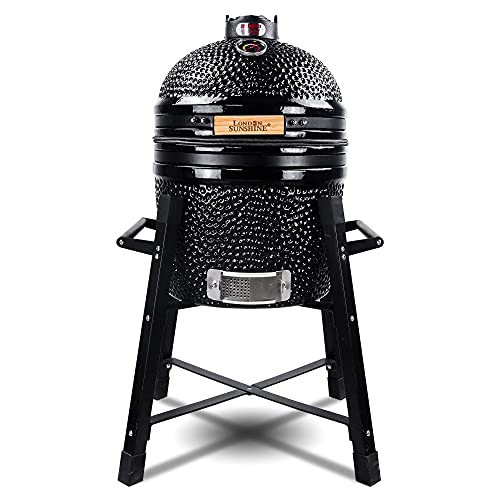
As an Amazon Associate we earn from qualifying purchases at no extra cost to you. Ratings are shown as listed on Amazon.
Best ceramic kamado grills by backyard situation
| Backyard need | Best fit | Why | Main compromise |
|---|---|---|---|
| First kamado, regular family cooking | Kamado Joe Classic Joe II | 18-inch grate, divided cooking system, hinged lid, and effective gasket and vent controls | Heavy for its cooking area |
| Flexible accessories and long-term ecosystem | Large Big Green Egg | Large accessory selection and a compact 18-inch format | Many useful accessories cost extra |
| Two-zone grilling and larger irregular foods | Primo Oval XL | Oval grate supports direct and indirect zones without a divider | Large footprint and substantial moving weight |
| Large parties and multiple racks of food | Kamado Joe Big Joe III | 24-inch cooking surface and three-tier Divide & Conquer system | Requires strong flooring, ample clearance, and careful moving |
| Lower purchase budget | Small or medium ceramic kamado | Lower charcoal consumption and easier placement | Limited space for a whole brisket, several steaks, or indirect cooking |
Head-to-head specifications
The figures below describe commonly sold standard configurations. Exact shipping weight, stand weight, and accessory packages vary by version and market. Ceramic thickness is rarely published as a single engineering measurement, so a manufacturer’s “thicker ceramic” claim should not be treated as a directly comparable number.
| Model | Cooking diameter or shape | Primary cooking area | Approx. cooker weight | Temperature range | Notable control feature |
|---|---|---|---|---|---|
| Large Big Green Egg | 18.25-inch round | 262 sq. in. | About 162 lb before some stand options | About 150–750°F | Top daisy-wheel or vent cap plus lower draft door |
| Kamado Joe Classic Joe II | 18-inch round | About 250 sq. in. | About 188 lb with stand and shelves | About 225–750°F | Kontrol Tower top vent and lower vent |
| Primo Oval XL | Approximately 400 sq. in. oval | About 400 sq. in. | About 250 lb with cart, depending on configuration | About 180–500°F | Separate direct and indirect zones using oval layout and accessories |
| Kamado Joe Big Joe III | 24-inch round | About 450 sq. in. | About 487 lb with cart and shelves | About 225–750°F | Three-tier cooking system, top vent, and lower vent |
Kamado Joe Classic Joe II: the easiest all-round recommendation
The Classic Joe II is a strong choice for a household that wants one grill for weeknight burgers, indirect-roasted chicken, pizza, and occasional low-and-slow barbecue. Its 18-inch grate is large enough for a family meal but does not demand the patio space of a 24-inch cooker.
Its divided cooking grates and heat deflectors make two-zone cooking practical: one half can hold food over indirect heat while the other half sears. The hinged lid reduces lifting effort, which becomes meaningful after repeated cooks. The ceramic body retains heat efficiently, so a properly loaded fire can cook for many hours without constant refueling.
The important limitation is weight. A cart with locking casters helps, but it does not make the grill light. Move it over smooth, level ground with at least two capable adults, and do not rely on small casters to cross steps, loose gravel, or cracked paving.
Large Big Green Egg: best ecosystem for gradual ownership
The Large Big Green Egg offers a familiar 18-inch format and a mature range of racks, heat deflectors, baking surfaces, tables, nests, and covers. It is appealing when you want to start with a basic cooker and add capabilities over time.
Its temperature control follows the classic kamado arrangement: the lower draft door supplies oxygen and the upper vent releases heat and smoke. Once the vents are set, the thick ceramic body holds temperature steadily. The learning curve is mostly about making small adjustments early rather than chasing the thermometer after the grill has already overshot.
Check the package carefully before comparing prices. A cooker, nest, shelves, heat-deflector system, side tables, and ash tool may be sold separately or bundled differently. The Egg can be an excellent long-term platform, but the final ownership cost is not represented by the ceramic base alone.
Primo Oval XL: best shape for two-zone cooking
The Primo Oval XL is distinctive because its cooking surface is oval rather than round. That geometry gives you a long hot zone and a long cooler zone, which is useful for cooking a steak over direct charcoal while holding vegetables or chicken over indirect heat.
The oval layout also suits awkward foods such as racks of ribs or several flattened chickens. It uses less vertical space than stacking multiple round levels, although accessories can expand its capacity. For a cook who often combines searing and roasting in the same session, the shape may be more valuable than a modest difference in headline square inches.
Its size makes patio planning important. Measure the cart, shelf swing, lid clearance, and a path to the final position. A large kamado that cannot be safely moved away from a wall for maintenance is a poor fit, regardless of its insulation.
Kamado Joe Big Joe III: choose capacity only when you will use it
The Big Joe III is aimed at frequent entertainers and cooks who regularly prepare large quantities. Its roughly 450-square-inch primary surface and multiple cooking levels can handle several racks of ribs, a large poultry cook, or different foods at different temperatures.
The cost of that capacity is not only purchase price. More ceramic means more startup fuel and a longer heat-up period. Its near-500-pound assembled weight also changes installation: use a firm, level surface, keep the casters locked while cooking, and plan any relocation before the grill is loaded with charcoal or food.
Temperature control, ceramic thickness, and fuel efficiency
All ceramic kamados benefit from insulation, but “thicker ceramic” is not a sufficient buying test. Ask whether the lid closes evenly, whether the gasket seals continuously, whether the bands are properly aligned, and whether replacement parts are available. A well-sealed medium-bodied cooker can outperform a poorly adjusted heavy one.
Temperature control depends on three things:
- Airflow precision: a stable top vent and lower vent allow small oxygen changes rather than abrupt swings.
- Thermal mass: heavier ceramic resists short-term temperature changes but takes longer to cool after an overshoot.
- Fire management: use a small, clean charcoal fire for low temperatures and avoid repeatedly opening the lid.
Fuel efficiency is best measured per cooking session, not by the amount poured into the firebox. For example, if a kamado uses 4 pounds of lump charcoal for a six-hour barbecue and charcoal costs $1.50 per pound, the fuel cost is about $6. A larger model might use 5 pounds for the same session, or $7.50, while providing valuable extra space. The cheapest fuel bill is not the best value if the grate is too small for your normal meals.
Cart stability and patio safety
A cart should have a low center of gravity, four substantial casters, positive wheel locks, and shelves that do not flex when loaded. Locking only two wheels may be adequate on a level patio, but four locked casters are preferable on any surface with a slight slope.
Keep the cooker on a noncombustible, load-rated surface and follow the model’s required clearance from walls, railings, roofs, and combustible furniture. Never place a heavy ceramic grill on a lightweight folding table. If the grill will remain in one location, a sturdy nest or masonry counter is usually safer than frequent movement.
Ownership realities: what wears out first
- Gaskets: the felt or woven seal eventually compresses, frays, or loosens. Replacing it restores airflow control and prevents heat leakage.
- Cast-iron parts: grates and fire grates can rust if stored wet. Brush them clean, dry them with heat, and apply a suitable light protective coating where appropriate.
- Firebox components: ceramic fire rings and fireboxes can develop cracks from thermal stress. Hairline cracks may remain serviceable, but a displaced section or poor fit calls for replacement.
- Cart hardware: casters, bolts, and band hardware deserve periodic inspection, especially after moving the grill.
Do not pour water onto hot ceramic, use lighter fluid inside the cooker, or run a high-temperature burn with the lid gasket already damaged. Remove ash only after the grill is fully cool, and leave some clean charcoal beneath the fire grate so airflow is not blocked.
Bottom line
Choose an 18-inch kamado if you cook for two to six people and want manageable patio dimensions. Choose the Primo Oval XL if direct-and-indirect cooking is central to your routine. Choose the Big Joe III only when you regularly need its capacity and have a permanent, stable location. For most first-time buyers, the Kamado Joe Classic Joe II is the most balanced combination of cooking area, temperature control, included functionality, and everyday usability.



Write Your Review
No reviews yet. Be the first to share your experience!