

Key takeaways
- Powder-coated steel: stable and available in many colors, but scratches need prompt attention to limit corrosion.
- Aluminum: light and corrosion-resistant, though it can dent and may need a heavier base in windy areas.
- Hardwood: warm-looking and sturdy, but it needs cleaning and periodic oiling or sealing.
- Tempered glass: easy to wipe clean and visually light, but fingerprints, impact, and winter storage deserve consideration.
- Resin or plastic: easy-care and inexpensive, but quality varies substantially in rigidity and ultraviolet stability.
Best Outdoor Bistro Sets for Small Patios
The best outdoor bistro sets for small patios are compact, foldable two-person sets with a table no wider than 28–30 inches, supportive seats, and weather-resistant finishes that match how often you will leave them outside.
For most apartments and narrow balconies, a powder-coated steel set offers the best balance of footprint, durability, and price. Choose a solid hardwood set if you value natural appearance and are willing to maintain it, or a resin-and-metal set if low maintenance matters more than furniture character. Among recognizable options, Fermob’s Bistro-style folding furniture is a premium choice, while IKEA TÄRNÖ-style sets are typically more budget-conscious. Exact dimensions and materials vary by configuration, so measure the set rather than relying on its name or product photos.
Our top picks

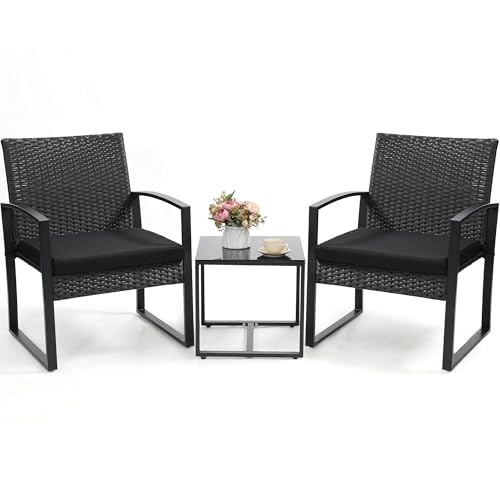


As an Amazon Associate we earn from qualifying purchases at no extra cost to you. Ratings are shown as listed on Amazon.
Quick comparison for compact spaces
| Set type | Typical table footprint | Typical chair footprint | Approx. set weight | Weather resistance | Typical market range |
|---|---|---|---|---|---|
| Folding powder-coated steel | 24–30 in. round or square | 17–20 in. wide each | 25–45 lb | Good; inspect chips and rust points | $140–$650 |
| Acacia or other hardwood | 24–30 in. round or square | 18–21 in. wide each | 35–65 lb | Good with regular oiling or sealing | $180–$500 |
| Resin or molded plastic | 24–30 in. round or square | 18–22 in. wide each | 20–40 lb | Very good; color may fade over time | $100–$350 |
| Aluminum folding | 24–30 in. round or square | 18–21 in. wide each | 18–35 lb | Very good; check wind stability | $180–$700 |
These are useful planning ranges, not specifications for every model. Add at least 18 inches of pull-out space behind each chair; 24 inches feels more comfortable. A 28-inch round table with two 19-inch-wide chairs therefore needs roughly 66 inches of usable width if both chairs are pulled out at the same time.
Best picks by patio situation
Best for a narrow balcony: folding steel or aluminum
A folding table and two folding chairs are usually the safest choice when every inch matters. A 24-inch table can support two drinks, a small meal, and a compact centerpiece without dominating a balcony. When folded, the chairs can stand against a wall and the table can be stored vertically.
Steel feels more planted in breezy locations, but it is heavier and can develop rust where the coating is damaged. Aluminum is easier to carry and will not rust in the same way, although lightweight frames may move in strong wind. Look for a table with a locking mechanism and non-marring feet. Avoid a pedestal base that leaves no place for your feet if the table is very small.
Best for frequent outdoor dining: rigid steel or hardwood
If the set will stay assembled and be used several times each week, a rigid frame is often more comfortable than a highly portable folding design. Hardwood tables feel stable and look less utilitarian, while powder-coated steel normally requires less seasonal treatment.
Acacia is common in this category, but “weather-resistant” does not mean maintenance-free. Sun and moisture gradually change its color. Clean spills promptly, allow the surface to dry, and follow the manufacturer’s recommendation for exterior oil or sealant. Do not apply oil over a damp or dirty surface, because that can trap discoloration and mildew.
Best for the lowest-maintenance patio: resin or molded plastic
Resin furniture is useful for renters, humid climates, and anyone who does not want to refinish wood. It can be wiped clean with mild soap and water, and many pieces are light enough to move indoors before storms. The tradeoff is that thin plastic can flex, fade, or become brittle after prolonged ultraviolet exposure.
Check the underside of the tabletop and the chair joints. Reinforcing ribs, thick edges, and molded drainage channels are more meaningful than a glossy surface. Very light chairs may be convenient, but they can slide or tip more easily on exposed balconies.
Best premium folding option: a Bistro-style metal set
Fermob’s Bistro collection is a well-known example of the classic French folding format: a small metal table and matching chairs designed to open quickly and store compactly. This style is attractive when the furniture must perform double duty as seating and balcony décor. Its main drawback is cost; a complete premium set can be several times the price of a basic steel set.
Pay attention to the chair back height and seat depth. Some café-style chairs prioritize a slim folded profile over lounge comfort. They work well for breakfast or coffee but may feel restrictive during a long dinner unless you add appropriately sized outdoor cushions.
What matters more than the advertised size
Two-person footprint
Table diameter is only part of the space calculation. Measure the full open width, including chair arms, and leave room for knees under the tabletop. For a compact patio, a square table measuring 24–28 inches per side is often easier to position against a wall than a round table. A round table usually creates fewer sharp corners and lets two people sit at slightly different angles.
Confirm the table height as well. A dining-height table is generally about 28–30 inches tall. Café-height tables may be higher, and a 24-inch “bistro” table can be awkward if paired with standard dining chairs. Match the seat height to the table rather than buying each piece separately.
Seat comfort
For short meals, a seat width around 17–19 inches can be adequate. For longer use, look for at least 18 inches of usable width, a slightly curved back, and a seat that does not slope sharply forward. Narrow metal slats can create pressure points, especially without cushions.
Cushions improve comfort but introduce storage and maintenance. If cushions are included, check whether the covers unzip for washing and whether the foam can dry quickly. Store them indoors during wet weather; a cushion that remains damp can stain the chair and develop an odor even when the frame is weather-resistant.
Tabletop material
- Powder-coated steel: stable and available in many colors, but scratches need prompt attention to limit corrosion.
- Aluminum: light and corrosion-resistant, though it can dent and may need a heavier base in windy areas.
- Hardwood: warm-looking and sturdy, but it needs cleaning and periodic oiling or sealing.
- Tempered glass: easy to wipe clean and visually light, but fingerprints, impact, and winter storage deserve consideration.
- Resin or plastic: easy-care and inexpensive, but quality varies substantially in rigidity and ultraviolet stability.
Assembly, folding, and ownership costs
A folding set may arrive mostly assembled, with only the table legs or hinge hardware requiring attachment. Budget 20–40 minutes for a simple set and 45–90 minutes for a heavier hardwood or slatted-metal design. Assembly time is not the only issue: confirm that the folded dimensions fit through your door, closet, or storage locker.
Use this simple cost-per-use calculation before paying more for premium construction. Suppose a $240 set is used 120 times per year for three years: 360 uses total, or about $0.67 per use before maintenance. A $600 set used 200 times per year for five years costs about $0.60 per use. The more expensive set only makes financial sense if it is likely to receive that heavier use and last longer.
The parts most likely to wear first are hinge hardware, chair feet, fabric ties, finish at contact points, and tabletop fasteners. Tighten bolts at the start and end of the season, replace missing foot caps, and do not drag the set across concrete. For metal furniture, touch up exposed scratches with an exterior-compatible coating after cleaning and drying the area. Avoid abrasive pads that remove the protective finish around the damage.
A practical buying decision
| Your priority | Look for | Acceptable compromise |
|---|---|---|
| Balcony under 6 feet wide | 24–26 in. table, folding chairs, total folded depth under 10 in. | Less elbow room during meals |
| Windy location | Heavier steel frame, locking hinges, broad feet | More effort to move indoors |
| Frequent long meals | 18–21 in. seat width, shaped back, cushion-compatible seat | Larger folded footprint |
| Minimal maintenance | Resin or powder-coated aluminum, removable cushions | Less natural texture than hardwood |
| Year-round exposure | Drainage, UV-resistant finish, protective cover, indoor winter storage plan | Covering and cleaning still required |
Bottom line
For most small patios, choose a 24–28-inch folding steel or aluminum table, two chairs at least 18 inches wide, and a set that can be carried indoors without help. Pick hardwood when appearance and a solid feel justify seasonal care; choose resin when easy cleaning and low weight are the priorities. Before ordering, measure the open footprint, folded storage space, doorway, and chair pull-out zone. Those measurements—and not the word “bistro” in a product title—determine whether the set will feel compact, comfortable, and usable.


Write Your Review
No reviews yet. Be the first to share your experience!