

Key takeaways
- Wheel locks or friction strips: Rubberized wheels or rear friction pads that add drag and prevent runaway rolling. Models without them often slide too quickly on hardwood.
- Wide base with anti-skid pads: Grippers on the base help stop the walker at step edges or uneven transitions.
- 360-degree swivel front wheels: Essential for turning without lifting the whole frame, which reduces tipping on slick floors.
The best baby walkers for mixed hardwood and carpet floors are models with adjustable seat height, lockable or friction-adjustable wheels, and a compact fold under 30 inches wide, like the Joovy Spoon, Chicco Walky Talky, and Baby Trend Smart Steps 3.0, because they let you control speed on slick surfaces, raise clearance for thick carpet, and still fit through standard 28-30 inch doorways.
Choosing a walker for hard floors versus carpet is not just about entertainment features. Hardwood exposes poor wheel control and tipping, while carpet exposes low seat height and weak push power. The right pick depends on your doorway measurements, floor transition height, and where you will store it.
Our top picks


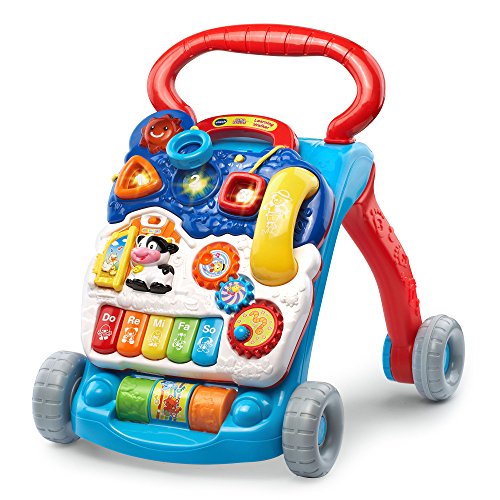

As an Amazon Associate we earn from qualifying purchases at no extra cost to you. Ratings are shown as listed on Amazon.
How Floor Type Changes What You Need in a Walker
Hardwood, Laminate, and Tile
On hard surfaces, wheels roll fast and with little resistance. Look for:
- Wheel locks or friction strips: Rubberized wheels or rear friction pads that add drag and prevent runaway rolling. Models without them often slide too quickly on hardwood.
- Wide base with anti-skid pads: Grippers on the base help stop the walker at step edges or uneven transitions.
- 360-degree swivel front wheels: Essential for turning without lifting the whole frame, which reduces tipping on slick floors.
Carpet and Rugs
Carpet creates the opposite problem: drag. Low-pile carpet needs more push force, and high-pile or shag can stop small plastic wheels completely.
- Higher seat height adjustment: If the seat is too low, baby’s feet drag and they cannot get traction. A 2-3 inch adjustment range makes a walker usable on both hard floors and carpet.
- Larger diameter wheels (at least 3 inches): Bigger wheels clear carpet fibers instead of sinking in.
- Stiffer frame push: Walkers with a rigid lower tray flex less when pushed over carpet seams.
Transition Strips Between Rooms
Most homes have a 0.5 to 0.75 inch transition strip where hardwood meets carpet. Narrow, hard plastic wheels get stuck there. Walkers with spring-suspended or slightly larger rear wheels handle transitions without jarring or stopping abruptly.
3 Measurements to Take Before You Buy
Spec sheets matter more than colors or toy bars for this category. Take these three measurements with a tape measure:
- 1. Narrowest doorway width: Measure the interior trim-to-trim, not the door itself. Most US interior doorways are 28, 30, or 32 inches. Your walker base must be at least 1.5 inches narrower than that to turn without scraping.
- 2. Seat height to floor: With baby in socks, measure from floor to the crease behind the knee while legs are slightly bent. That is the ideal seat height. Compare it to the walker’s adjustable range.
- 3. Storage footprint: Measure where you will keep it daily – next to a kitchen island, in a closet, or behind a door. Fold-flat depth matters more than height for small patios, apartments, and dining areas.
Spec Comparison: Top Walkers for Hardwood & Carpet
These are established 2026 models sold as seated walkers (not push-behind walkers). Dimensions and capacities are based on manufacturer specs and can vary slightly by fabric and production year.
| Model | Seat Height Range (floor to seat) | Base Width | Folded Depth | Wheel Type & Lock | Weight Capacity | Product Weight |
|---|---|---|---|---|---|---|
| Joovy Spoon | 11.5 – 13.5 inches (3 positions) | 28 inches | 9.5 inches flat fold | 4x rubber wheels, rear friction strips, non-swivel lock option | 30 lbs / up to 33.5 inches tall | 14.5 lbs |
| Chicco Walky Talky | 11 – 13 inches (3 positions) | 26.5 inches | 10 inches flat fold | 4x swivel wheels with rear brake pads | 26.5 lbs | 9 lbs |
| Baby Trend Smart Steps 3.0 Activity Walker | 11 – 13.5 inches (3 positions) | 27 inches | 11 inches flat fold | 4x plastic wheels with adjustable speed lock on rear | 30 lbs | 11 lbs |
| Bright Starts Walk-A-Bout | 10.5 – 12.5 inches (3 positions) | 26 inches | 12 inches (does not fold flat, collapses) | 4x plastic wheels, front swivel lock | 26 lbs | 8.5 lbs |
| Disney Baby Music & Lights Walker | 11 – 12.5 inches (2 positions) | 27.5 inches | 10.5 inches flat fold | 4x plastic wheels with grip strips | 26 lbs | 10 lbs |
For hardwood-heavy homes, the Joovy Spoon and Chicco Walky Talky have the best wheel control due to rubberized wheels and friction pads. For carpet-heavy homes, the Joovy Spoon and Baby Trend Smart Steps 3.0 have the highest seat positions and most clearance.
Decision Matrix: Which Walker Fits Your Situation
Match your floor mix, doorway, and storage reality to the right feature priority:
| Your Situation | Priority Feature | Best Fit From Table | Why |
|---|---|---|---|
| Mostly hardwood + narrow 28″ doorways | Narrow base + wheel friction control | Chicco Walky Talky, Bright Starts Walk-A-Bout | 26-26.5″ base clears trim; brake pads prevent sliding |
| Mixed hardwood and medium-pile carpet | 3-position seat height + large wheels | Joovy Spoon, Baby Trend Smart Steps 3.0 | 13.5″ top height keeps feet from dragging on carpet |
| Small apartment / need to store daily | Flat fold under 10″ depth + light frame | Joovy Spoon, Chicco Walky Talky | Slides behind door or between washer and wall |
| High-pile rug or thick carpet throughout | Highest seat height + rubber wheels | Joovy Spoon | Only model in this list with both rubber wheels and 13.5″ height |
| Tight budget, occasional use | Lowest weight and simple collapse | Bright Starts Walk-A-Bout | Lighter and lower cost range, but less hardwood control |
Fit Check: Will It Clear Your Doorway and Carpet?
Use this quick calculation before ordering:
1. Doorway clearance: Narrowest doorway width minus walker base width = clearance. You need at least 1.5 inches total (0.75 per side) to turn without catching.
Example: 28-inch doorway – 28-inch Joovy Spoon base = 0 inches clearance. That walker will scrape that doorway. A 26.5-inch Chicco Walky Talky in the same doorway gives 1.5 inches clearance and will pass.
2. Seat height check for carpet: Baby’s inseam (floor to knee crease) should be within the walker’s seat height range. If baby measures 12.5 inches inseam in socks, a walker that only goes to 12.5 inches will have toes dragging on carpet. Choose one that goes to 13-13.5 inches so feet can plant flat on hardwood and still push on carpet.
3. Folded storage check: Measure your storage gap depth. If you only have 10 inches behind a door, an 11-12 inch collapsed walker will not fit. Flat-fold models at 9.5-10 inches will.
Durability and Ownership Realities
Walkers are not long-use products, but how they wear affects safety and resale.
- What wears first: Seat fabric and wheel axles. Mesh seats collect crumbs and the stitching at the leg holes stretches after 4-6 months of daily use. Wheels develop hair and thread wrap that adds drag, especially on carpet. Clean axles weekly.
- Hardwood scratches: Hard plastic wheels can leave scuffs on softer hardwood or luxury vinyl. Rubber wheels and silicone friction strips are gentler. Check the base tray underside for exposed screw heads that can scratch when the walker is folded and dragged.
- Cleaning: Tray inserts with removable, dishwasher-safe inserts are easier to keep clean than one-piece trays. Fabric seats that are machine washable and fully removable will last longer; spot-clean-only seats stain quickly from purees.
- Common mistakes: Using a walker on an unblocked step or sunken living room, leaving brake pads engaged on carpet (which burns out the friction strip), and adjusting the seat to the lowest setting for a taller baby, which forces toe-walking posture. Follow manufacturer height and weight limits exactly.
- When to stop using: Most seated walkers are rated to 30 lbs or 32-33.5 inches, or when baby can walk unassisted. Transition to a push-behind walker wagon at that point for continued support.
Safety and Setup Notes
Seated walkers require constant adult supervision and a gated, step-free area. Pediatric and safety organizations have raised concerns about walker-related injuries, particularly falls down stairs and access to hazards at higher speed. The American Academy of Pediatrics discourages use of mobile infant walkers for these reasons. If you choose to use one, limit sessions to 15-20 minutes, keep baby within arm’s reach, block all stairs and raised thresholds with mounted gates, and remove access to hot surfaces, cords, and sharp edges. This is general information only and not medical advice. Talk to your pediatrician about mobility and developmental questions.
For initial setup, adjust the seat so baby’s feet are flat on the floor with knees slightly bent, lock wheels when placing baby in and out, and test roll speed on your hardwood before freeing movement in the full room.
Our Picks by Floor Type
Best Overall for Mixed Floors: Joovy Spoon
The widest seat height range and rubber wheels give the most control on hardwood and the best clearance on carpet. The super-flat fold also solves storage in tight homes despite a wider 28-inch base, so double-check your narrowest doorway.
Best for Hardwood and Small Doorways: Chicco Walky Talky
At 26.5 inches wide with effective brake pads, it moves well on hardwood without extra speed and fits 28-inch openings. It is also one of the lightest options for moving between rooms.
Best for Carpet-Heavy Homes on a Mid Range: Baby Trend Smart Steps 3.0
The high seat position and speed lock help on thicker carpet while still allowing you to slow the walker for hardwood sections. The fold is slightly deeper, so plan for closet storage.
Measure your doorways and check seat height against your baby’s inseam before choosing. That one step avoids the two most common returns: a walker that will not fit through doors and one that drags on carpet.

Write Your Review
No reviews yet. Be the first to share your experience!