

Key takeaways
- The best building block sets for kids compared by age fit, block size, piece count and storage, from first toddler blocks to a 790-piece LEGO box.
Buying a first block set looks simple until you realise the real decision is sizing, not theme. Blocks are made in incompatible size families, and the wrong one quietly ends play: jumbo toddler blocks frustrate a five-year-old who wants detail, while standard small bricks are too fiddly, and too easy to mouth, for a one-year-old. Piece count matters just as much, because a set that runs out of bricks halfway up a tower teaches a child to stop building.
This guide serves parents shopping for a first set, families who want siblings of different ages building side by side, and gift buyers who cannot watch the child play first. The five sets below were chosen from the names and specifications printed on their Amazon pages: the age grading, piece count, block dimensions, material and storage format listed for each one, arranged as a ladder from a first birthday through the early school years.
Quick Picks
As an Amazon Associate we earn from qualifying purchases.
| Product | Best for | Key spec from title |
|---|---|---|
| MEGA BLOKS First Builders Big Building Bag (Blue) | A first set for a one-year-old | 80 pieces |
| LEGO DUPLO Classic Brick Box 10913 | Toddlers ready for figures and vehicles | Ages 1.5+ years |
| Melissa & Doug Wooden Building Blocks, 100-Piece Set | Stacking, sorting and colour play at two to four | 100-piece set |
| Melissa & Doug Standard Unit Blocks, 60-Piece | Preschoolers building structures that stay up | 60 solid-wood pieces |
| LEGO Classic Large Creative Brick Box 10698 | School-age builders who invent their own models | Toy storage solution |
How to Choose
Match the block size to the child’s hands and age
Block diameter decides whether a set works at all. Oversized first blocks, like the MEGA BLOKS bag below, are built for a whole-hand grip and a mouthing toddler, and the listing grades them from 12 months. DUPLO bricks are twice the size of standard LEGO bricks and suit children from about 18 months. Standard bricks and small wooden blocks around one to two inches belong to children past the mouthing stage. Always read the manufacturer age grading on the listing rather than the age in a headline, because the grading is the figure the maker safety-tested against.
Decide between interlocking bricks and loose blocks
Interlocking systems hold a model together, so a child can carry a finished car or house around the room; loose wooden blocks fall when they are knocked, which is exactly what makes them better teachers of balance and patience. Interlocking sets also lock you into one brand’s size family, and bricks from different families do not connect. Loose blocks mix freely across sets and brands as long as the unit sizing matches. Think about which frustration your child handles better: a tower that topples, or a model that will not come apart without fingernails and effort.
Count pieces against what your child actually builds
A toddler who stacks six blocks and knocks them down needs variety of shape, not volume, and 60 to 80 pieces is generous. A four-year-old building houses with walls, roofs and windows burns through bricks quickly, and sets under 200 pieces start to feel thin. Check what the headline count includes before comparing sets: some counts fold in figures, wheels and storage pieces, while others are bricks only. The contents list on the product page tells you the split, and it is the honest way to compare two sets with similar numbers on the box.
Plan storage and cleanup before the set arrives
Hundreds of loose pieces on a playroom floor is the main reason block sets get packed away and forgotten. Sets that ship with their own storage, a resealable bag, a lidded brick box or a wooden tray, get tidied because the container is part of the routine. Sets without storage need a bin bought separately, ideally one wide and shallow so a child can see and reach every piece. Measure the shelf or floor space the container needs too: a wooden block tray is over a foot long, and a large brick box is closer to fifteen inches wide.
The 5 Best Options
MEGA BLOKS First Builders Big Building Bag (Blue)

For a first birthday or a young toddler, this is the set sized correctly. The 80 blocks are deliberately oversized for a whole-hand grip, easy to press together and easy to pull apart, and the manufacturer’s own description frames them as a first building toy for children learning to build with two hands. The resealable bag with a carry strap means the set travels to grandparents and tidies away in seconds. This is the blue DCH63 version; the pink bag is a separate listing. Children graduate from it by about age three, but as a starting point nothing below beats it.
Specs
- Pieces: 80 big building blocks
- Model: DCH63 (Blue)
- Manufacturer: Mattel
- Age grading: 12 months to 5 years
- Package dimensions: 12 x 6 x 14 inches
- Storage: reusable storage bag with hand strap
- Material: not stated
Best for: first-time builders aged one to three who need oversized, easy-grip blocks.
Watch out for: check the colour variant before ordering, because the pink bag is a different listing from this blue DCH63 set.
ASIN: B007GE75HY
LEGO DUPLO Classic Brick Box 10913
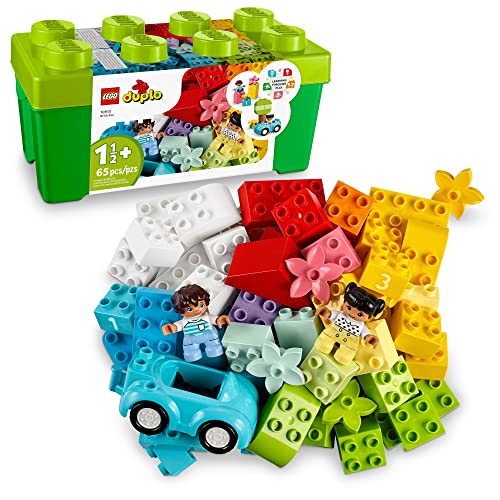
DUPLO is the natural second step, and this box is the cleanest way into it. The 65 pieces mix plain bricks in modern colours with the extras that turn stacking into pretend play: two figures, a car with moving wheels, a roof, a window, flowers and bricks printed with the numbers 1, 2 and 3. Simple printed instructions show starter models, and everything packs back into the sturdy brick-shaped storage box. Because DUPLO bricks are twice standard LEGO size, toddlers can build models big enough to play with, and the pieces stay compatible with every other DUPLO set you add later.
Specs
- Pieces: 65 bricks and pieces, including 2 figures
- Model: 10913 (model number 6288647)
- Age grading: 18 months and up
- Box dimensions: 14.57 x 7.09 x 7.09 inches
- Material: plastic
- Storage: brick-shaped storage box included
- Extras named on the page: car with moving wheels, numbered 1-2-3 bricks
Best for: toddlers from 18 months who are ready for figures, vehicles and early pretend play alongside building.
Watch out for: the 65-piece count includes figures and the car, so the pure brick count is lower than the headline number suggests.
ASIN: B07WJJF8PB
Melissa & Doug Wooden Building Blocks, 100-Piece Set

This set swaps clicking plastic for the weight and friction of wood. One hundred blocks in four colours and nine shapes give two- to four-year-olds enough material for sorting games, colour matching and low, wide structures, and at roughly one to two and a quarter inches each, the blocks are sized for small hands to grasp and place deliberately. The wood is FSC certified, which the listing states plainly, and the smooth finish suits children who are past mouthing everything but still drop, throw and chew on occasion. There is no tray or tub included, so budget for a storage bin of your own.
Specs
- Pieces: 100 wooden blocks
- Shapes and colours: 9 shapes in 4 colours
- Block size: approximately 1 to 2.25 inches
- Age grading: 24 months to 8 years
- Certification: FSC certified (stated on the listing)
- Package dimensions: 3.55 x 8.85 x 13.4 inches
- Storage: not stated
Best for: two- to four-year-olds learning stacking, balancing, colours and shapes with classic wooden blocks.
Watch out for: the painted blocks are small and the grading starts at 24 months, so keep the set away from younger, still-mouthing siblings.
ASIN: B000068CKY
Melissa & Doug Standard Unit Blocks, 60-Piece

Unit blocks are the set preschools buy, and this is the home version of that standard. The 60 pieces are solid wood with a natural finish and smooth rounded edges, cut to standard unit proportions, which is why they balance so predictably: a half-unit, a unit and a double-unit relate to each other exactly, so bridges, ramps and symmetrical castles work out. They arrive in a wooden storage tray that keeps the set together and doubles as a building base. The natural finish will not suit children who sort by colour, but for construction quality per piece, this is the strongest set here.
Specs
- Pieces: 60 solid-wood standard unit blocks
- Finish: natural, smooth rounded edges
- Storage: wooden storage tray included
- Model: 503
- Age grading: 36 months to 6 years
- Packaging: 5.25 x 12.5 x 15 inches (stated in the product description)
- Material: solid wood
Best for: preschoolers and home classrooms building balanced, architectural structures that stay standing.
Watch out for: solid wood is heavy and the filled tray is bulky, so check you have the shelf space before ordering.
ASIN: B00008W72D
LEGO Classic Large Creative Brick Box 10698

When a child outgrows DUPLO, this is the standard-size library to hand them. The product description counts 790 pieces in 33 colours, including eight types of windows and doors with frames, two green baseplates, three pairs of eyes, and six tires with wheel rims, so houses, vehicles and creatures are all buildable from one box. Building ideas are included to start children off, and the whole collection stores in the plastic brick box it ships in. It is a parts library rather than a single model kit, which is precisely its strength: nothing in it is finished, so everything in it gets rebuilt.
Specs
- Pieces: 790 (product description count)
- Colours: 33 different colours
- Included extras: 2 green baseplates, 8 window and door types, 6 tires and rims
- Age grading: 4 years and up (manufacturer minimum 48 months)
- Box dimensions: 14.57 x 10.31 x 7.09 inches
- Material: plastic
- Storage: plastic storage box included
Best for: children aged four and up who want a large open-ended brick library for their own designs.
Watch out for: standard-size bricks are small parts, so respect the 4+ grading if younger siblings share the play space.
ASIN: B00NHQF6MG
Which One Fits Your Situation
Your toddler is stacking for the very first time
Start with the MEGA BLOKS Big Building Bag. The blocks are the largest in this guide, the press-together action works with a whole-hand grip, and the grading begins at 12 months. The DUPLO box becomes the upgrade path once stacking turns into building scenes, usually somewhere around the second birthday, and the two systems cover the toddler years between them without overlap.
You are buying one gift without knowing the child’s other toys
Choose a loose-block set rather than an interlocking one. The Melissa & Doug 100-piece wooden set connects to nothing and needs nothing, so it cannot clash with a brick system the child already owns. It also spans the widest useful age range here, graded from 24 months to 8 years, which makes it the safest single gift for a two-, three- or four-year-old whose toy box you have never seen.
Your preschooler builds structures that stay up for days
The Standard Unit Blocks reward that child. Precise unit sizing means long bridges and tall towers balance instead of wobbling, and the wooden tray gives finished pieces a home off the floor. If the same child also wants figures and stories in the builds, pair the tray with the DUPLO box rather than replacing it; the two sets do different jobs and both earn their shelf space.
You are stocking a classroom or shared playroom
Buy for durability and tidiness. The Standard Unit Blocks are the preschool standard for a reason, and the LEGO Classic 10698 box adds a high piece count with its own storage for older children. Both sets keep every piece in a container that belongs to the set, which is what makes daily cleanup by children themselves realistic in a shared space.
Common Mistakes
- Buying standard-size small bricks for a child under three, when the age grading on the listing says four and up.
- Mixing block systems from different brands and expecting them to connect, when each size family only fits its own.
- Comparing sets on headline piece counts without checking how many pieces are figures, wheels or packaging.
- Choosing a set with no storage container, then losing pieces under furniture until the set is unusable.
- Buying a toddler a themed kit with one intended model, when open-ended blocks get rebuilt far more often.
Frequently Asked Questions
At what age should a child start with building blocks?
Most children are ready for oversized first blocks around their first birthday, which is where the MEGA BLOKS grading starts. DUPLO-sized bricks follow from about 18 months, wooden blocks from two years, and standard small bricks from four. Treat the manufacturer grading on each listing as the deciding figure, because it reflects the piece size the maker tested for that age.
Do blocks from different brands fit together?
Only within the same size family. DUPLO bricks fit other DUPLO sets, and standard bricks fit standard bricks, but the families do not connect to each other, and oversized first blocks fit neither. Loose wooden blocks are the exception: they never connect at all, so any wooden set can be combined with another as long as you accept that structures balance rather than lock.
How many pieces does a good first set need?
For a toddler, 60 to 80 pieces is plenty, because young children stack a handful of blocks at a time and value shape variety over volume. Piece count starts to matter at around age four, when walls, roofs and vehicles consume bricks quickly; that is where a library of several hundred pieces, like the LEGO Classic box, earns its place.
Are wooden blocks better than plastic bricks?
Neither is better outright; they teach different things. Wooden blocks develop balance and patience because nothing holds a structure up except placement, and solid wood survives decades of play. Interlocking plastic bricks let children carry finished models around and build far more detail. Many families end up with one set of each, used at different ages and for different moods.
More from Amazon
Programs that pair well with the guide above. Offers and eligibility are set by Amazon and may change.
Collect the home and kitchen items you want in one registry that guests can shop from.
Create a wedding registrySet up recurring deliveries of everyday items on eligible products. Terms and savings are set by Amazon.
Explore Subscribe & SaveFree shipping on eligible items, Prime Video and more. Eligible new members can start with a free trial.
Start a Prime free trialAudiobooks and podcasts to listen to on the go. Eligible new members can start with a free trial.
Try Audible freeAs an Amazon Associate we earn from qualifying purchases.
Write Your Review
No reviews yet. Be the first to share your experience!