

Key takeaways
- Rail width and height: measure the flat mounting surface, not only the decorative top rail.
- Post width: common deck posts are about 3.5 inches or 5.5 inches wide, but cladding can make them larger.
- Available clearance: confirm that the bracket does not interfere with hand placement or violate the usable grip area.
- Mounting surface: a screw bracket may work on wood or composite, while adhesive pads need a clean, smooth surface protected from rain.
- Cable route: allow space beneath the rail for a drip loop and connectors that will not sit in standing water.
Best Deck Rail Lights for Safer Steps
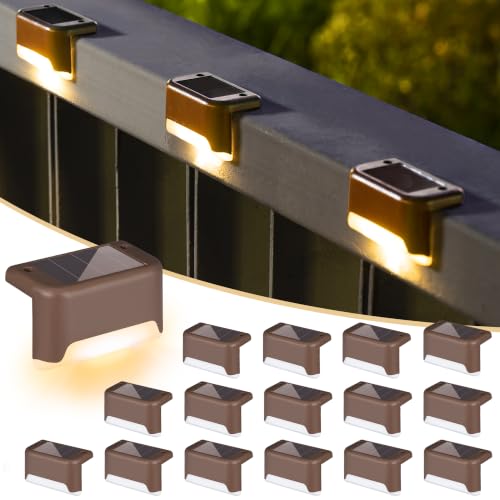
The best deck rail lights for safer steps are low-voltage wired fixtures when you want dependable brightness, solar lights when you have no nearby power, and battery lights when you need the simplest installation or occasional illumination.
For stairs, prioritize downward light on each tread rather than decorative glow along the railing. A useful target is roughly 30–100 lumens per stair light, a warm-white color temperature of 2,700–3,000K, and even spacing that avoids bright spots and deep shadows. Before buying, measure the rail width, post size, available sunlight, and distance to an outlet or transformer.
Our top picks


As an Amazon Associate we earn from qualifying purchases at no extra cost to you. Ratings are shown as listed on Amazon.
Quick comparison: solar vs. battery vs. wired
| Light type | Typical brightness | Typical runtime | Weather resistance | Best mounting range | Ongoing work |
|---|---|---|---|---|---|
| Solar cap or rail light | 10–80 lumens | 6–12 hours after a full charge | Look for IP44–IP65; sealed designs last longer | Posts and rails about 3–6 inches wide, depending on bracket | Clean panel; replace rechargeable cell every 1–3 years |
| Battery-powered LED | 20–150 lumens | 20–100 hours per battery set | Prefer IP54 or higher for exposed locations | Surface mounting on rails, posts, walls, or stair stringers | Replace batteries; inspect the seal and switch |
| Low-voltage wired LED | 50–200 lumens per fixture | Continuous while switched on | Choose IP65 for direct exposure; use outdoor-rated cable | Most flexible, provided the base or bracket fits | Check connectors and cable; replace occasional fixtures |
These are practical buying ranges rather than guarantees for every model. Brightness, runtime, and life depend on lens design, temperature, battery chemistry, shade, and how often the lights are activated.
Best choices by situation
| Your situation | Best choice | Why | What to compromise on |
|---|---|---|---|
| Lowest installation cost | Solar rail or post lights | No transformer, trenching, or routine wiring | Brightness falls after cloudy days and in winter |
| Shaded deck or north-facing stairs | Battery or wired LEDs | They do not depend on several hours of direct sun | Battery replacement or cable installation |
| Frequent nighttime use | Wired low-voltage lights | Consistent output and no dead batteries | Higher initial labor and more visible cable planning |
| Rental or no electrical experience | Battery lights with removable brackets | Fast installation with minimal permanent alteration | Lower runtime and less resistance to water intrusion |
| Modern deck with wide posts | Surface-mounted wired or battery fixtures | Works when cap lights do not match the post dimensions | Fixtures remain visible from the side |
| Most discreet appearance | Recessed or under-rail wired lights | Light source is hidden while the tread is illuminated | More precise drilling and cable routing |
Head-to-head: which technology handles stairs best?
Solar deck rail lights
Solar lights are attractive for a short stairway, remote deck, or installation where running cable would be disruptive. The panel should face unobstructed daylight; ambient outdoor brightness is not enough. A fixture that receives only two or three hours of weak sun may still turn on, but its late-evening output can be much lower than its advertised maximum.
Choose a model with a replaceable rechargeable battery, a separate on/off switch protected by a cover, and a downward or shielded lens. Solar post caps often fit only a narrow range of post tops, so measure both the post width and the cap’s interior opening. A universal side bracket is usually more adaptable than a cap that simply sits on top.
Battery-powered deck lights
Battery fixtures are the easiest retrofit when you cannot access household power. They are also useful for a small deck used a few nights each month. Look for two or more brightness settings, a timer or motion sensor, and a battery compartment that opens from the sheltered side. Warm-white LEDs are generally easier on the eyes than very cool white light when viewed directly at stair level.
Runtime claims should be read alongside the operating mode. For example, a light rated for 60 hours may achieve that figure at a low setting, while maximum brightness could reduce runtime substantially. Lithium batteries typically perform better in cold weather than alkaline cells, but the fixture must specifically support them.
Low-voltage wired lights
Wired lights are the strongest choice for regular use, long staircases, and locations that remain shaded. A 12-volt system can provide stable output without the complexity of connecting each fixture to household-voltage wiring. Use an outdoor-rated transformer, cable, connectors, and timer; do not substitute indoor extension cords or unprotected wire nuts.
Wiring also gives you more control over spacing and brightness. It is worth choosing a system with replaceable fixtures or standardized connectors because a single failed LED should not force you to remove an entire run.
Check the rail and post dimensions before ordering
“Universal” mounting hardware does not mean universal fit. Record these measurements:
- Rail width and height: measure the flat mounting surface, not only the decorative top rail.
- Post width: common deck posts are about 3.5 inches or 5.5 inches wide, but cladding can make them larger.
- Available clearance: confirm that the bracket does not interfere with hand placement or violate the usable grip area.
- Mounting surface: a screw bracket may work on wood or composite, while adhesive pads need a clean, smooth surface protected from rain.
- Cable route: allow space beneath the rail for a drip loop and connectors that will not sit in standing water.
For stair safety, mount lights so they illuminate the tread without shining directly into a person’s eyes. Under-rail placement or a downward-facing shield is usually better than a bare LED aimed horizontally across the stairs.
A simple coverage and runtime calculation
Suppose a staircase has eight treads and you plan to install one 50-lumen light above every other tread. Four lights provide about 200 lumens in total, but spacing matters more than the sum. If each fixture effectively illuminates a 3-foot-wide by 4-foot-deep area, overlapping the edges slightly can reduce dark bands between treads.
For solar lights, assume a claimed 10-hour runtime but a shaded site that delivers only 60% of the expected daily charge. A practical estimate is:
10 hours × 0.60 = about 6 hours of useful runtime.
That may be enough for early evening, but not for a long winter night. If the stairs are used after midnight, wired lights or high-capacity battery fixtures are the safer choice. Treat published runtime as an upper-limit estimate, especially when using maximum brightness.
Weather resistance and durability details that matter
IP ratings are useful, but they do not tell the whole story. The first number concerns dust; the second concerns water. IP44 resists splashing, IP54 adds limited dust protection, and IP65 provides stronger protection against water jets. For an uncovered deck exposed to driving rain, IP65 is a sensible target, although the mounting orientation and cable entry still matter.
The parts that commonly wear first are rechargeable solar cells, rubber seals, adhesive pads, and corroded connectors. Direct sun can make clear plastic cloudy, while freeze-thaw cycles can loosen a poorly fitted cap. Stainless-steel or coated screws are preferable near treated lumber and coastal air.
- Clean solar panels with a damp microfiber cloth several times each season.
- Keep leaves and snow off panels and lenses.
- Do not seal drainage holes with caulk; they help condensation escape.
- Replace cracked lenses or swollen battery compartments rather than continuing to use them outdoors.
- Route cables with a downward loop before each connection so rain runs away from the connector.
Bottom line
Choose solar for simple, low-cost lighting in a sunny location; battery power for a quick retrofit or occasional use; and low-voltage wired fixtures for the most consistent brightness and dependable overnight operation. Whichever type you select, match the bracket to the actual rail dimensions, use a shielded downward beam, and buy enough output to reveal every tread without creating glare. The safest deck rail lights are the ones that remain charged, firmly mounted, and evenly spaced through the weather you actually receive.

Write Your Review
No reviews yet. Be the first to share your experience!