

Key takeaways
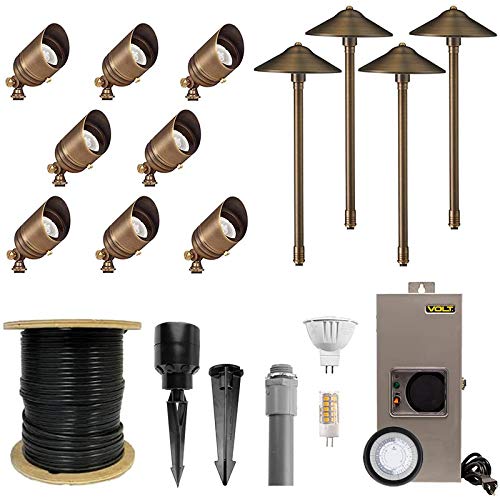
- Long-lasting premium kit: VOLT brass spotlight and path light kit with a 150-watt transformer.
- Tree and wall uplighting: Kichler Landscape Pro kit with six spotlights and a 300-watt transformer.
- Lined walkway: Kichler cast aluminum path-light set (12 fixtures with transformer).
- First system on a tight budget: Hampton Bay 7-piece kit (four path lights, three spotlights).
- Maximum brightness out of the box: SUNVIE 300-watt kit with 12-watt, roughly 900-lumen fixtures.
- App-controlled color and scenes: Philips Hue Lily outdoor spotlights on a Hue outdoor power supply.
The best landscape lighting kits for most yards are the VOLT 12-volt brass kit (eight spotlights plus four path lights on a 150-watt transformer) for long-term durability, the Kichler Landscape Pro spotlight kit (300-watt smart-timer transformer, six spotlights) for accenting trees and walls, the Hampton Bay 7-piece kit for an entry-level starter system, and the SUNVIE 300-watt kit when you want the brightest all-in-one package. For paths specifically, a Kichler cast aluminum path-light set or a Hampton Bay path kit gives even, low-glare coverage at a mid-range or entry-level budget.
Landscape lighting kits are low-voltage systems: a plug-in transformer steps house current down to 12 volts, a weatherproof cable runs through the yard, and fixtures clip or splice onto it. A kit bundles all three. The main buying mistakes are an undersized transformer, too few lumens for the job, and fixtures that corrode within two seasons. This guide explains how to size a kit with a worked wattage calculation, how bright each fixture type should be, what to expect from brass versus aluminum versus plastic, and which kits to compare.
Our top picks


As an Amazon Associate we earn from qualifying purchases at no extra cost to you.
Quick answer: pick by the job
- Long-lasting premium kit: VOLT brass spotlight and path light kit with a 150-watt transformer.
- Tree and wall uplighting: Kichler Landscape Pro kit with six spotlights and a 300-watt transformer.
- Lined walkway: Kichler cast aluminum path-light set (12 fixtures with transformer).
- First system on a tight budget: Hampton Bay 7-piece kit (four path lights, three spotlights).
- Maximum brightness out of the box: SUNVIE 300-watt kit with 12-watt, roughly 900-lumen fixtures.
- App-controlled color and scenes: Philips Hue Lily outdoor spotlights on a Hue outdoor power supply.
How we chose
This guide is based on desk research, not first-hand evaluation. We compared manufacturer specifications and product listings for current kits, then ranked them against buyer criteria: transformer capacity, fixture material, lumen output, ingress protection, cable length, controls, and warranty. Several published roundups disagree on exact wattage and lumen figures for the same kit, so where a number could not be confirmed on a manufacturer page we describe the spec by class instead. Check the package contents and ratings on the listing before purchase, since kits are revised often.
Selection filters:
- A 12-volt low-voltage design with a transformer included.
- Fixtures rated IP65 or higher for rain and sprinklers.
- LED sources, so a full system draws a small fraction of the watts an older halogen system needed.
- A timer or photocell on the transformer, or a smart-control option.
Know your three numbers: watts, lumens, voltage drop
Transformer wattage
Add up the wattage of every fixture, then choose a transformer with 15 to 25 percent headroom. That margin covers future additions and keeps the transformer from running at its limit. Never exceed the rated capacity.
Lumens by fixture type
| Fixture | Typical lumen target | Typical LED watts | Use |
|---|---|---|---|
| Path light | 100 to 200 lumens | 2 to 4 W | Walkways, bed edges |
| Spotlight (small accent) | 200 to 300 lumens | 3 to 6 W | Shrubs, house corners |
| Spotlight (tree or wall) | 300 to 500 lumens | 5 to 8 W | Trees, columns, facades |
| Flood or wash light | 400 to 900 lumens | 8 to 12 W | Large walls, open areas |
Voltage drop
Low-voltage power weakens along a long cable, so fixtures at the far end look dimmer. Heavier wire (12-gauge instead of 14 or 16) and shorter runs reduce this. A common fix is to wire the cable in a loop or feed the system from the middle rather than the end.
Worked example: size a transformer for a typical front yard
Suppose you want to light a front walkway and two trees.
- Walkway: 8 path lights at 3 W each = 24 W.
- Trees: 4 spotlights at 6 W each = 24 W.
- Porch accent: 2 wall washers at 4 W each = 8 W.
- Total load = 24 + 24 + 8 = 56 W.
- Add 25 percent headroom: 56 x 1.25 = 70 W. Round up to the next transformer size.
A 100-watt transformer fits comfortably, and a 150-watt unit like the one in the VOLT kit leaves room to double the fixture count. At the other extreme, a 300-watt transformer suits a large property of 20 or more fixtures or older, higher-wattage fixtures. Buying more capacity than you need costs more but is useful if you plan to expand; buying less forces a transformer replacement later.
Now check the cable. A 100-foot run of 12-gauge wire carrying the 56 W load will keep voltage loss small, while the same load on 16-gauge wire at the same distance may show visible dimming at the last fixture. If your yard needs runs over 100 feet, choose a kit with 12-gauge cable or buy heavier wire separately.
Materials: brass vs. aluminum vs. plastic
| Material | Durability | Look over time | Cost class |
|---|---|---|---|
| Solid brass | Highest; resists rust and corrosion, often with a lifetime warranty | Develops a natural patina | Premium |
| Cast aluminum | Good; powder-coated finishes resist corrosion for years | Finish can chip or fade | Mid-range |
| ABS plastic | Lowest; can crack from UV and lawn equipment | May yellow or fade | Entry-level |
If you live where winters bring road salt or you are near the coast, brass is the safer long-term choice. In dry climates, powder-coated aluminum performs well for a lower price.
Landscape lighting kits to compare
1. VOLT 12-Volt Brass Spotlight and Path Light Kit
Spec line: 8 brass spotlights + 4 brass path lights · 150 W transformer · 12 V · 250 ft cable · lifetime warranty · lumen figures vary by listing
Best for: Homeowners who want one system to last a decade or more.
Skip if: You need the lowest upfront cost or large wash lighting from each fixture.
- Pros: Solid brass fixtures, long cable, strong warranty, enough capacity to add fixtures.
- Cons: Premium cost class, and the individual fixtures are modest in brightness.
2. Kichler Landscape Pro Spotlight Kit
Spec line: 6 spotlights · 300 W transformer with smart timer · 12 V
Best for: Uplighting trees, columns and house walls.
Skip if: You mainly need path lighting.
- Pros: A well-known lighting brand, generous transformer capacity, built-in timer controls.
- Cons: Only spotlights in the box; paths need separate fixtures.
3. Kichler Cast Aluminum Path Light Set
Spec line: 12 path lights · transformer included · cast aluminum · 10-year warranty (per listing)
Best for: Long straight walkways and driveway edges.
Skip if: You want accents on walls or trees.
- Pros: Mid-range cost, durable cast construction, even spacing.
- Cons: Path-only kit; finish can scratch in tight beds.
4. Hampton Bay 7-Piece Low-Voltage Kit
Spec line: 4 path lights + 3 spotlights · transformer with dual timer · 12 V · transformer wattage listed as 150 W or 200 W depending on source
Best for: First-time buyers lighting a small front entry.
Skip if: You have a large yard or expect to expand heavily.
- Pros: Entry-level cost class, widely available, simple setup.
- Cons: Mixed material quality and a small fixture count.
5. Hampton Bay Pearson Path and Flood Light Kit
Spec line: Path and flood fixtures · about 205 lumens per listing · low-voltage
Best for: Basic path and small-bed lighting.
Skip if: You want accent lighting for tall trees.
- Pros: Low cost, adequate brightness for walkways.
- Cons: Limited output for wash or uplighting.
6. SUNVIE 300-Watt Landscape Lighting Kit
Spec line: 300 W transformer · 12 W fixtures · about 900 lumens each (per roundup) · IP65 class
Best for: Bright flood lighting of large walls and open areas.
Skip if: You want soft, subtle accent lighting.
- Pros: Very high output per fixture, big transformer capacity.
- Cons: High wattage per fixture means the 300 W limit is reached with fewer lights; plastic or lighter metal bodies in this class.
7. Philips Hue Lily Outdoor Spotlights (smart option)
Spec line: Low-voltage smart spots · white and color · app and voice control · requires the Hue outdoor power supply (verify current kit contents)
Best for: Seasonal color scenes and schedules controlled from a phone.
Skip if: You want a simple single-purchase kit with a timer.
- Pros: Color changing, scene control, integrates with a smart home.
- Cons: Mid- to premium cost class, and a hub or bridge is recommended for the full feature set.
Buying and decision matrix
| Your goal | Kit class | Example | Minimum transformer |
|---|---|---|---|
| Light a 40 to 60 ft walkway | Path light set, 100 to 200 lumens each | Kichler cast aluminum path set | 60 to 100 W |
| Uplight 2 to 4 mature trees | 300 to 500 lumen spotlights | Kichler Landscape Pro | 100 W |
| Whole front yard, long life | Mixed brass kit | VOLT 12-fixture kit | 150 W |
| Small entry, low budget | 7-piece starter | Hampton Bay 7-piece | Included |
| Wash a large facade | High-lumen floods | SUNVIE 300 W kit | 300 W |
| Color and scenes | Smart low-voltage | Philips Hue Lily | Hue power supply |
Design tips that make any kit look better
- Layer your lights: Use path lights for safety, spotlights for focal points, and one wash for depth. Do not light everything evenly.
- Warm white first: A color temperature around 2700 K to 3000 K looks natural on foliage and brick. Cool white above 4000 K looks harsh outdoors.
- Stagger path lights: Alternate sides of the path about six to eight feet apart so pools of light overlap without a runway look.
- Angle spotlights up from the side: Place them at the base of a tree angled up through the canopy, set back a foot or two from the trunk.
- Hide the glare: Aim fixtures so the bulb is not visible from seating areas.
Installation and safety
- Call 811 before you dig: In the United States, call 811 before burying cable or driving stakes to have underground utility lines marked.
- Plug the transformer into a GFCI outlet: Use a protected outdoor receptacle with a weatherproof in-use cover, mounted at least a foot above ground.
- Unplug while working: Disconnect the transformer when splicing or moving fixtures.
- Bury or cover cable lightly: Tuck cable a few inches below mulch or soil so mowers and trimmers cannot cut it. Keep splices in waterproof connectors.
- Do not exceed transformer capacity: Overloading can overheat the unit or trip its protection.
- Keep the transformer ventilated: Mount it on a wall, not buried or covered.
Common mistakes
- Buying by fixture count: A 12-piece kit of dim plastic lights does less than six good brass spotlights.
- No expansion room: Choose at least 25 percent headroom if you may add lights.
- Long single runs on thin cable: Voltage drop causes dim far-end fixtures. Use heavier gauge or split the run.
- Lighting at the wrong height: Path lights that are too tall create glare; aim for the fixture head to sit low.
- Ignoring the photocell and timer: A kit without automatic controls means manual switching every evening.
Solar vs. low-voltage: which should you choose?
Solar stake lights need no wiring and are easy for renters, but they depend on sunshine, dim late in the night, and rarely match the brightness of a wired system. Low-voltage kits offer consistent output, timer control and expandability. If you want reliable light for safety on a walkway or stairs, a wired kit is the better choice. Solar suits decorative accents in sunny spots where you do not mind variable brightness.
Frequently asked questions
How many lumens do I need for landscape lighting?
Aim for 100 to 200 lumens for path lights and 300 to 500 lumens for spotlights on trees and walls. Flood lights for large facades can run higher.
More lumens is not always better: soft, layered light usually looks better than one bright source.
What size transformer do I need for a landscape lighting kit?
Add up the fixture wattage and multiply by 1.15 to 1.25. A typical yard of 8 to 15 LED fixtures needs about 60 to 150 watts of capacity.
For example, a 56-watt load with 25 percent headroom calls for about 70 watts, so a 100-watt transformer is a safe choice.
Are brass landscape lights worth the extra cost?
Usually yes in wet, salty or snowy climates. Solid brass resists rust and often carries a long warranty.
Powder-coated aluminum can be a fine mid-range choice in dry regions where corrosion is less of a concern.
Can I add more lights to a kit later?
Yes, as long as the total fixture wattage stays under the transformer rating, ideally with 15 to 25 percent spare capacity.
Check that new fixtures are 12-volt compatible and that the cable can handle the extra length.
Why are the last lights on my cable dimmer?
That is voltage drop. Power weakens along long or thin cable runs, so far fixtures receive less voltage.
Fix it with heavier 12-gauge wire, shorter runs, a looped layout, or by feeding the cable from the middle instead of one end.
Do landscape lighting kits need an electrician?
Most 12-volt kits do not; you plug the transformer into an outdoor GFCI outlet and lay the cable yourself.
If you do not have a protected outdoor outlet, hire a licensed electrician to install one rather than using an extension cord permanently.
What color temperature is best for outdoor lighting?
Warm white at 2700 K to 3000 K suits most homes, because it flatters plants, wood and brick.
Use cooler light only for task areas where you want a crisp look, and avoid very blue light near seating.
How long do LED landscape lights last?
Quality LED fixtures are commonly rated for tens of thousands of hours, which is many years at a few hours per night.
Real lifespan depends on the housing, seals and sprinkler exposure, so material quality and warranty matter more than the LED hours quoted.


Write Your Review
No reviews yet. Be the first to share your experience!