

Key takeaways
- Full sun, south or west exposure, and you water daily anyway: a wire basket with a thick coco liner, 14 inches or larger, so the soil volume buffers heat.
- Hot, windy, or you travel: a resin or polypropylene pot with a built-in reservoir.
- Shady porch with ferns or fuchsias: a lighter pot-style planter or a hybrid liner basket, because shade plants dry out slowly and water-holding styles can stay too wet.
- Railing or pergola with a weak hook: a compact planter under about 12 quarts, or a light macrame holder carrying a plastic nursery pot.
The best outdoor hanging planters for most patios are the Arcadia Emerald 20-inch coco-lined basket for classic full-sun color, the AquaSav Oxford for fewer watering trips, and the Southern Patio Magic self-watering resin planter for hot, windy porches. The right pick depends on three things: how much sun the spot gets, how heavy the planter will be once soaked, and whether the hook or bracket can carry that load.
This guide is built from published manufacturer specifications and gardening-source comparisons, not from product handling. Where a spec could not be confirmed, the product is described by class (for example, “UV-stabilized resin basket”) instead of by an invented number.
Our top picks

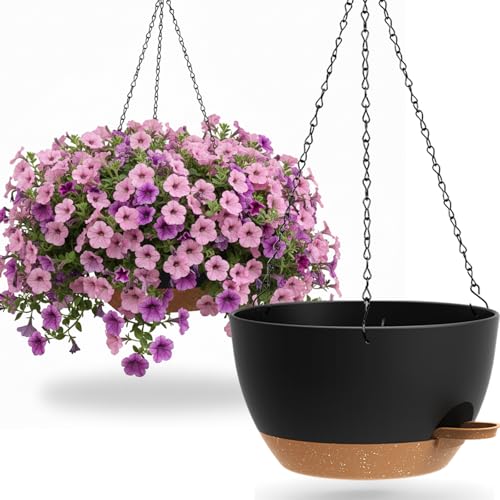


As an Amazon Associate we earn from qualifying purchases at no extra cost to you.
Quick answer: which style fits which spot
- Full sun, south or west exposure, and you water daily anyway: a wire basket with a thick coco liner, 14 inches or larger, so the soil volume buffers heat.
- Hot, windy, or you travel: a resin or polypropylene pot with a built-in reservoir.
- Shady porch with ferns or fuchsias: a lighter pot-style planter or a hybrid liner basket, because shade plants dry out slowly and water-holding styles can stay too wet.
- Railing or pergola with a weak hook: a compact planter under about 12 quarts, or a light macrame holder carrying a plastic nursery pot.
Basket vs. pot styles: what actually changes
Outdoor hanging planters fall into three structural families. Each one trades looks, water retention and weight differently.
Wire baskets with a liner
A metal frame, usually powder-coated steel, holds a liner of coconut fiber (coco coir) or a molded fiber insert. Plants can be tucked through the sides, which produces the full “ball of flowers” look. Drainage and airflow are excellent, which is also the weakness: in direct sun the soil dries fast, and a basket can need water once or even twice a day in midsummer.
Solid pots with chains or hanger cords
Resin, plastic, ceramic or metal pots hang from three or four chains. They hold moisture longer than a coco basket and are easier to keep tidy, but ceramic versions are heavy and fragile, and plants can only emerge from the top. Look for drainage holes and, ideally, a removable plug so you can control saucer water.
Self-watering hanging planters
These add a reservoir in the base and a wicking path to the soil. Good ones include an overflow port so rain does not drown the roots. They shine in sun, but they also carry the most total weight when the reservoir is full.
Coco liner vs. plastic-backed liner vs. solid plastic
The liner material is the single biggest factor in how often you water.
- Straight coco fiber: best airflow and the most natural look, lowest moisture retention. In hot direct sun the fibers also break down faster, so a thin liner may need replacing after one season. A thicker, tighter weave resists this better. Pre-soak the liner before filling, and let about half an inch of liner stand above the rim to reduce edge drying.
- Coco fiber sandwiching a plastic layer: keeps the natural look but slows water loss. Leave the bottom clear so excess water can leave.
- Solid UV-stabilized resin or polypropylene: best durability and moisture holding, with a less natural appearance. Resin composites generally outlast thin plastic. Vinyl-coated wire can rust if the coating chips.
Replace a coco liner each season. An old liner can harbor fungal spores and insect eggs, and a degraded one slumps and spills soil.
How we chose
This is a research-based shortlist. We compared published dimensions, capacity, material and hanger details across manufacturer listings and independent gardening roundups, then kept products that meet these criteria:
- Soil volume of roughly 10 quarts or more for sun-exposed spots, since small pots dry out in hours.
- A real drainage path (holes, overflow port or pluggable base).
- A metal chain or sturdy cord sized for the filled weight, not a thin decorative cord.
- UV-stable or rust-resistant materials for outdoor exposure.
- Products that are still listed in 2026.
Comparison table
| Planter | Style | Size | Capacity | Material | Empty weight | Drainage |
|---|---|---|---|---|---|---|
| Arcadia Emerald | Wire basket, coco liner | 20 in wide, 8 in high | 28 qt | Coated metal, coconut fiber | 4.3 lb | Yes |
| AquaSav Oxford | Hybrid liner basket | 19.5 in wide, 9.5 in high | 25 qt | Steel, coconut fiber, plastic layer | 2.8 lb | Yes |
| Southern Patio Magic | Self-watering pot | 13 in wide, 7 in high | 10 qt | High-density resin | 2.2 lb | Pluggable |
| Viva Self-Watering | Self-watering pot | 13.75 in wide, 7.5 in high | 10 qt | Polypropylene, ABS | 2.5 lb | Overflow feature |
| Mkono macrame holder | Cord holder for a pot | Adjustable | Pot up to 9 in | Cotton cord, wood | 0.4 lb | Depends on inner pot |
Worked example: how heavy is a hanging planter when watered?
Empty weight is misleading. Wet potting mix typically weighs very roughly 1.2 to 1.6 pounds per quart, depending on how much perlite or bark is in the blend, and a freshly watered basket sits at the top of that range. These figures are estimates, so treat the math as a planning check, not a rating.
- Take the Arcadia Emerald at 28 quarts. Filled about 90 percent, that is roughly 25 quarts of mix.
- At 1.4 pounds per quart watered: 25 x 1.4 = 35 pounds of soil.
- Add 4.3 pounds for the basket and perhaps 3 to 6 pounds for established plants: about 42 to 45 pounds in total.
- Now a 10-quart self-watering pot: 9 quarts of mix x 1.4 = about 12.6 pounds, plus 2.2 to 2.5 pounds of pot, plus a reservoir that may hold a couple of quarts of water (about 2 pounds per quart), plus plants. Expect 18 to 22 pounds.
Rule of thumb: pick hardware that can carry at least double your calculated number. A single screw-in cup hook in thin trim is not suitable for a large basket. Use a hook or bracket that is bolted or screwed into a structural member (a rafter, beam or solid post) and rated for the load, and check it each spring.
The best outdoor hanging planters
1. Arcadia Emerald 20-inch coco-lined basket: best for a full, classic look
Spec line: 20 in wide · 8 in high · 28 qt · coated metal frame, coconut fiber liner · 19.5 in chain · 4.3 lb empty
Best for: sunny porch eaves and pergola beams where you want mounded petunias, calibrachoa or sweet potato vine, and you are fine watering daily in summer.
Skip if: your hook is not structural, or you want low-maintenance watering.
- Pros: huge soil volume buffers heat; drainage and airflow are excellent; side planting gives a full-coverage look.
- Cons: coco dries fast in direct sun; liner needs yearly replacement; roughly 40 pounds when full and wet.
2. AquaSav Oxford: best for a natural look with slower dry-out
Spec line: 19.5 in wide · 9.5 in high · 25 qt · steel frame, coconut fiber with plastic layer · 21 in chain · 2.8 lb empty
Best for: sunny spots where you want the coco appearance but cannot water twice a day.
Skip if: you grow drought-lovers such as portulaca and prefer the fast drainage of an unlined coco basket.
- Pros: plastic layer slows water loss; lighter than the Arcadia at similar size; drainage is retained.
- Cons: covering the base can block drainage; side planting still needs care to keep the plastic layer intact.
3. Southern Patio Magic: best self-watering hanging pot for heat
Spec line: 13 in wide · 7 in high · 10 qt · high-density resin · self-watering reservoir · 26 in chain · pluggable drainage · 2.2 lb empty
Best for: hot, breezy balconies and anyone who travels for a few days in July.
Skip if: your plants dislike constant moisture, such as lavender or most succulents.
- Pros: reservoir cuts refills; chain is long enough to hang from a hook and still clear a railing; light for its capacity.
- Cons: limited soil volume for large plants; plug management matters in rainy weeks.
4. Viva Self-Watering hanging planter: best for overflow protection
Spec line: 13.75 in wide · 7.5 in high · 10 qt · polypropylene and ABS · reservoir with overflow feature · 17 in chain · 2.5 lb empty
Best for: covered or partly open porches that still get driving rain, since the overflow feature helps keep the reservoir from flooding the root zone.
Skip if: you need a long drop, because the chain is short.
- Pros: overflow design; durable plastics; moderate weight.
- Cons: shorter chain; plastic can look less natural next to wood or stone.
5. Amagabeli 14-inch powder-coated wire basket with coco liner: best entry-level wire basket
Spec line: 14 in diameter · powder-coated steel frame · coco fiber liner · chain hanger · exact capacity not published in the sources checked
Best for: a first basket, trailing annuals, and railing or hook-bracket spots where a 20-inch basket would be too heavy.
Skip if: you are growing large plants that need deep soil.
- Pros: entry-level tier; rust-resistant coating; light enough for modest hooks.
- Cons: smaller soil volume means faster dry-out in full sun; liner needs replacing.
6. Keter resin rattan-style hanging planter: best for low-maintenance durability
Spec line: UV-resistant resin · woven rattan look · solid-walled pot · mid-range tier · exact capacity not confirmed
Best for: sun-baked or freeze-and-thaw climates where a ceramic pot would crack and a coco liner would degrade.
Skip if: you want side planting; this style grows from the top only.
- Pros: resin composites are among the most durable options; will not rust; holds moisture longer than coco.
- Cons: less airflow to roots; confirm the drainage hole is present and unobstructed before planting.
7. Lechuza Cascada: best premium self-watering hanging option
Spec line: premium resin planter · built-in reservoir · decorative hanging design · premium tier · exact volume and weight not confirmed
Best for: design-focused porches and covered patios where an engineered reservoir and a clean look justify a premium tier.
Skip if: budget is the priority, or you want open, basket-style planting.
- Pros: reservoir system designed for longer gaps between refills; polished finish.
- Cons: premium tier; check the manufacturer’s stated capacity and drainage guidance for rainy climates.
8. Mkono macrame plant hanger: best for light plants on shaded porches
Spec line: cotton cord and wood bead · adjustable fit for pots up to 9 in · about 35 in cord · 0.4 lb
Best for: small plastic nursery pots on covered porches, where rain and sun will not rot the cord quickly.
Skip if: the spot is fully exposed. Cotton cord weathers, fades and can rot, and it is not suitable for heavy, wet baskets.
- Pros: very light; low cost; flexible with different pot sizes.
- Cons: limited weight capacity; no drainage of its own, so the inner pot must drain freely.
Match the planter to sun exposure
| Exposure | Dry-out speed | Best style | Minimum size to aim for |
|---|---|---|---|
| Full sun, 6+ hours | Very fast | Self-watering resin or plastic-backed coco | 10 qt or larger; 14 in or wider basket |
| Part sun, 3 to 6 hours | Moderate | Coco basket, resin pot | 8 qt or larger |
| Shade | Slow | Standard pot with drainage, light hanger | Any, but avoid reservoirs that keep soil soggy |
Hooks, chains and hanging safety
- Find a structural member. Screw-in hooks should go into solid wood or a bracket bolted to a post, never into thin trim or drywall.
- Use the 2x rule from the worked example: choose hardware rated for double your calculated wet weight.
- Prefer metal chains and S-hooks that close fully. A pot that can swing or slip off an open hook is a hazard in wind and for people walking underneath.
- Hang baskets above head height and out of walkways.
- Check the hook, chain links and any rust spots at the start of every season.
Water retention tips for sun exposure
- Use a quality potting mix, never garden soil. Mixes with water-retaining components hold moisture better.
- Pre-moisten dry mix and coco liners before planting.
- Choose a larger basket rather than a smaller one: doubling volume roughly doubles the buffer against dry-out.
- Mulch the top surface lightly.
- Water slowly until it drains, then check again in a few minutes. A basket that has gone bone dry can repel water, so soak it in a bucket if it will not rewet.
- Match plants to the setup: petunias and geraniums like moderate moisture; portulaca and succulents prefer fast-draining coco baskets.
Frequently asked questions
What is the best material for an outdoor hanging planter?
UV-stabilized resin lasts longest with the least upkeep; coco-lined steel looks best but needs liner changes. Ceramic is attractive but heavy and can crack in freezing weather.
Choose by climate: resin in hot sun and freeze-thaw zones, coco where airflow and appearance matter most.
How often should I water a hanging basket in summer?
In full sun, a coco-lined basket may need water daily and sometimes twice on hot, windy days. Self-watering pots can stretch this to several days.
Check by pressing a finger about an inch into the soil. If it is dry, water until it drains from the base.
Is a coco liner better than plastic?
Coco gives better airflow and a natural look, while plastic holds water longer. Neither is universally better; it depends on your sun and how often you can water.
A hybrid with a plastic layer between coco layers is a reasonable middle ground.
How much weight can a porch hook hold?
It depends on the hook and what it is fastened into; there is no universal number. Check the hardware’s rating and anchor it into a structural member.
Calculate your planter’s wet weight first, then choose hardware rated for roughly twice that.
Do self-watering hanging planters work in rain?
They can, if they have an overflow port or a drainage plug. Without one, heavy rain can flood the reservoir and keep roots wet.
Open the plug during long rainy spells if your model provides one.
How often should I replace a coco liner?
Replace it every season. Fibers degrade in sun and an old liner can hold fungal spores and insect eggs.
Thicker, tightly woven liners last longer than thin ones but still should not be reused indefinitely.
What size hanging basket is best for sun?
Choose 14 inches or wider, or a pot of at least 10 quarts. Larger soil volume dries out more slowly.
Small 8 to 10 inch baskets can dry out within hours in midsummer sun.
Can I leave hanging planters out in winter?
Resin and metal usually can; ceramic risks cracking when wet soil freezes. Empty or move fragile planters before hard freezes.
Replace the soil each spring, and inspect hardware before re-hanging.





Write Your Review
No reviews yet. Be the first to share your experience!