

Key takeaways
- UV-stabilized plastic: light, inexpensive, and easy to clean; thin plastic can become brittle after several summers.
- Polypropylene or resin: generally better suited to repeated outdoor use than unprotected low-density plastic, particularly when the walls are thick and reinforced.
- Galvanized steel: rigid and wind-resistant, but inspect cut edges, seams, and coating damage for rust.
- Wood: attractive and stable when built from naturally durable or treated lumber; it requires more care and can retain moisture against walls.
- Fabric: light and inexpensive, with excellent drainage, but seams and hanging loops are common failure points.
- Terracotta or ceramic: attractive and breathable, though heavy, breakable, and prone to faster drying.
The best vertical garden planters match your available height, watering routine, and load-bearing surface—not simply the greatest number of pockets: choose a narrow pocket tower for herbs on a balcony, a stable stacked container for a patio, or a deep raised planter for vegetables in a small yard.
Our top picks


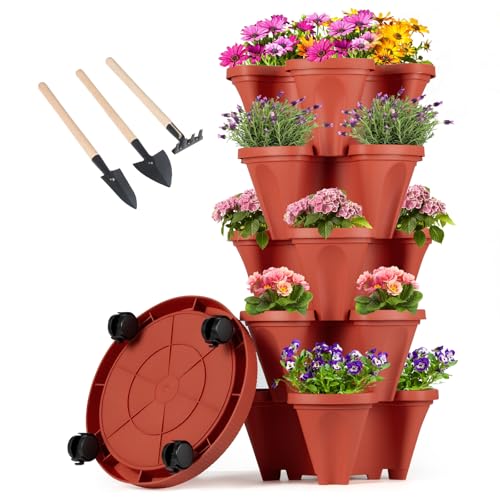

As an Amazon Associate we earn from qualifying purchases at no extra cost to you. Ratings are shown as listed on Amazon.
Best vertical garden planters by situation
| Situation | Best planter type | Useful target specifications | Typical market range |
|---|---|---|---|
| Small apartment balcony | Wall-mounted pocket planter or slim tower | 24–48 in. high, 6–12 pockets, under 20 lb empty | $30–$120 |
| Frequent herb harvesting | Tiered planter with individual drainage holes | 8–16 planting pockets, 6–10 in. soil depth | $50–$180 |
| Patio vegetables | Stacked pots or self-watering tower | 4–6 tiers, 20–40 qt total soil volume | $70–$250 |
| Small yard with wind exposure | Freestanding trellis planter or broad-base tower | 36–72 in. high, 18–30 in. base width, 30–80 lb when planted | $100–$350 |
| Lowest-cost seasonal display | Fabric pocket organizer or recycled-container system | 6–18 pockets, UV-resistant fabric, removable liner | $20–$80 |
What to check before buying
1. Height and reach
Measure the actual space from the floor or mounting point to the lowest obstruction. A planter listed as 60 inches tall may need another 6–12 inches above it for watering, plant growth, and access. For daily-use herbs, keep most pockets between knee and shoulder height. The highest tier of a tall tower is often the least convenient place for plants that need regular harvesting.
Balcony shoppers should also measure the railing, door swing, and clearance from neighboring walls. A narrow planter 10 inches deep can still obstruct a walkway when foliage extends outward. For a small yard, height is less important than the footprint and the width of the base.
2. Pocket capacity versus usable soil
A planter can advertise 20 planting openings while offering only a few inches of soil in each pocket. That is adequate for thyme, chives, lettuce, and many annual flowers, but limiting for tomatoes, peppers, rosemary, and larger strawberries. Look for at least 1–2 quarts of soil per herb pocket and 3–5 gallons for a container intended to support a fruiting vegetable.
Deep, individually filled containers are more forgiving than shallow pockets. They hold moisture longer and give roots more room, but they also make the planter heavier. A good vertical planter is not necessarily the one with the highest pocket count; it is the one whose pocket size suits the crops you will actually grow.
3. Drainage and water management
Every pocket should have a defined drainage path. Drainage holes that are too small clog with potting mix, while completely open fabric pockets can stain walls and waste water. For a balcony, choose a model with a catch tray, bottom reservoir, or a drainage outlet that can be directed into a container.
Self-watering designs reduce daily attention, but they do not eliminate maintenance. Reservoirs need occasional cleaning, and an overfilled reservoir can keep roots too wet. In a rainy climate, a planter with open drainage and an elevated base is usually safer than a permanently saturated reservoir system.
4. Materials and weather exposure
- UV-stabilized plastic: light, inexpensive, and easy to clean; thin plastic can become brittle after several summers.
- Polypropylene or resin: generally better suited to repeated outdoor use than unprotected low-density plastic, particularly when the walls are thick and reinforced.
- Galvanized steel: rigid and wind-resistant, but inspect cut edges, seams, and coating damage for rust.
- Wood: attractive and stable when built from naturally durable or treated lumber; it requires more care and can retain moisture against walls.
- Fabric: light and inexpensive, with excellent drainage, but seams and hanging loops are common failure points.
- Terracotta or ceramic: attractive and breathable, though heavy, breakable, and prone to faster drying.
5. Stability and loaded weight
Wet potting mix is heavy. As a planning estimate, one gallon of moist container mix may weigh roughly 8–12 pounds, before adding the planter and plants. A six-tier tower holding 30 gallons of mix can therefore weigh about 240–360 pounds when fully watered. That is appropriate only for a surface and structure designed to carry it.
For a balcony, verify the building’s rules and load limits rather than placing a large tower near the outer edge. Use a broad base, locking casters only on level surfaces, or a strap and wall support where appropriate. On windy patios, a lower, wider planter is usually safer than a tall narrow model, even if both claim the same capacity.
Head-to-head: pocket planters, towers, and tiered containers
Pocket planters: best for herbs and flowers
Fabric or rigid pocket systems provide the most planting positions in the least floor space. They work well against a sheltered wall or railing and are usually the easiest option for renters. Their limitations are shallow soil, uneven watering, and faster drying at the top and outer edges. Choose one with reinforced hanging points, a washable backing, and pockets large enough for mature roots rather than nursery-size plants.
Stacked towers: best for maximum capacity in a small footprint
Stacked pots and rotational towers provide more root depth than pocket walls while using little floor area. They are suitable for lettuce, strawberries, herbs, and some compact vegetables. Water distribution can be uneven: upper tiers may drain into lower ones, leaving the bottom wet and the top dry. A built-in central watering tube or a reservoir with overflow protection is valuable.
Tiered planters: best for accessibility
Stepped boxes are easier to plant, prune, and harvest because each level remains visible. They are often more stable than tall towers and can hold larger plants. Their drawback is a wider footprint and potential water runoff from upper tiers. Put thirsty plants on the lower levels and install drainage protection where water could mark a patio.
Trellis planters: best for climbers
A deep container paired with a trellis is the right choice for peas, compact cucumbers, beans, and flowering vines. The container should be broad enough that the trellis does not act like a sail. Secure the trellis to the container or a fixed structure, and choose compact or determinate varieties to avoid overwhelming the root zone.
A practical sizing calculation
Suppose you want 12 herb pockets, each holding approximately 1.5 quarts of mix. The planting volume is 18 quarts, or 4.5 gallons. Allowing about 15 percent extra for settling, you should buy roughly 5.2 gallons of potting mix. If the wet mix weighs 8–12 pounds per gallon, the growing medium alone may weigh 42–62 pounds. Add the planter, water reservoir, and foliage before deciding whether a balcony railing or wall can support it.
This calculation also explains why small pockets are useful in restricted spaces: twelve 1.5-quart pockets may offer substantial growing area without the hundreds of pounds associated with a large, deep tower.
Setup steps that prevent common failures
- Choose the location first. Track sunlight for a day or use the site’s seasonal exposure. Leafy greens tolerate less direct sun than fruiting vegetables.
- Assemble the empty planter and check its balance. Confirm that doors, paths, drains, and watering access remain clear.
- Add a quality container mix. Avoid ordinary garden soil, which compacts in small pockets and restricts drainage. Mix in a suitable slow-release fertilizer if the product instructions allow it.
- Water the filled planter before planting. Dry mix can repel water and settle unevenly. Top up low pockets afterward.
- Plant according to root and water needs. Put drought-tolerant herbs in faster-drying upper pockets and plants needing consistent moisture in deeper or lower positions.
- Water slowly from the top, then inspect the bottom. Water should eventually exit the lowest drainage point. If it never does, look for blocked holes.
Durability and ownership realities
The parts most likely to wear first are fabric seams, hanging loops, thin plastic corners, wheel locks, reservoir fittings, and metal fasteners. Before winter, empty or move ceramic and water-filled planters in freezing climates; expanding ice can crack containers. Clean reservoirs and drainage channels at least once per season, remove dead roots, and flush accumulated fertilizer salts with plain water.
Do not place a fabric planter directly against a painted wall without an air gap or backing: persistent dampness can stain surfaces and encourage deterioration. Do not overplant every pocket at the start, either. Mature foliage reduces airflow, increases water demand, and can make the whole structure top-heavy.
Final buying recommendation
Choose a pocket system when floor space is the main constraint and your crops are small. Choose a stacked tower when you need more soil depth and many plants in a compact footprint. Choose a tiered planter when accessibility and stability matter more than maximum vertical density. For windy yards or heavier vegetables, select a broad-base container with a trellis or low tiers rather than the tallest available design. The best vertical garden planters are the ones you can safely support, reach, drain, and maintain throughout the growing season.

Write Your Review
No reviews yet. Be the first to share your experience!