

Key takeaways
- Wall brackets: Best for permanent installations. Use fasteners matched to wood framing, brick, or concrete; generic screws are not suitable for every wall.
- Rail or deck hooks: Useful for balconies and rentals, but verify the rail diameter and the hook’s load rating. Prevent side-to-side movement with stabilizing straps or stops.
- Window-sill supports: Suitable only where the sill and surrounding trim are designed to carry the load. Do not assume a decorative sill is structural.
- Freestanding brackets: A good solution when drilling is prohibited, especially on porches. They still need a wide, stable base in windy locations.
The best window box planters for most homes are UV-stable resin or powder-coated metal boxes with drainage holes, a secure bracket system, and a length that is at least as wide as the window without extending beyond the supporting wall area.
The right choice depends less on appearance than on four practical questions: how much weight your wall can carry, whether the box is exposed to wind and freezing weather, what you want to grow, and how much watering you can realistically provide. A shallow plastic box may suit annual flowers on a sheltered apartment window, while a deep, bracket-mounted planter is a better fit for herbs or a windy second-story facade.
Our top picks


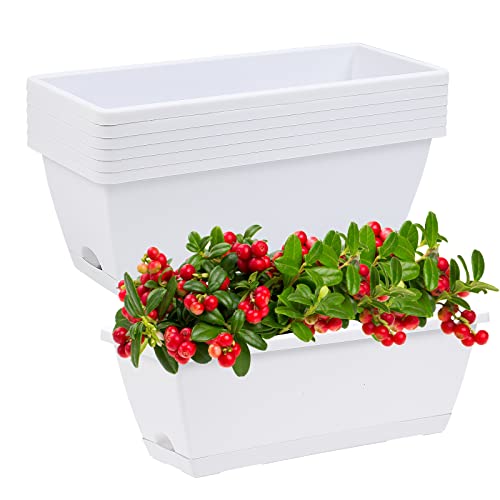
As an Amazon Associate we earn from qualifying purchases at no extra cost to you. Ratings are shown as listed on Amazon.
Best window box planters by situation
| Situation | Best planter type | Useful size | Why it fits |
|---|---|---|---|
| Low budget or rental-friendly setup | UV-resistant resin or polypropylene box | 24–30 in. long, 7–9 in. deep | Lightweight, inexpensive, and easy to replace; use railing hooks or freestanding supports where drilling is not allowed |
| Permanent wood or masonry installation | Powder-coated steel, aluminum, or heavy resin | 30–36 in. long, 9–12 in. deep | Provides better visual scale and enough root volume for mixed plantings |
| Herbs and compact vegetables | Deep resin, fiberglass, or metal box with drainage | 24–36 in. long, at least 10 in. deep | More soil volume supports basil, parsley, chives, lettuce, and compact peppers |
| Windy or exposed upper window | Low-profile metal or reinforced resin box with through-bolted brackets | 24–30 in. long, 8–10 in. deep | Shorter length and secure mounting reduce leverage and sway |
| Minimal watering | Self-watering box with a reservoir and water-level indicator | 24–36 in. long, 8–12 in. deep | Buffers missed watering, although the reservoir does not eliminate maintenance |
Material comparison: what lasts outdoors
Resin and polypropylene
Resin is usually the best all-purpose material for a first window box. It is lighter than metal, resists rust, and comes in many colors and textures. Products from brands such as Bloem and The HC Companies represent the common lightweight-resin category. Look for UV-resistant construction rather than thin decorative plastic, especially on south- or west-facing windows.
The weaknesses are predictable: inexpensive plastic can become brittle after years of sun exposure, and a long box may bow when filled with wet soil. A box with a reinforced rim, molded feet, and separate metal brackets is more dependable than one supported only by a thin lip.
Powder-coated steel
Steel offers a crisp architectural appearance and good rigidity. It works particularly well on modern homes and large windows, but scratches or chips in the powder coating can expose metal to rust. Inspect welds, fasteners, and drain openings each spring. Steel also becomes heavy quickly, so its attractive appearance should not distract from the structural calculation.
Aluminum
Aluminum is lighter than steel and naturally resistant to rust. It is a strong choice for exposed windows, provided the box has sufficient wall thickness and a stiffened rim. Thin aluminum can dent, and dark finishes may heat the root zone in intense sun. Use an appropriately sized liner or choose a lighter-colored finish in hot climates.
Fiberglass and composite
Fiberglass and composite planters offer a more substantial appearance without the full weight of stone or concrete. They generally cost more than basic resin, but they resist swelling and can remain attractive for many seasons. Check whether the drainage holes are factory-made; drilling a brittle composite incorrectly can cause cracking.
Wood
Cedar and other naturally durable woods look excellent against traditional siding, but they require more ownership care. The interior should be protected with a plant-safe liner or a removable plastic insert, while the exterior benefits from periodic sealing. Avoid trapping water between the box and the wall, and expect wood to eventually soften at joints and around fasteners.
Mounting is more important than the planter
A window box is safest when the brackets carry its base, rather than when screws simply pass through the box’s back rim. The preferred arrangement is two or more brackets attached to solid framing, masonry anchors, or a properly engineered support surface. For boxes longer than 30 inches or those filled with herbs, three brackets are often preferable.
- Wall brackets: Best for permanent installations. Use fasteners matched to wood framing, brick, or concrete; generic screws are not suitable for every wall.
- Rail or deck hooks: Useful for balconies and rentals, but verify the rail diameter and the hook’s load rating. Prevent side-to-side movement with stabilizing straps or stops.
- Window-sill supports: Suitable only where the sill and surrounding trim are designed to carry the load. Do not assume a decorative sill is structural.
- Freestanding brackets: A good solution when drilling is prohibited, especially on porches. They still need a wide, stable base in windy locations.
Follow the bracket manufacturer’s spacing and hardware instructions rather than relying on a box’s advertised capacity. The weakest component—wall, anchor, bracket, fastener, or planter—sets the practical limit.
Calculate the filled weight before buying
Manufacturers often list a dry planter weight, but the mounting system must support the filled weight. A useful planning estimate is:
Filled weight = planter weight + soil weight + plant weight + water weight.
For example, consider a 30-inch box holding approximately 12 gallons of potting mix. Potting mix weighs roughly 6–10 pounds per gallon when dry, depending on ingredients and moisture. Using 8 pounds per gallon gives:
- Planter: 6 pounds
- Dry mix: 12 × 8 = 96 pounds
- Plants and accessories: about 8 pounds
- Water retained after watering: about 10 pounds
- Estimated working load: 120 pounds
This is why a seemingly small window box can exceed the capacity of light-duty hooks. If the structure cannot safely handle the estimated load with a margin, choose a shorter or shallower box, use a lighter soilless mix, or move the planting to the ground.
Choose dimensions by the plants, not the window alone
Measure the clear width of the window, then check trim, shutters, and nearby corners. A box slightly narrower than the window is easier to mount and less likely to interfere with opening casements. For visual balance, a box between 70% and 100% of the window width usually looks proportional.
- 6–8 inches deep: Suitable for pansies, alyssum, small succulents, and shallow-rooted annuals.
- 8–10 inches deep: A versatile range for most flowering combinations and culinary herbs.
- 10–12 inches deep: Better for vigorous herbs, compact vegetables, and plants that dry out quickly.
- More than 12 inches deep: Adds substantial weight and is rarely necessary for a typical window planting.
Length also affects watering. A 36-inch box can hold a generous display, but it may develop dry spots if plants are crowded or the box receives uneven sun. Two shorter boxes can be easier to lift, replace, and maintain than one very long container.
Drainage and self-watering features
Drainage holes should be distributed across the base, not concentrated at one end. A tray or reservoir is valuable over siding, but it should not leave the roots permanently saturated. Raise the box slightly on its brackets or feet so water can escape freely.
Self-watering designs are useful for hot, sunny windows and gardeners who cannot water daily. They work through a reservoir and a wicking zone, so the growing medium still needs to be appropriate and the overflow must remain clear. In freezing climates, empty the reservoir before hard freezes if the instructions call for it; trapped water can expand and damage plastic or fittings.
Do not fill the bottom with gravel as a substitute for drainage. It reduces usable root space without creating a reliable drainage layer. Use a quality container mix, keep drainage openings unobstructed, and add a thin mesh screen only when needed to prevent mix loss.
Ownership realities: what wears out first
Drainage screens, reservoir wicks, liners, and plastic brackets usually wear before the planter body. Replace cracked liners and hardened wicks rather than trying to restore them with glue. Salt deposits from fertilizer can clog holes and stain exterior surfaces; rinse the box several times during the growing season and clean it fully between plantings.
Common mistakes include using garden soil, which compacts in containers; filling a box before installing it; placing a heavy box on weak trim; and packing plants too closely for an instant full look. Crowding increases watering demand and encourages poor airflow. Leave enough space for mature plant width and choose plants with similar light and moisture requirements.
Best buying checklist for 2026
- Confirm the box’s interior dimensions and approximate soil capacity, not just its exterior length.
- Check that drainage holes, overflow openings, or a reservoir system are included and accessible.
- Match the mounting method to the actual wall or railing material.
- Calculate the saturated weight before selecting brackets.
- Prefer UV-resistant resin, corrosion-resistant metal, or properly protected wood for exposed locations.
- Choose a box that can be lifted safely when empty and serviced without leaning dangerously out of a window.
For most homes, a 24- to 30-inch UV-resistant resin box with two or three properly rated brackets is the safest starting point. Choose a deeper self-watering model for sunny herbs, a rigid aluminum or powder-coated steel box for demanding exposure, and a shorter, lighter planter whenever the wall or mounting surface is uncertain.




Write Your Review
No reviews yet. Be the first to share your experience!