

Key takeaways
- Narrow stoop or single door (under 5 feet wide): one pair of 24-inch planters, about 12 to 14 inches wide.
- Standard 6 to 8 foot entry: pair of 28 to 32 inch planters flanking the door, a shorter one beside a bench if needed.
- Wide covered porch or double doors: two pairs, or 30 inches plus a mix of heights to avoid a stiff look.
- Windy, uncovered porch: heavier fiberglass, concrete blend, or any light planter ballasted with pavers.
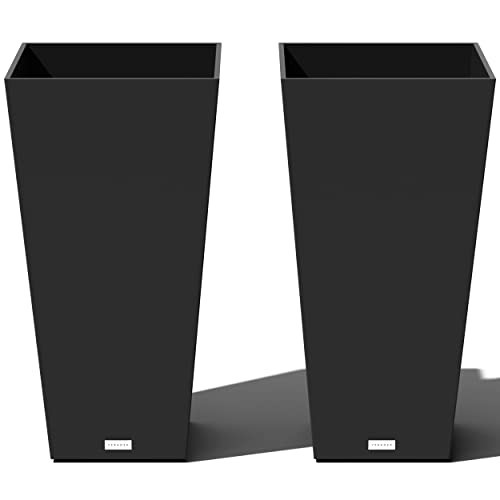
The best tall outdoor planters for porches are the Veradek V-Resin Taper at 30 inches for a premium front-door statement, the Jupiter fiberglass cylinder at 31.5 inches for height without heavy weight, and the Devoko 24-inch resin pair for a mid-range, drainage-friendly set. For most entryways, 24 to 32 inches tall and a frost-proof, lightweight material (fiberglass or polypropylene composite) is the sweet spot.
This guide is built from published specifications and independent roundups rather than product handling. Many “resin” planters in this category are polypropylene composite, not true fiberglass, so the material and weight details below are labeled accordingly. Where a spec could not be confirmed, it is described by class.
Our top picks


As an Amazon Associate we earn from qualifying purchases at no extra cost to you.
Quick answer: pick by porch size
- Narrow stoop or single door (under 5 feet wide): one pair of 24-inch planters, about 12 to 14 inches wide.
- Standard 6 to 8 foot entry: pair of 28 to 32 inch planters flanking the door, a shorter one beside a bench if needed.
- Wide covered porch or double doors: two pairs, or 30 inches plus a mix of heights to avoid a stiff look.
- Windy, uncovered porch: heavier fiberglass, concrete blend, or any light planter ballasted with pavers.
Height and width for entryways
Most tall planter picks run 20 to 32 inches tall, and 24 and 30 inches are the most common porch sizes. Think of the planter and plant together: a 24-inch container with a 2 to 3 foot plant reads as a 4 to 5 foot arrangement.
- Height rule: planter plus plant should reach about two-thirds to the full height of the door frame without hiding it.
- Width rule: a planter should be at least 12 inches wide to hold a stable root ball, and 14 to 18 inches if you want a full seasonal display.
- Clearance: leave at least 36 inches of walking path, and check door swing before choosing a width.
- Pairs vs. singles: pairs look formal and balanced; a single tall planter with a lower cluster looks relaxed.
Frost-proof materials compared
| Material | Frost behavior | Weight | Wind stability | Typical look |
|---|---|---|---|---|
| Fiberglass | Frost resistant; best weight-to-durability ratio | Light to medium | Good when planted; may need ballast when empty | Sleek, modern, painted finishes |
| Fiberstone (fiberglass, resin and stone powder) | Frost resistant | Medium | Better than plain resin | Stone-like |
| Polypropylene composite (“resin”) | Flexes rather than cracks; UV stabilizers matter | Light | Needs ballast; tips easily when dry | Wicker, wood-look and modern styles |
| Metal (powder-coated steel, aluminum) | Does not crack; can dent | Light to medium | Aluminum needs ballast | Contemporary, industrial |
| Terra cotta and ceramic | Can crack when wet soil freezes | Heavy | Very stable | Classic, but a poor choice in freeze-thaw zones |
How we chose
This is a research-based shortlist. We compared published height, material, drainage, and inner-pot details across manufacturer information and independent roundups, and included planters that meet these criteria:
- 20 to 32 inches tall, suited to a porch or entry.
- Frost-resistant, UV-resistant material (fiberglass, fiberstone or polypropylene composite).
- A drainage path: holes, a plug, or an inner pot that sits above drainage water.
- Sold singly or in pairs, so you can style an entry.
- Currently listed in 2026.
Drainage and false-bottom depth
A tall planter is mostly empty space under the roots. Without a false bottom, you need a lot of soil to fill it, and that adds weight and cost. A removable inner pot, a planting box or an insert shelf raises the plants above drainage water and cuts the soil you need.
- Drainage holes: at least one, ideally several. Some planters ship without any, so check before buying. If there are none, drill your own before planting.
- Removable plug: useful for controlling water on covered porches and for stopping puddles on wood decks.
- Inner pot or planting box: removable inner pots make seasonal swaps easy.
- Do not use a gravel layer as a substitute for holes. It does not move the water table down and takes up root space.
Worked example: soil volume and weight with a false bottom
These numbers use a simplified shape to show the logic. Your planter will differ, so substitute your own interior measurements.
- Take a tall planter with an interior diameter of about 12 inches and an interior depth of 28 inches.
- Volume of a cylinder: 3.14 x 6 x 6 x 28 = about 3,165 cubic inches, which is 1.83 cubic feet (about 13.7 gallons).
- Wet potting mix weighs very roughly 40 to 50 pounds per cubic foot. At 45 pounds: 1.83 x 45 = about 82 pounds of soil in a fully filled planter.
- Now add a false bottom or inner pot that raises the planting level by 12 inches, leaving 16 inches of soil depth: 3.14 x 36 x 16 = 1,809 cubic inches = 1.05 cubic feet. At 45 pounds: about 47 pounds.
The false bottom saves roughly 35 pounds and about 43 percent of the soil. Sixteen inches is plenty of root depth for most annuals, grasses and small evergreens.
The same math shows the wind issue. A light composite planter of around 17 pounds empty (the figure reported for a 30-inch Veradek) can tip over when empty or planted with a tall, leafy shrub in a gust. Ballast with two or three pavers or bags of gravel at the bottom of the planter, below the planting zone, and keep the planter on a level surface.
The best tall outdoor planters for porches
1. Veradek V-Resin Taper 30-inch: best overall for a premium entry
Spec line: 30 in tall · high-grade polypropylene composite · tapered shape · about 17 lb empty (one roundup) · frost and UV resistant · premium tier
Best for: a modern or traditional entry where you want a refined, uniform pair.
Skip if: you need to see drainage details before buying. Source pages did not detail the drainage setup, so confirm holes and plug on the maker’s page.
- Pros: tall and light; resin composite resists frost; easy to move seasonally.
- Cons: light enough to tip in wind unless ballasted; premium tier.
2. Jupiter fiberglass cylinder planter: best lightweight tall option
Spec line: 31.5 in tall · fiberglass · frost resistant · lightweight · cylinder form
Best for: a tall, sleek look on an upper deck or porch where weight limits matter.
Skip if: your porch is very windy and you do not want to add ballast.
- Pros: best weight-to-durability material; slim silhouette.
- Cons: light enough to need ballast; confirm drainage hole size and diameter before ordering.
3. Devoko 24-inch resin planters: best mid-range pair with an inner pot
Spec line: 24 in tall (also sold at 23.6 in and 32 in) · polypropylene composite · 4 drainage holes · removable inner pot
Best for: a front door pair where you want to swap plants by lifting out the inner pot.
Skip if: you need exact width and soil capacity, which sources did not list.
- Pros: value pricing; four holes for water; inner pot cuts soil use.
- Cons: light enough to tip; style is wicker or modern, so check your porch décor.
4. Greesum 24-inch tall planters, set of 2: best set with a leak-proof inner layer
Spec line: 24 in tall · lightweight resin · 4 drainage holes · leak-proof inner layer · removable inner pot · set of 2
Best for: covered porches and wood decks where dripping water onto the surface is a concern.
Skip if: you want a planter that stays put in strong wind without ballast.
- Pros: sold as a pair; removable inner pot; stays tidy.
- Cons: lightweight; confirm width and soil capacity on the listing.
5. VEVOR 22-inch tall planters, set of 2: best with a water tray
Spec line: 22 in tall · polypropylene · built-in drainage system and water tray · built-in planting box with pull ring · set of 2
Best for: narrow stoops where a shorter tall planter fits under a low overhang.
Skip if: you want a premium finish; this is an entry-level to mid-range tier.
- Pros: built-in planting box lifts the plants and reduces soil; tray protects the surface.
- Cons: shorter than other picks; tray water can pool in rainy weeks, so empty it.
6. Keter 22-inch wood-look planters, set of 2: best wood-look appearance
Spec line: 22 in tall · resin with wood-look finish · set of 2 · mid-range tier · exact drainage and weight not confirmed
Best for: traditional and farmhouse porches that want a natural look without rot.
Skip if: you want a sleek modern finish.
- Pros: brand known for outdoor resin; looks like wood without upkeep; sold as a pair.
- Cons: shorter profile; confirm drainage setup on the maker’s page.
7. Maple99 30-inch planters, 2-pack: best 30-inch pair on a budget
Spec line: 30 in tall · resin composite · drainage holes · 2-pack · entry-level to mid-range tier
Best for: a taller pair at a lower price, for covered porches.
Skip if: you want a heavier, more stable planter in a windy spot.
- Pros: 30-inch height in a pair; drainage holes.
- Cons: exact width and weight not confirmed; light enough to need ballast.
8. Mayne Nantucket 32-inch: best self-watering tall planter
Spec line: 32 in tall · self-watering design · resin construction · confirm reservoir volume on the maker’s page
Best for: busy households and sunny entries where watering a tall pot daily is a chore.
Skip if: your plants dislike constant moisture, or you want to use a standard drain-through pot.
- Pros: reservoir cuts watering; tall form; brand offers other long-warrantied models.
- Cons: reservoir details not confirmed in the sources checked; may hold water in rainy weeks.
Wind stability: weight vs. height
- Light is good for moving and bad for gusts. Every tall composite planter becomes a sail when empty.
- Add ballast low: pavers, bags of gravel, or a base layer of heavier soil.
- Use plants with a low center of mass in tall pots on exposed porches. A tall, leafy shrub in a 24-inch pot is the top-heavy case.
- Group two or three planters together. Clustering increases stability.
- On upper-floor porches, check local rules and the railing before placing tall planters near edges.
Decision guide: which one for your porch
- Measure the space first. Note the door swing, the clear width beside the door and the lowest overhang. If the overhang is under about 7 feet, a 24-inch planter plus plant fits more comfortably than a 32-inch one.
- Check the exposure. Open porches in gusty areas call for fiberglass or a ballasted composite. Covered porches can use the lightest sets.
- Choose the watering style. If you want to water rarely, pick a self-watering model such as the Mayne Nantucket. If you want full control of drainage, pick a plug or hole-based model such as the Devoko or Greesum.
- Pick the finish. Wicker and wood-look resin suit traditional porches; smooth fiberglass and tapered composite suit modern ones.
- Plan for the cold season. In freeze-thaw climates, avoid ceramic and leave an inch of space under the rim so expanding soil has room.
Plant picks that fit a tall porch planter
- Thriller, filler, spiller: a vertical plant in the center (dwarf conifer, ornamental grass, canna), a mounded filler, and a trailing plant at the edge.
- Year-round structure: dwarf boxwood, dwarf spruce or similar evergreens suited to your zone. Plants in containers are less hardy than in the ground, so choose plants rated for a zone or two colder than yours.
- Shade: hosta, fern, coleus.
- Sun: grasses, geraniums, lantana, salvia.
Frequently asked questions
How tall should porch planters be?
Most are 24 to 32 inches tall. Choose a height so planter and plant together reach about two-thirds of the door frame.
Shorter stoops and low overhangs suit 22 to 24 inches; wide entries suit 30 inches or more.
Which tall planter material is best for freezing winters?
Fiberglass, fiberstone and polypropylene composite resist frost cracking. Terra cotta and ceramic can crack when wet soil freezes.
If you use ceramic, empty it and store it under cover before winter.
Are fiberglass planters better than resin?
Fiberglass has the best weight-to-durability ratio, but many resin planters are polypropylene composite and last well too. Both are light.
Check UV resistance and wall thickness regardless of material.
Do tall planters need drainage holes?
Yes. Without them, roots sit in water and rot. Some planters ship without holes, so check and drill them if needed.
A removable plug gives you control on covered porches.
What is a false bottom in a tall planter?
It is a raised insert or inner pot that fills the lower part of the planter so you need less soil. It also lifts roots above drainage water.
In the worked example, a 12-inch false bottom cut the soil from about 82 pounds to about 47 pounds.
How do I stop tall planters from blowing over?
Add ballast at the bottom, such as pavers or gravel, and plant them. Cluster two or three planters together on exposed porches.
Avoid top-heavy plants in tall, light pots in gusty spots.
Can I leave plants in tall planters over winter?
Often yes with cold-hardy plants and a frost-proof planter, but container roots are more exposed than in-ground roots.
Choose plants rated for a zone or two colder than yours, and cluster pots against the house wall.
How far apart should a pair of planters be?
Place them evenly on either side of the door, leaving at least 36 inches of walking space and clearance for the door swing.
On wide porches, stagger heights or use two pairs for a balanced look.






Write Your Review
No reviews yet. Be the first to share your experience!