

Key takeaways
- High-resilience foam: holds its shape and is the better seat core. One Sunbrella-class set is listed with 25-density PU foam wrapped in Dacron, which is a typical firm-but-plush construction.
- Memory foam: soft and conforming, but slow to bounce back and best kept indoors or under a roof.
- Shredded foam or polyester fiber: softer and cheaper, but flattens over time.
- Quick-dry foam: some custom makers recommend a quick-drying foam core for outdoor use, since it drains and dries faster than a standard foam.
The best glider and rocker cushions for outdoor chairs are a made-to-measure Sunbrella seat and back set such as those from Fabrica Kraft for exposed porches, a ready-made Sunbrella high-back set in about 24.5 x 27 in. with a 6 in. foam seat for standard gliders, and the Codi Rocking Chair Cushions with a water-resistant polyester cover for a low-cost outdoor option. The catch is that many popular rocker sets, including baibu, Lokex, YZ HOME and mudilun, are sold for indoor or covered-porch use, so the fabric and exposure matter as much as the fit.
Gliders and rockers are harder to fit than a standard patio chair. The seat is contoured, the back is often high and curved, the frame moves, and the cushion has to stay in place when the chair tilts. A flat pad slides off, and a cushion that is too thick can change how the chair rocks. This guide shows how to measure, how to choose fill and fabric for outdoor use, and how seven real options compare, including which ones belong only under a roof.
Our top picks


As an Amazon Associate we earn from qualifying purchases at no extra cost to you.
How we chose
This guide is based on research, not on first-hand use. We compared published product specification pages, retailer listings and a 2026 roundup of rocker cushions, then grouped them by how they are meant to be used. We scored each option on fit for glider and rocker shapes (tie-on, contoured or flat, seat-plus-back sets or single pieces), seat thickness and fill, fabric class (true solution-dyed acrylic, polyester with a water-repellent finish, or indoor fabric such as chenille), stated water and fade resistance, and non-slip features. Many listings lack complete specs, so where a thickness or fill was not stated we say so. Fabric claims are the maker’s, so check the current product page before buying.
Step 1: measure your glider or rocker
Do not use old cushion sizes alone, because they compress and stretch. Measure the frame while the chair is level.
- Seat width: between the inside of the arms at the front, then again at the back if the seat tapers.
- Seat depth: front edge of the seat deck to the back support.
- Back height: from the seat deck to the top of the back rail. High-back gliders often measure 26 to 30 inches.
- Back width: across the back at the widest point and at the top if the back curves in.
- Ties: note where the slats or rails allow a tie to be anchored.
Worked example: a glider seat measures 20 in. wide at the front, 18 in. at the back, and 19 in. deep, with a 27 in. back. A square 19.5 x 19.5 in. seat (like the baibu seat size) will overhang the narrow rear corners and buckle. A contoured seat that is 20 in. at the front and 18 in. at the back, or a rectangular cushion cut to the narrowest dimension, will sit flat. A 24.5 x 27 in. high-back piece fits the 27 in. back, but a 22 x 17 in. back (YZ HOME’s listed size) will leave a gap of 5 in. at the top. When the sizes are close, favor the narrower width and rely on ties to keep the cushion in position.
Contoured, tie-on or flat?
Contoured cushions
Contoured sets are shaped to the curve of a glider seat and back. They look tailored and stay put better, but they only fit the frame style they were cut for. Look for a size and a shape that matches your frame, or use a made-to-measure service.
Tie-on cushions
Ties at the seat and back keep a cushion from sliding when the chair moves. For rockers and gliders, this is the single most useful feature, because the chair tilts and any loose pad drifts forward. Check for at least two ties per piece, and add a non-slip bottom if the seat is smooth.
Single-piece or sets
A seat-plus-back set is the usual choice for a glider, because the back is often the part that wears out first. Some owners prefer one long piece that serves as both seat and back, usually a 44 in. or 48 in. strip with ties. These work well on flat benches and some rockers, but they do not follow a contoured back as closely.
Thickness, fill and comfort
Thicker is not always better on a glider. A 4 to 5 in. seat is common and comfortable, but a very thick seat can push the sitter forward and change the clearance between the arms. A 6 in. foam seat suits deep, wide gliders but can feel high on a narrow rocker.
- High-resilience foam: holds its shape and is the better seat core. One Sunbrella-class set is listed with 25-density PU foam wrapped in Dacron, which is a typical firm-but-plush construction.
- Memory foam: soft and conforming, but slow to bounce back and best kept indoors or under a roof.
- Shredded foam or polyester fiber: softer and cheaper, but flattens over time.
- Quick-dry foam: some custom makers recommend a quick-drying foam core for outdoor use, since it drains and dries faster than a standard foam.
Fabric: what survives outdoors
Solution-dyed acrylic such as Sunbrella has color through the fiber, so it resists fade and mildew and dries quickly. It is the best choice for exposed porches. Water-repellent polyester is cheaper and handles light rain, but its finish wears, and most budget polyester fades faster. Chenille, linen-look and other indoor fabrics will mildew and fade if left outside. Several rocker cushions in the market use these fabrics because they are sold primarily for indoor or nursery rockers, so read the listing line that says indoor or outdoor before you buy.
Comparison table
| Option | Size | Thickness and fill | Fabric | Use |
|---|---|---|---|---|
| Made-to-measure Sunbrella set (Fabrica Kraft) | Cut to your seat and back | Your choice; quick-dry foam recommended outdoors | Sunbrella acrylic | Outdoor, exposed |
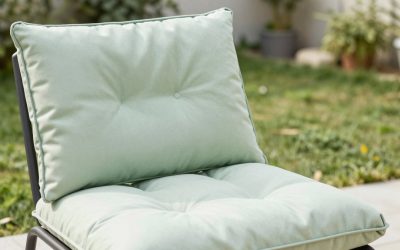
| Ready-made Sunbrella high-back set | About 24.5 x 27 in. | 6 in., 25-density PU foam wrapped in Dacron | Sunbrella acrylic | Outdoor |
| Codi Rocking Chair Cushions | 18 x 18 or 18 x 22 in. (seat) | Polyurethane foam | Water-resistant polyester | Outdoor, light exposure |
| mudilun Adirondack Chair Cushion | Back 44 x 19 in. | Silk cotton and high-resilience sponge | Striped polyester | Indoor, covered porch acceptable |
| baibu Rocking Chair Cushion Set | Seat 19.5 x 19.5, back 25.5 x 19.5 in. | 4 in., shredded memory foam plus high-density foam | High-density polyester | Indoor |
| Lokex Rocking Chair Cushion (Tufted Striped) | Seat 21 x 17, back 17 x 17 in. | Not stated | Striped polyester | Indoor |
| YZ HOME Rocking Chair Cushion | Seat 17 x 17, back 22 x 17 in. | 5 in. memory foam | Beige polyester | Indoor |
Best for exposed outdoor gliders
Made-to-measure Sunbrella glider and rocker sets (for example, Fabrica Kraft)
Spec line: cut to your seat and back dimensions · Sunbrella acrylic cover · quick-dry foam recommended by the maker for outdoor use · ties can be added
Best for: owners of gliders with an unusual shape or taper, or exposed porches where rain and sun hit daily. A custom cut avoids the gap and buckle you get from a nearly-right standard size.
Skip if: you need the cushion quickly or at a low cost, since custom work takes longer and costs more than a standard set.
- Pros: exact fit, premium outdoor fabric class, ties and foam choice, handles contoured and tapered seats.
- Cons: higher cost, lead time, you must provide accurate measurements.
Ready-made Sunbrella high-back seat and back set (about 24.5 x 27 in.)
Spec line: about 24.5 x 27 in. high-back piece · 6 in. thick · 25-density PU foam wrapped in Dacron · Sunbrella acrylic
Best for: standard-size gliders with a tall back, where you want true outdoor fabric without paying for custom work.
Skip if: your frame is narrow or tapered, since the standard size will overhang. Retailer feedback on sets from marketplace sellers has also mentioned stains and missing ties on arrival, so inspect the delivery.
- Pros: true outdoor fabric class, thick Dacron-wrapped foam, ready to ship.
- Cons: fixed sizes, higher cost than polyester, quality control varies by seller.
Best budget outdoor option
Codi Rocking Chair Cushions
Spec line: 18 x 18 in. or 18 x 22 in. seat pad · polyurethane foam · water-resistant polyester · slip-resistant bottom · listed for outdoor use
Best for: a simple seat pad on a small rocker, where you want a water-resistant cover at an entry-level cost.
Skip if: you need a matching back cushion or a contoured glider fit, because these are seat pads.
- Pros: outdoor-listed, water-resistant polyester, slip-resistant bottom, two sizes.
- Cons: seat only, ties and thickness not clearly stated, polyester will fade sooner than acrylic.
Best for a covered porch or sunroom (indoor-rated)
These options are comfortable and well-shaped for rockers, but their makers list them as indoor products. Use them only on a covered porch where no rain reaches them, and bring them inside in humid weather.
baibu Rocking Chair Cushion Set
Spec line: seat 19.5 x 19.5 in. · back 25.5 x 19.5 in. · 4 in. thick · dual-layer shredded memory foam and high-density foam · high-density polyester · ties · silicone non-slip pad
Best for: a wide, square rocker seat with a standard back, where you want a plush dual-layer foam and a silicone pad that grips the seat.
Skip if: the chair lives in the rain or direct sun, or your seat tapers narrower than 19.5 in. at the back.
- Pros: dual-layer foam, silicone non-slip pad, ties, set with back.
- Cons: indoor-rated, memory foam is slow to dry if damp.
mudilun Adirondack Chair Cushion
Spec line: 44 x 19 in. back piece · silk cotton and high-resilience sponge fill · striped polyester · ties, silicone base and spring belts
Best for: Adirondack-style or slatted rockers on a covered porch, where the triple anchoring (ties, silicone, spring belts) keeps a long cushion from shifting.
Skip if: you need a true weatherproof cover; the listing treats it as indoor with covered-porch use only.
- Pros: strong anti-slip system, long single piece, soft fill.
- Cons: not made for open weather, silk cotton holds moisture.
Lokex Rocking Chair Cushion (Tufted Striped)
Spec line: seat 21 x 17 in. · back 17 x 17 in. · striped polyester · ties · non-slip dots · thickness and fill not stated
Best for: a wide-and-shallow rocker seat where a tufted, patterned set adds color on a covered porch.
Skip if: you need a tall back (17 in. is short for most gliders) or want a stated foam type.
- Pros: ties, non-slip dots, tufting keeps fill in place.
- Cons: short back, indoor-rated, fill and thickness unspecified.
YZ HOME Rocking Chair Cushion
Spec line: seat 17 x 17 in. · back 22 x 17 in. · 5 in. memory foam seat · beige polyester · ties
Best for: small nursery-style rockers or sunroom chairs where a thick, conforming seat matters more than weather resistance.
Skip if: the chair is outdoors, or your seat is wider than 17 in.
- Pros: thick memory foam, ties, set with back.
- Cons: small size, indoor-rated, memory foam is not suited to damp conditions.
Decision matrix
| Your chair | Choose | Why |
|---|---|---|
| Exposed to rain and sun, tapered seat | Made-to-measure Sunbrella set | Exact fit and true outdoor fabric |
| Exposed, standard high-back glider | Ready-made Sunbrella high-back set | Outdoor fabric, thick Dacron-wrapped foam |
| Small rocker, light exposure, tight budget | Codi seat pads | Outdoor-listed, slip-resistant bottom |
| Covered porch, wide square seat | baibu set | Dual-layer foam, ties, silicone pad |
| Slatted Adirondack-style rocker, covered | mudilun | Triple anti-slip system |
| Nursery or sunroom rocker | YZ HOME | Thick memory-foam seat |
Set versus single piece
- Do you have a glider with a separate back rail? A set (seat plus back) fits best and lets you replace the more worn part separately.
- Do you have a slatted bench-style rocker? A single long cushion, such as a 44 or 48 in. piece with ties, can serve as seat and back.
- Is your seat tapered? Choose a contoured or made-to-measure piece. Square pads buckle at the narrow end.
- Do you need non-slip? Add a non-slip bottom or silicone pad if ties alone do not hold.
Care, rain and storage
- Bring cushions inside or under cover during storms. Even outdoor-rated foam stays wet longer than the cover.
- Prop wet cushions on their edge so air flows through the foam and cover, and do not store them damp.
- Spot clean with mild soap and water, and avoid bleach on dyed fabric.
- Rotate or flip seat pads regularly so the foam wears evenly.
- Check ties and stitching each season. A frayed tie is the usual first failure on a rocker pad.
- Do not leave cushions on a chair in direct, strong sun for weeks; fade and heat wear shorten the life of every fabric.
Frequently asked questions
How do I keep glider cushions from sliding?
Use ties at the seat and back, and add a non-slip bottom if the frame is smooth. A snug fit matters too, since gaps let the pad drift.
Sets with silicone pads or spring belts, like the baibu and mudilun options, add extra grip for covered-porch use.
Can I use indoor rocking chair cushions outside?
Only on a covered porch with no rain exposure. Indoor fabrics such as chenille and plain polyester can mildew and fade outdoors.
If the chair is exposed, choose an outdoor-listed set or a Sunbrella-class cover.
What thickness is best for a glider cushion?
Four to five inches is common and comfortable. A 6 in. seat suits deep gliders but can feel high on a narrow rocker.
Check the clearance under the arms, because a thick cushion can crowd the sitter.
Do I need a seat and back set or one long cushion?
A set fits most gliders, because the seat and back are separate. A single long piece works on slatted or bench-style rockers.
If the back curves, choose a set cut to that curve.
What is the best fabric for outdoor glider cushions?
Solution-dyed acrylic, the Sunbrella fabric class, holds color and resists mildew best. Water-repellent polyester is cheaper but fades sooner.
Avoid chenille and other indoor fabrics on exposed chairs.
How do I measure for custom glider cushions?
Measure the seat width at the front and back, the seat depth, the back height and the back width, with the chair level.
Send the narrowest width and mention any taper so the maker can cut to the real shape.
Are made-to-measure cushions worth the cost?
For tapered or unusual gliders, yes, because a standard size will buckle or leave gaps. For standard frames, a ready-made set is often enough.
Weigh the cost against how long you plan to keep the chair.
How long do outdoor glider cushions last?
It depends on fabric, exposure and storage. Acrylic covers and quick-dry foam usually last longer than budget polyester over several seasons.
Keeping cushions dry and out of direct sun when not in use helps every type.




Write Your Review
No reviews yet. Be the first to share your experience!