

Key takeaways
- Best everyday value: Beau Jardin 8-pack (about 10 to 20 lumens each, listed 10 to 13 hours of runtime).
- Best brightness and adjustability: Linkind SP3 (up to 200 lumens, IP54, 12 hours on low and 6 hours on high).
- Best for security and steps: Ring Solar Pathlight (motion burst to about 80 lumens).
- Brightest listed: NYMPHY (400 lumens, IP68) and XMCOSY+ (300 lumens, 13+ hours constant and 48+ hours in motion mode).
- Best mid-range output with a classic look: Gama Sonic Baytown II (about 130 lumens, up to 10 hours).
- Longest listed runtime: TomCare 6-pack (1000 mAh battery, listed 12 to 16 hours).
- Best budget accent: Gigalumi and Maggift (about 2 to 6 lumens).
The best solar path lights for most yards are the Beau Jardin 8-pack for everyday value, the Linkind SP3 when you want real brightness, and the Ring Solar Pathlight when you want a motion-triggered boost for safety. If you need maximum output, the NYMPHY (listed at 400 lumens per fixture) and XMCOSY+ (listed at 300 lumens) sit at the top of the brightness range, while Gigalumi and Maggift style accent stakes are for marking edges, not lighting steps.
Solar path lights look alike in photos and differ a lot in practice. Output ranges from a few lumens to several hundred, battery capacity runs from about 100 mAh to 1000 mAh, and weather ratings run from IP44 to IP68. This guide explains which numbers matter, how many lights your path needs, and which products fit which job.
Our top picks


As an Amazon Associate we earn from qualifying purchases at no extra cost to you.
Quick answer: top picks
- Best everyday value: Beau Jardin 8-pack (about 10 to 20 lumens each, listed 10 to 13 hours of runtime).
- Best brightness and adjustability: Linkind SP3 (up to 200 lumens, IP54, 12 hours on low and 6 hours on high).
- Best for security and steps: Ring Solar Pathlight (motion burst to about 80 lumens).
- Brightest listed: NYMPHY (400 lumens, IP68) and XMCOSY+ (300 lumens, 13+ hours constant and 48+ hours in motion mode).
- Best mid-range output with a classic look: Gama Sonic Baytown II (about 130 lumens, up to 10 hours).
- Longest listed runtime: TomCare 6-pack (1000 mAh battery, listed 12 to 16 hours).
- Best budget accent: Gigalumi and Maggift (about 2 to 6 lumens).
How we chose
This is a research-based guide, not a product test. We reviewed manufacturer specifications and the lumen, runtime, battery and weather-rating figures that appear across independent buying guides and retailer listings, and kept products whose figures were consistent between sources. Lumen and runtime figures for solar lights are manufacturer-listed and are not independently measured here, and real output depends on sun exposure, season and battery age. Where a spec could not be confirmed, the entry says so and describes the product by spec class. Choose by the thresholds in this guide, then check the listed numbers on the current product page.
Comparison table
| Product | Listed brightness | Runtime / battery | Weather rating | Special feature | Tier |
|---|---|---|---|---|---|
| Beau Jardin 8-pack | About 10-20 lm | 10-13 hrs listed | Outdoor-rated (confirm IP) | 8 lights per pack | Entry to mid-range |
| Linkind SP3 | Up to 200 lm | 12 hrs low, 6 hrs high | IP54 | Multiple brightness modes | Mid-range |
| Ring Solar Pathlight | Motion burst to about 80 lm | Battery class (confirm) | Outdoor-rated (confirm IP) | Motion detection, app/bridge ecosystem | Premium |
| NYMPHY | 400 lm | Confirm on listing | IP68 | Highest listed output | Mid-range |
| XMCOSY+ | 300 lm | 13+ hrs constant, 48+ hrs motion mode | Confirm on listing | Motion mode | Mid-range |
| Gama Sonic Baytown II | About 130 lm | Up to 10 hrs | Confirm on listing | Lantern-style design | Mid-range to premium |
| TomCare 6-pack | Decorative class (confirm) | 12-16 hrs listed, 1000 mAh | Confirm on listing | Large battery | Entry-level |
| Gigalumi | About 2-6 lm | Small battery class | Outdoor-rated (confirm) | Accent only | Entry-level |
| Maggift | About 2-6 lm | Small battery class | Outdoor-rated (confirm) | Accent only | Entry-level |
The specs that matter
Lumens: how bright is enough?
Most solar path lights fall between 5 and 30 lumens, enough to show where a path is but not to light the surface. Sources disagree on thresholds, so use job-based guidance:
- 2 to 15 lumens: Decorative edge marking along a garden bed or lawn border.
- 15 to 50 lumens: Walkway guidance where people already know the route.
- 50 to 100 lumens: Visible light on the path surface; good for entry walks.
- 100+ lumens or motion boost: Steps, driveways, dark corners, areas where you need to see hazards.
Battery capacity and runtime
Battery capacity in solar path lights runs from about 100 mAh to 1000 mAh. A bigger battery generally holds more charge, but runtime depends on the brightness mode. For example, the Linkind SP3 is rated about 12 hours on low and 6 hours on high, which shows how much output changes endurance. Check whether the listed runtime is for low or high mode, and whether it assumes a full day of sun.
Solar panel size and placement
Panel area matters as much as battery size. A small panel on a big battery refills slowly, so lights may not fully charge in winter or under tree cover. Place lights where the panel sees direct sun for about six hours, and keep leaves and dust off the panel.
Weather rating
The IP rating describes dust and water protection. IP44 resists splashes. IP54 adds better dust protection. IP65 handles water jets. IP68 handles submersion under stated conditions, which matters for flood-prone or low spots. For ordinary garden paths, IP44 to IP65 is adequate; spend more on IP68 only for puddle-prone beds.
Material and stake design
Cheap lights use thin plastic that can crack in cold or UV. Metal or thick stainless or aluminum housings last longer. Check stake length and thickness: hard clay soil needs a sturdy stake, and some lights ship with pilot spikes for this reason.
Color temperature
Warm white (about 2700 K to 3000 K) matches house lighting and feels welcoming. Cool white (5000 K and up) reads brighter and more clinical. Many solar lights offer color options, but warm white is the most forgiving on plants and paving.
Worked example: how many lights does your path need?
Use spacing based on light output so the pools of light overlap enough to be useful.
- Measure the path. Say it is 40 feet long.
- Pick spacing by lumens. For 10 to 20 lumen lights, a spacing of 6 to 8 feet gives dotted guidance. For 100+ lumen lights, spacing of 10 to 15 feet is enough.
- Divide length by spacing, then add one for the end. With 8-foot spacing: 40 / 8 = 5, plus 1 = 6 lights.
- Add one light per step run or sharp turn, since these are the trip points. Suppose two turns and one set of steps: 3 more lights.
- Total: 9 lights. An 8-pack plus one single fixture, or two 6-packs if you want to stagger them on both sides.
- Compare against a high-output option: at 12-foot spacing with about 130 lumens each (Gama Sonic Baytown II class), 40 / 12 = about 3.3, rounded to 4, plus 1 at the steps gives 5 lights. Fewer fixtures, higher cost per light.
This calculation shows why lumens and quantity trade off. Many dim lights give a dotted line; fewer bright lights give real illumination.
The top solar path lights
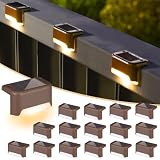
Beau Jardin 8-pack
Spec line: About 10 to 20 lumens · listed 10 to 13 hour runtime · 8 lights · stake mount
Best for: Lining a typical front walk on a budget with even, soft light. Skip if: you need to see steps or uneven ground clearly.
- Pros: Eight lights in one pack covers a standard walkway; runtime is in the long end of the category.
- Cons: Output is accent level, not task level; plastic construction is typical for the price.
Linkind SP3
Spec line: Up to 200 lumens · IP54 · 12 hours on low, 6 hours on high · multiple brightness modes
Best for: People who want adjustable, genuinely useful brightness. Skip if: you want a purely decorative look; this is function first.
- Pros: Real brightness with a stated tradeoff between low and high modes; IP54 handles weather.
- Cons: High mode halves runtime; costs more per light than basic multi-packs.
Ring Solar Pathlight
Spec line: Motion burst to about 80 lumens · low glow at rest · works with Ring ecosystem (confirm bridge requirement)
Best for: Safety and security paths where you want light to rise as someone approaches. Skip if: you do not use or want a smart-home ecosystem; the benefit drops without it.
- Pros: Motion-activated boost saves battery while giving useful light on demand.
- Cons: Premium tier per light; some features depend on additional hardware.
NYMPHY
Spec line: 400 lumens per fixture (listed) · IP68 · solar powered
Best for: Driveways, long approaches and areas that need strong light with few fixtures. Skip if: you want soft ambiance; 400 lumens is closer to a floodlight than a path marker.
- Pros: Highest listed output; IP68 rating handles wet spots.
- Cons: Runtime and battery details should be confirmed; high output drains a solar battery faster.
XMCOSY+
Spec line: 300 lumens (listed) · 13+ hours constant · 48+ hours in motion mode
Best for: Dark rural yards where you want bright, long-lasting light with a motion option. Skip if: you need light-duty accent marking.
- Pros: Strong brightness plus a motion mode that stretches runtime across nights.
- Cons: Bulkier fixtures; verify weather rating on the current listing.
Gama Sonic Baytown II
Spec line: About 130 lumens · up to 10 hours · lantern-style housing
Best for: A traditional look with useful output, such as on a front porch walk. Skip if: you want a minimal, low-profile stake.
- Pros: Good output for the style; heavier-duty build than basic stakes.
- Cons: Higher cost tier; larger footprint than slim stakes.
TomCare 6-pack
Spec line: 1000 mAh battery (listed) · 12 to 16 hour runtime (listed) · 6 lights
Best for: Long-lasting decorative light on a shaded or winter path where battery size helps. Skip if: you need a lot of brightness.
- Pros: Large battery and long runtime for the class.
- Cons: Lumen output sits in the decorative range; confirm weather rating.
Gigalumi and Maggift accent stakes
Spec line: About 2 to 6 lumens · small battery class · stake mount · multi-pack
Best for: Marking garden bed edges, adding sparkle, and keeping cost low. Skip if: you want a path you can walk safely at night.
- Pros: Lowest cost per light; easy to move around.
- Cons: Very dim; shorter life expected from small batteries and plastic parts.
Decision guide by situation
| Situation | Minimum output | Weather rating | Good fit |
|---|---|---|---|
| Garden bed edge, ambiance | 2 to 15 lm | IP44 | Gigalumi, Maggift, TomCare |
| Front walk, known route | 15 to 50 lm | IP44 to IP54 | Beau Jardin |
| Steps and turns | 50+ lm or motion boost | IP54 or higher | Linkind SP3, Ring Solar Pathlight |
| Long driveway, rural yard | 130+ lm | IP54 to IP68 | Gama Sonic Baytown II, XMCOSY+, NYMPHY |
| Shaded yard | Large battery, panel on separate lead if available | IP54 | TomCare; consider relocating panels to sun |
Installation and placement tips
- Keep the panel in direct sun for about six hours; a shaded panel is the top reason for dim lights.
- Pre-drill or wet clay soil before pushing in a stake to avoid snapping it.
- Stagger lights on both sides of a path for even coverage, or run a single line closer together.
- Keep fixtures away from porch lights, streetlights and motion floodlights; dusk sensors can misread nearby light and stay off.
- Switch each light on before installing, and charge a full day first if instructions say so.
Maintenance
- Wipe the solar panel every few weeks to remove dust and pollen.
- Replace the rechargeable battery after about one to two years if runtime drops; match the chemistry and voltage on the original.
- Bring lights indoors or turn them off in prolonged freezing weather if the manufacturer advises.
- Keep mowers and string trimmers clear of stakes; most breakage comes from yard equipment.
- Do not use a pressure washer on seals; rinse gently.
Frequently asked questions
How many lumens do solar path lights need?
For decorative marking, 5 to 15 lumens is enough. For useful light on steps or a driveway, look for 50 lumens or more, or a motion boost.
Brightness comes with a runtime cost, so check whether the listed hours apply to high or low mode.
How long do solar path lights stay on?
Listed runtimes run from about 8 to 16 hours on a full charge, depending on battery size and brightness mode. Winter and shade shorten this.
A light listed for 12 hours on low may last about half that on high, as the Linkind SP3 example shows.
Do solar path lights work in winter or shade?
They work, but with less charge. Short days and low sun reduce runtime, and shade can prevent full charging.
Choose a larger battery, keep the panel clean and clear of snow, and put lights where the panel gets direct sun.
What IP rating should I look for?
IP44 handles splashes and is enough for most garden paths. IP54 to IP65 is better for exposed locations. IP68 suits spots that flood or collect standing water.
A higher rating does not improve brightness; match the rating to your exposure.
How far apart should I space path lights?
Use about 6 to 8 feet for 10 to 20 lumen lights and 10 to 15 feet for 100-plus lumen lights. Add extra lights at steps and sharp turns.
The worked example above shows how to turn path length into a fixture count.
Why do my solar lights turn on during the day or flicker?
Usually the panel is shaded, dirty or aimed at another light source. Dusk sensors can also misread nearby light.
Clean the panel, move the light away from porch or street lighting, and check that the battery is not failing.
Can I replace the batteries in solar path lights?
Most use rechargeable cells that can be replaced. Match the type, voltage and size on the original, and use rechargeable batteries designed for solar fixtures.
Avoid standard non-rechargeable batteries, which the solar circuit is not designed to charge.
Are solar path lights bright enough for security?
Basic models are not. For security, choose a motion-activated model that boosts to about 80 lumens or higher, or one of the high-output fixtures in the 130 to 400 lumen range.
Pair them with a clear sightline and a well-lit entry. Solar path lights supplement security lighting; they should not be your only source.


Write Your Review
No reviews yet. Be the first to share your experience!