

Key takeaways
- Post caps (4×4 posts): Davinci Edison (about 30 lumens) for a premium look; VOLISUN 4×4 12-pack (about 26 lumens) for value across many posts.
- Brighter post caps: VOLISUN 6-pack (rated about 60 lumens) when posts also need to light a walkway.
- Stairs and steps: AUDLES solar step lights (about 80 lumens, IP67) for steady light; Torchstar Polyvalent for motion-triggered brightness.
- Rails: JSOT solar rail lights (6-pack, about 30 lumens, about 8 hours runtime).
- Subtle accents: Siedinlar and Othway solar post lights (about 10 to 12 lumens) for ambience only.
- Flush-fit alternative post cap: Davinci Flex-Fit (about 25 lumens) when your post size varies.
The best solar deck lights for most decks are the Davinci Edison post cap lights for posts, the AUDLES solar step lights for stairs, and the JSOT solar rail lights for railings. For high-traffic steps that need a bright, motion-activated beam, the Torchstar Polyvalent solar step light is the stronger pick. Which one you need depends on where the light goes, because a post cap, a step light, and a rail light solve three different problems.
Solar deck lighting has a reputation for dim, short-lived lights, and a lot of that comes from buying the wrong type for the job. A 10 lumen post cap makes a pleasant glow but will not show you a stair tread edge. A 300 lumen motion light will show the stair but looks like a security light on a rail. This guide explains how to match lumens, mounting style, and battery behavior to each location on your deck, and then lists nine real products with honest pros and cons.
Our top picks
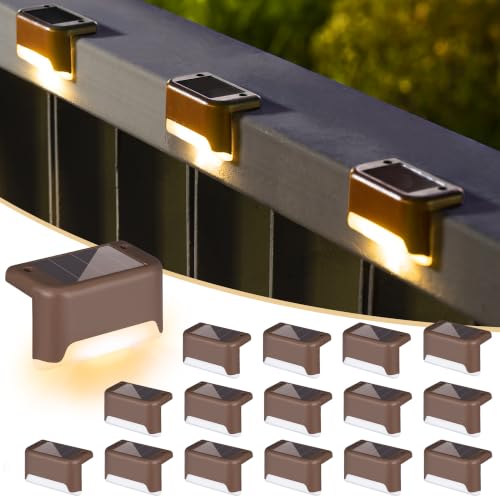


As an Amazon Associate we earn from qualifying purchases at no extra cost to you.
Quick answer: best solar deck lights by location
- Post caps (4×4 posts): Davinci Edison (about 30 lumens) for a premium look; VOLISUN 4×4 12-pack (about 26 lumens) for value across many posts.
- Brighter post caps: VOLISUN 6-pack (rated about 60 lumens) when posts also need to light a walkway.
- Stairs and steps: AUDLES solar step lights (about 80 lumens, IP67) for steady light; Torchstar Polyvalent for motion-triggered brightness.
- Rails: JSOT solar rail lights (6-pack, about 30 lumens, about 8 hours runtime).
- Subtle accents: Siedinlar and Othway solar post lights (about 10 to 12 lumens) for ambience only.
- Flush-fit alternative post cap: Davinci Flex-Fit (about 25 lumens) when your post size varies.
How we chose
This guide is built from research, not first-hand evaluation. We compared manufacturer and retailer specifications and published roundups for 2026, and kept products that are sold now and documented by multiple sources. Published lumen figures vary between sources for the same product, so the numbers in this article are labeled “about” or “as listed”, and you should confirm them on the current product page. Where we could not verify a detail, we describe a spec class rather than guess.
The selection criteria were:
- Fit for the location. Post size, step edge, or rail profile.
- Lumen output in the right range. Too dim for steps, or too bright for ambience, is a miss.
- Color temperature. Warm 2700K to 3000K for decks; cool white only for task areas.
- Weather and build. IP rating, housing material (diecast aluminum, glass, or plastic), and UV resistance.
- Battery and panel behavior. Replaceable battery, panel size, and realistic runtime.
Comparison table
| Product | Type | Output (as listed) | Notes |
|---|---|---|---|
| Davinci Edison | Post cap | About 30 lumens | Diecast aluminum and glass housing |
| Davinci Flex-Fit | Post cap | About 25 lumens | Adjustable fit for varied post sizes |
| VOLISUN 4×4 12-pack | Post cap | About 26 lumens each | Multi-pack for many posts |
| VOLISUN 6-pack | Post cap | Rated about 60 lumens | Brightest of the common 4×4 options |
| Siedinlar solar post lights | Post cap | About 10 lumens | Ambient glow only |
| Othway solar fence post lights | Post cap | About 12 lumens | Budget-oriented option |
| AUDLES solar step lights | Step | About 80 lumens, IP67 | Steady stair light |
| Torchstar Polyvalent low-voltage solar step light | Step | Up to about 320 lumens (as listed) | Motion-sensing beam |
| JSOT solar rail lights (6-pack) | Rail | About 30 lumens each | About 8 hours runtime (as listed) |
How many lumens does a deck need?
Solar lights are rated in lumens, and the number matters differently by location. These are practical ranges based on how people use decks.
- Ambience (post caps, rail glow): 10 to 30 lumens. Enough to mark the edge of the deck without causing glare.
- Safety lighting (steps, stairs): 30 to 100 lumens per light, depending on how many lights are on the staircase. Spacing matters more than raw brightness.
- Task lighting (grill area, gate, walkway): 100 lumens or more, ideally from a motion-triggered light so it saves charge.
One guide advises avoiding post caps above about 40 lumens on decks because they glare into the eyes of seated guests. Brighter outliers exist, such as post lights listed at 80 to 160 lumens, and these suit driveways and gates more than dining decks.
Worked example: sizing lights for a deck staircase
This decision logic turns the lumen ranges above into a purchase list. Take a deck with a five-step staircase, 4 ft wide, and eight railing posts.
- Stair lights. A common safety goal is to light every tread, or at least every second tread, so a person can see the step edge. Five steps with a light on each is five lights. At about 80 lumens each (the AUDLES class), the staircase gets about 400 lumens total spread along the path, which is enough to see the treads clearly.
- Alternative: motion light. One Torchstar-class motion step light (up to about 320 lumens as listed) can cover the top of the stairs for a short time. This saves battery but leaves lower steps dimmer, so use it for short stairs or add a second one.
- Posts. Eight posts need eight caps. A 12-pack of about 26 lumens (VOLISUN 4×4 class) covers all eight with four spares, giving a combined output of about 208 lumens of soft ambient light.
- Rail. If the rail runs 16 ft, a 6-pack of rail lights spaced about 3 ft apart fits the run, with the lights centered along the length.
- Total. Five step lights, eight post caps, and one rail 6-pack equals 19 lights. Because each solar unit has its own panel, the system has no single point of failure.
The lesson is that deck lighting works best as a layered system. Dim ambient lights on posts, steady safety lights on steps, and one brighter option at the entry point beat a single bright light.
Top solar deck lights, with spec lines
1. Davinci Edison solar post cap
Spec line: About 30 lumens · post cap for 4×4 posts · diecast aluminum and glass housing · warm light
Best for: Decks where the posts are part of the look and you want a premium, lantern-style appearance.
Skip if: You need to light many posts on a budget, or your posts are not a standard 4×4 size.
- Pros: Metal and glass construction; attractive look; output in the sweet spot for decks.
- Cons: Higher cost per post than plastic multi-packs; fit depends on the actual post size, which often differs from the nominal size.
2. Davinci Flex-Fit solar post cap
Spec line: About 25 lumens · adjustable fit for varied post sizes · warm light
Best for: Decks with 4×4, 5×5, or irregular posts, or when you are not sure which size you have.
Skip if: You want a glass lantern look. The adjustable design is more functional than decorative.
- Pros: Flexible fit; moderate brightness that suits seating areas.
- Cons: Slightly lower output than the Edison; adjustable mounts may need periodic checking against wind.
3. VOLISUN 4×4 12-pack solar post caps
Spec line: About 26 lumens each · 4×4 post caps · 12-pack · plastic housing
Best for: Long fences and large decks with many posts.
Skip if: You want a hand-crafted look or have posts that are not a true 4×4 size.
- Pros: Low cost per light; consistent output across the set; easy to replace one at a time.
- Cons: Plastic housing can fade under strong sun; solar performance depends on panel clarity, so wipe it clean each season.
4. VOLISUN 6-pack solar post caps
Spec line: Rated about 60 lumens · post caps · 6-pack
Best for: Posts that must also light a walkway or a gate.
Skip if: Seating is near the posts. At this brightness, glare can bother seated guests.
- Pros: Brighter than most 4×4 post caps; good for entry points.
- Cons: May be too bright for ambience; higher output drains the battery faster.
5. AUDLES solar step lights
Spec line: About 80 lumens · IP67 · step and stair mounting
Best for: Stairs and landings where you need clear, even visibility of each tread.
Skip if: You want a hidden, flush look. These are surface lights that are visible on the step.
- Pros: High water-resistance rating for wet decks; enough output for safety; simple installation.
- Cons: Panel placement on stairs may be shaded by the house; steady output uses more charge than motion models.
6. Torchstar Polyvalent low-voltage solar step light
Spec line: Motion-sensing · beam listed up to about 320 lumens · solar powered · step mounting
Best for: Dark stairs that are used briefly at night, where a bright light on demand is more useful than a constant dim one.
Skip if: You want a constant ambient glow. Motion lights stay dark until triggered.
- Pros: Very bright when triggered; conserves battery when idle.
- Cons: Motion sensors can trigger on pets and wind-moved plants; the listed output varies by mode, so check the product page for the continuous figure.
7. JSOT solar rail lights (6-pack)
Spec line: About 30 lumens each · 6-pack · about 8 hours runtime (as listed) · rail mount
Best for: Deck railings where you want a row of soft lights along the edge.
Skip if: Your railing is shaded most of the day. Solar rails need direct light to fill the battery.
- Pros: Clear edge marking; good output; multi-pack value.
- Cons: Mount fit varies with the rail profile; confirm that the clamp fits your rail thickness.
8. Siedinlar solar post lights
Spec line: About 10 lumens · post cap · ambient accent
Best for: A subtle glow on posts where other lights provide the main illumination.
Skip if: Posts are your only light source. Ten lumens marks a post but does not light a path.
- Pros: Subtle, low-glare look; named among popular picks by a major reviewer.
- Cons: Too dim for safety; output varies across seasons.
9. Othway solar fence post lights
Spec line: About 12 lumens · fence and post mounting · budget tier
Best for: Budget-minded buyers who want a simple, soft glow.
Skip if: You need dependable brightness all night in winter.
- Pros: Affordable; subtle glow; easy install.
- Cons: Dim; plastic construction ages faster in strong sun.
Solar panel and battery basics
A solar deck light has four working parts: a small panel, a rechargeable battery, an LED, and a dusk sensor. The panel charges the battery in daylight, and the sensor turns the LED on when light drops. Your results depend on three variables.
Sun hours
Solar lights need direct sun for several hours to fully charge. A deck shaded by a roof or a tree often gets less than half the sun that a lawn does, so panels on shaded post caps may only partially charge. If your deck is in shade, choose lights with a separate remote panel, or accept shorter runtime.
Battery chemistry
Most solar lights use small rechargeable batteries, and they wear out in two to three years of daily cycling. Choose lights with replaceable batteries so that a worn battery does not mean replacing the entire light.
Runtime math
A simple estimate helps. A light with a 600 mAh battery at 3.2 volts stores about 1.9 watt-hours. If the LED draws about 0.3 watts at its listed output, the runtime is about 6 hours, which matches the claims on many products. A 1,200 mAh battery doubles that. If you see a light claiming 12 hours of runtime at a high lumen output, check the battery capacity, because the numbers may not fit together.
Which light for which location? Decision matrix
| Location | Goal | Recommended output | Pick |
|---|---|---|---|
| Corner posts, seating area | Soft glow, no glare | 10 to 30 lumens | Davinci Edison, Davinci Flex-Fit |
| Long fence or many posts | Consistent glow, low cost | 20 to 30 lumens | VOLISUN 4×4 12-pack |
| Gate or walkway post | Visibility | 50 to 100 lumens | VOLISUN 6-pack |
| Stairs, constant use | Tread visibility | 60 to 100 lumens | AUDLES solar step lights |
| Stairs, occasional use | Bright on demand | 150 lumens or more, motion | Torchstar Polyvalent |
| Railings | Edge marking | 20 to 40 lumens | JSOT solar rail lights |
| Accent only | Ambience | 10 to 15 lumens | Siedinlar, Othway |
Installation tips
- Measure your posts. Nominal 4×4 posts measure about 3.5 inches square, while some decks use thicker posts with a cap rail. Measure before you buy post caps.
- Face the panel to the sky. Even a small tilt toward the south in the northern hemisphere increases charge.
- Clean panels seasonally. Dust and pollen cut charging by a noticeable margin.
- Use the switch. Many solar lights have an on/off switch. Turn them off for the first day to let the battery charge fully before first use.
- Space step lights evenly. Lighting every tread or every second tread gives a uniform path. Avoid a single bright light with dark steps below it.
- Use mounting hardware. Adhesive alone fails in heat and rain, so use the included screws on wood.
Safety notes
Stair lighting is a safety feature, so make sure every tread edge is visible after dark. Check that lights do not extend into the walking path, and that cords or stakes do not create tripping hazards. If you replace batteries, use the same battery type and chemistry specified by the manufacturer, and dispose of old rechargeable batteries at a recycling point instead of the household trash. Keep solar lights away from open flames and grills, because plastic housings melt.
Frequently asked questions
How bright should solar deck lights be?
For ambience, 10 to 30 lumens is enough. For stairs, aim for 60 to 100 lumens per light, and for gates and walkways, 100 lumens or more, ideally motion-activated.
Do solar deck lights work in the shade?
They work, but with reduced runtime. If your deck is mostly shaded, choose lights with a remote panel that can sit in the sun, or expect fewer hours of light each night.
How long do solar deck lights last?
The LED often lasts many years, but the rechargeable battery typically wears out after two to three years. Pick lights with replaceable batteries to extend their life.
What color temperature is best for deck lights?
Warm white in the 2700K to 3000K range suits most decks. It matches wood tones and feels comfortable, while cool white feels harsh except for task lighting.
Can solar lights stay out in winter?
Most can, if they are weather-rated, but runtime drops in winter. Short days and low sun mean the battery may not fully charge, and freezing weather can reduce battery capacity.
What is the best solar light for deck stairs?
A steady step light of about 60 to 100 lumens, such as the AUDLES class, suits constant use. A motion-sensing light like the Torchstar suits stairs used only occasionally at night.
Will solar post caps fit my posts?
Only if you match the size. Nominal 4×4 posts measure about 3.5 inches square, so measure your actual posts and choose a cap that lists the same dimension or an adjustable fit.
Are solar deck lights bright enough for safety?
Step lights of about 60 lumens or more can provide safe stair visibility. Post caps of 10 to 30 lumens mark edges but should not be your only stair lighting.
Specs to confirm before buying
Lumen figures differ across sources for the same products, so confirm output on the current listing for each light. Also confirm the Torchstar Polyvalent continuous versus triggered output, the IP rating on the VOLISUN, JSOT, Siedinlar, and Othway lights, and whether the battery is replaceable on each model. Post cap dimensions vary, so verify that the listing matches your post size.
Bottom line
Match the light to the job. Use 25 to 30 lumen post caps such as the Davinci Edison for ambience, 80 lumen step lights such as the AUDLES for stairs, and rail lights like the JSOT for edges. Add one brighter motion light, such as the Torchstar Polyvalent, where you need light on demand. Measure your posts, check the shade on your deck, and choose replaceable batteries so the lights last beyond two seasons.


Write Your Review
No reviews yet. Be the first to share your experience!