

Key takeaways
- Bagged systems: The disposable bag holds dust and protects the motor. They are usually the simplest option for households that want low-contact emptying and consistent filtration. Replace the bag before it is packed full, because restricted airflow increases motor load.
- Bagless cyclonic systems: These separate heavier debris before air reaches the filter and avoid recurring bag costs. Emptying the canister can release dust, and the filter still needs periodic cleaning or replacement.
- Hybrid systems: These can operate with a bag or filter arrangement depending on the model. They offer flexibility but have more parts to understand and maintain.
The best central vacuum systems depend on your home’s tubing layout: choose a high-air-wattage, cyclonic unit for a large or frequently cleaned house, a compact bagged system for a smaller home, or a retractable-hose system when convenience matters more than the lowest installation cost.
Our top picks

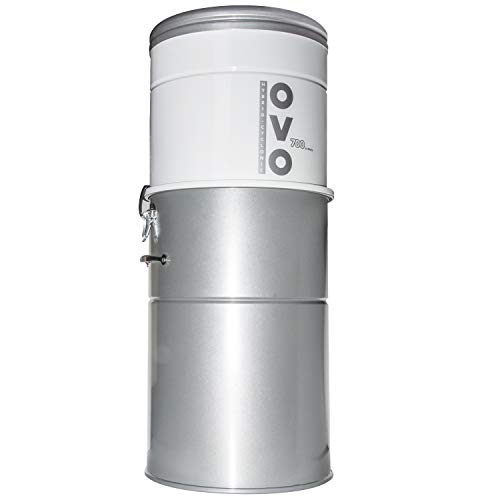


As an Amazon Associate we earn from qualifying purchases at no extra cost to you. Ratings are shown as listed on Amazon.
Best central vacuum systems by home situation
| Home situation | Best system type | Useful target specifications | Main trade-off |
|---|---|---|---|
| Apartment, townhouse, or home under 1,500 sq. ft. | Compact bagged power unit | 500–650 air watts, 4–6 gallon dirt capacity, 1 motor | Less reserve for long tubing runs and large debris loads |
| Typical 1,500–3,000 sq. ft. house | Bagged or hybrid system | 600–750 air watts, 5–7 gallon capacity, 30–45 ft. equivalent reach | Requires careful inlet placement to avoid hose stretching |
| Large house over 3,000 sq. ft. | High-capacity cyclonic or hybrid unit | 700–1,000 air watts, 7–10 gallon capacity, 2–3 inch tubing | Higher purchase price, noise, and installation demands |
| Existing home with limited remodeling access | Hide-A-Hose or exposed-hose retrofit | 50–60 ft retractable hose or 30–35 ft conventional hose | Special tubing and valve locations can increase labor cost |
| Allergy-sensitive household | Sealed bagged unit with fine filtration | Sealed motor compartment, disposable filter bags, exhaust routed outside the living area | Ongoing bag purchases and somewhat lower airflow as the bag fills |
What to compare before buying
Suction power: air watts matter more than motor horsepower
Central vacuum manufacturers commonly advertise motor horsepower, but that number alone does not tell you how well the system cleans at the hose. Air watts, airflow, sealed suction, tubing diameter, hose length, and the quality of the floor tool all affect real performance.
For most homes, 600–750 air watts is a practical middle range. A large home with several long tubing runs may benefit from approximately 700–1,000 air watts, while a compact home can work well with 500–650 air watts. More power is not automatically better: an oversized unit can cost more, draw more electricity, and produce more noise without improving cleaning if the tubing is poorly designed.
Use the manufacturer’s air-watt and airflow figures as comparison points, not as a guarantee. A narrow hose, clogged screen, sharp bend, or undersized inlet pipe can waste much of the motor’s potential.
Motor lifespan and serviceability
A quality central-vacuum motor often lasts roughly 10–20 years, depending on use, ventilation, filtration, and whether it is operated with blocked airflow. Motors with replaceable carbon brushes or serviceable motor assemblies are easier to repair than sealed units that require complete power-unit replacement.
Ask whether the manufacturer sells replacement motors, relays, gaskets, filters, bags, and circuit boards. Brands such as Beam, Cyclo Vac, MD Manufacturing, and Hide-A-Hose have established central-vacuum product lines, but availability varies by model and region. Confirm parts support before purchasing rather than assuming every component will remain available for the life of the installation.
The motor is not usually the first part to fail. Hose cuffs, inlet-valve springs, electrical contacts, filters, belts in powered floor heads, and plastic latches commonly need attention earlier.
Filtration: bagged, bagless cyclonic, or hybrid
- Bagged systems: The disposable bag holds dust and protects the motor. They are usually the simplest option for households that want low-contact emptying and consistent filtration. Replace the bag before it is packed full, because restricted airflow increases motor load.
- Bagless cyclonic systems: These separate heavier debris before air reaches the filter and avoid recurring bag costs. Emptying the canister can release dust, and the filter still needs periodic cleaning or replacement.
- Hybrid systems: These can operate with a bag or filter arrangement depending on the model. They offer flexibility but have more parts to understand and maintain.
Look for a sealed system rather than judging filtration only by the filter’s marketing label. A fine filter is useful only if air cannot bypass it through a loose lid, damaged gasket, or poorly fitted bag. If exhaust is released indoors, choose a unit with strong filtration and install it away from bedrooms and main living areas. Some installations route exhaust outdoors, but that requires suitable venting and must follow local requirements.
Inlet placement and tubing determine everyday convenience
A central vacuum is only convenient when an inlet is within comfortable reach of the cleaning area. For a conventional 30–35 ft hose, many homes need one inlet for approximately 600–900 sq. ft., although walls, staircases, furniture, and floor plan shape matter more than square footage alone.
Place inlets near hallway intersections, at the base of staircases, and on open wall sections rather than behind doors or inside crowded closets. Before cutting openings, measure the hose reach from each proposed inlet and include the distance around furniture. A long hose that technically reaches a room may still be awkward to drag or may not turn easily around corners.
Hide-A-Hose-style systems store a retractable hose inside the tubing network. They can make a conventional home feel much tidier, but the tubing layout must accommodate the hose, the valves require suitable wall depth, and installation is easiest during new construction or major remodeling.
Standard central-vacuum tubing is commonly 2 inches in diameter, with special fittings and long-radius bends designed to reduce blockage risk. Do not substitute ordinary plumbing pipe without confirming compatibility. Plumbing fittings can create internal lips or sharp turns that catch hair and debris.
Noise, electrical load, and installation needs
The power unit is usually quieter in rooms away from the living space than a portable vacuum beside the user, but central systems are not silent. A typical unit may produce approximately 60–75 decibels at the power unit, depending on motor design and installation. Mounting it in a garage, utility room, or basement and adding an approved muffler can reduce perceived noise. Never block the motor’s cooling vents or enclose it in a small unventilated cabinet.
Most residential systems use a dedicated 120-volt circuit or a specified branch circuit. Confirm the amperage, outlet type, low-voltage control wiring, and local electrical rules before installation. The power unit needs clearance for removing the dirt container or filter, and the mounting wall must support its weight.
New construction typically allows tubing to be installed through open framing. In a finished house, installers may use attics, basements, closets, and wall cavities, but access holes and patching can make labor the largest part of the project. A rough market range for a complete installed system is often about $1,200–$3,500 for a conventional home, with retractable-hose layouts and difficult retrofits potentially costing more. Power-unit-only prices commonly range from approximately $500–$1,800, depending on capacity and filtration.
A practical decision matrix
| Priority | Choose | Why | Avoid if |
|---|---|---|---|
| Lowest ongoing maintenance | Bagged sealed system | Dust stays contained and the filter is less frequently handled | You dislike buying replacement bags |
| Lowest recurring consumable cost | Cyclonic bagless system | No disposable collection bags | You want dust-free emptying |
| Best reach with minimal hose carrying | Retractable-hose system | The hose stores in the tubing network | The walls cannot accommodate the larger installation requirements |
| Large family or pets | High-capacity unit with powered floor head | More airflow reserve and fewer emptying interruptions | The electrical service or tubing is undersized |
| Small home or occasional use | Compact single-motor unit | Lower cost and simpler installation | You plan very long hose runs or frequent heavy debris pickup |
Maintenance that protects performance
- Inspect the collection method monthly. Replace a bag or empty a canister before it reaches its stated maximum. A packed container reduces airflow.
- Clean or replace the filter as directed. A washable filter must be completely dry before refitting. A damp filter can restrict airflow and encourage odor.
- Check the hose and floor head. Remove hair from the brush roll, inspect the belt, and check the hose for cracks or a loose cuff.
- Test each inlet. Weak suction at one inlet but not others suggests a local blockage, valve problem, or leak rather than a failed motor.
- Use the right cleanup method. Avoid sucking liquids, hot ashes, drywall dust, or large sharp objects unless the system is specifically designed for them.
A useful ownership calculation is simple: if a bagged system uses six bags annually at $8–$15 each, collection supplies cost roughly $48–$90 per year. A bagless system may eliminate that cost, but a replacement filter, professional service call, or dusty emptying process can offset the savings. Choose the filtration routine you will maintain consistently, not merely the one with the lowest theoretical running cost.
Final buying recommendation
For most 1,500–3,000 sq. ft. homes, the best central vacuum systems are sealed, bagged or hybrid units in the 600–750 air-watt range, installed with correctly sized 2-inch tubing and strategically placed inlets. Choose a high-capacity cyclonic model for a large home or heavy debris, prioritize a serviceable motor and available replacement parts for long ownership, and select a retractable-hose design when daily storage convenience justifies more complex installation. The power unit matters, but accurate tubing, good inlet placement, and routine filter maintenance usually determine whether the system performs well year after year.

Write Your Review
No reviews yet. Be the first to share your experience!